Introduction
Expanding into Southeast Asia offers significant opportunities for business growth. However, one of the biggest challenges during the first year is deciding how to build a local team. The workforce model a business chooses can affect hiring speed, compliance, costs, and the ability to scale as operations grow.
Many businesses get stuck between two options. Setting up a local entity takes time, upfront investment, and internal HR resources. Hiring through an Employer of Record can be faster during the first year of ASEAN market entry, but companies often worry about control and long-term team building.
In this article, we at Source of Asia explain how each workforce model works during the first year of ASEAN expansion and help businesses choose the approach that best fits their goals and stage of growth.
Key Insights
- Companies can build a local team in ASEAN either through direct hiring with a local entity or through an Employer of Record.
- In the first year, EOR can help companies hire faster, test the market, and build local presence before committing to entity setup.
- Direct hiring is better suited for companies with long-term commitment, larger headcount, and internal HR capacity.
- EOR does not mean losing control of daily work; the company still manages tasks, performance, and business objectives.
- Many companies start with EOR, then transition to their own local entity once the market and team become more mature.
 Add Source of Asia as a preferred source on Google
Directly Building a Team Through a Local Entity: Best for Long-Term Commitment
Direct hiring through a local entity gives businesses full ownership of their workforce, but it also comes with greater responsibilities. Before choosing this model, it is important to understand what it involves, where it creates the most value, and the challenges to expect during the first year.
What direct hiring involves
Direct hiring usually requires a local legal entity before the company can legally employ staff in the target market. Once the entity is incorporated, the company becomes the legal employer and assumes responsibility for employment compliance, payroll, and statutory obligations.
Before hiring the first employee, businesses typically need to complete:
- Entity registration and tax setup
- Corporate bank account opening
- Payroll and HR administration
- Locally compliant employment contracts
- Recruitment and employee onboarding
While these steps are generally similar across ASEAN, employment regulations vary by country. Contract requirements, statutory contributions, employee benefits, and termination procedures differ significantly, making local HR, legal, or payroll expertise important for maintaining compliance from the start.
| 👉 Beyond employment compliance, businesses must also navigate wider market differences across ASEAN. Explore why ASEAN expansion is difficult to execute. |
Where direct hiring creates the most value
Direct hiring creates the most value when a business is building a long-term presence in an ASEAN market. Instead of focusing only on entering the market, the priority shifts to building a workforce that supports future growth.
This model is typically the right choice for businesses that:
- Plan to operate in the market for the long term
- Expect steady workforce growth
- Need direct contracts with customers, suppliers, or government agencies
- Operate core functions such as sales, manufacturing, sourcing, or customer support
Although direct hiring requires more upfront investment, it provides greater operational control and a stronger foundation for long-term expansion.
Challenges to prepare for in Year 1
Direct hiring gives businesses full ownership of their local workforce, but it also requires greater investment and operational readiness from the start. During the first year, businesses should prepare for several common challenges before deciding to establish a local entity.
- Longer setup timeline: Entity incorporation and employment registration can delay hiring by weeks or months.
- Higher upfront costs: Businesses must budget for entity setup, payroll, legal, HR, and ongoing compliance.
- Compliance responsibility: The company remains legally responsible for labor laws, payroll, taxes, and statutory contributions.
- Need for local expertise: Managing country-specific employment regulations requires experienced HR or local support.
- Less flexibility: Early entity setup may not suit businesses that are still testing the market or hiring a small team.
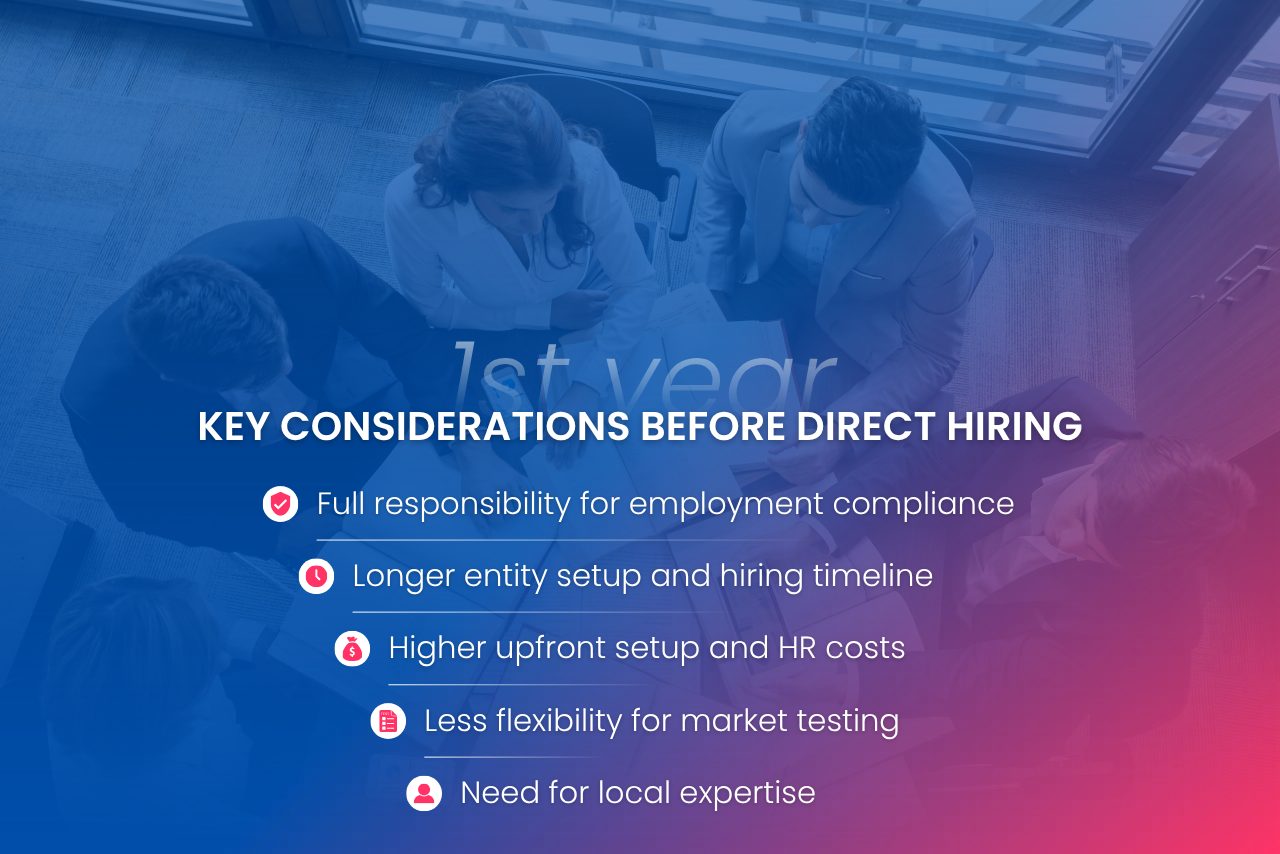
Direct hiring requires businesses to prepare for entity setup, compliance, payroll, HR administration, and longer implementation timelines.
Hiring Through EOR: Building a Local Team Without Setting Up an Entity
An Employer of Record (EOR) allows businesses to build a local team without establishing a legal entity. Understanding how the model works, where it adds value, and its key considerations helps businesses determine whether it fits their first-year expansion strategy.
How outsourcing employees via EOR works in ASEAN
An EOR is a local company that legally employs staff in the country where they are hired. This enables businesses to hire employees without first establishing a local entity.
The EOR manages key employment responsibilities, including:
- Employment contracts
- Payroll and salary payments
- Personal income tax withholding and statutory contributions
- Employee benefits and leave
- Compliance with local labor laws
The business continues to assign daily work, manage performance, set business objectives, and integrate employees into its operations. In other words, the EOR serves as the legal employer, while the business retains responsibility for day-to-day management and operational decisions.
Why EOR supports faster first-year market entry
The first year of expansion is often focused on market validation rather than building a permanent operation. During this stage, speed and flexibility usually matter more than establishing a local entity. An EOR allows businesses to hire employees before entity incorporation is complete, helping them enter the market and begin local operations sooner.
An EOR also reduces upfront investment by removing the need for immediate legal setup and HR infrastructure. Many businesses use this model to build an initial team, validate market opportunities, and transition employees to their own entity once long-term expansion plans become more certain.
What companies should clarify before using EOR?
Choosing the right EOR provider is just as important as choosing the right workforce model. Clear responsibilities help reduce compliance risks and support smoother operations.
Before selecting an EOR, businesses should clarify:
- Which services are included, such as payroll, statutory contributions, and HR administration.
- How responsibilities are divided between the EOR and the internal management team.
- Which labor laws apply, including rules for employee benefits, notice periods, and termination.
- Whether employees can transition to the company’s own entity in the future.
For cross-border hiring, companies should also review country-specific tax, social security, and permanent establishment risks with qualified advisors. This is especially important when employees work from a country where the business has no entity.
| As workforce needs change, businesses should also plan for smooth EOR transitions. Learn more about managing employee transitions when changing EOR providers. |
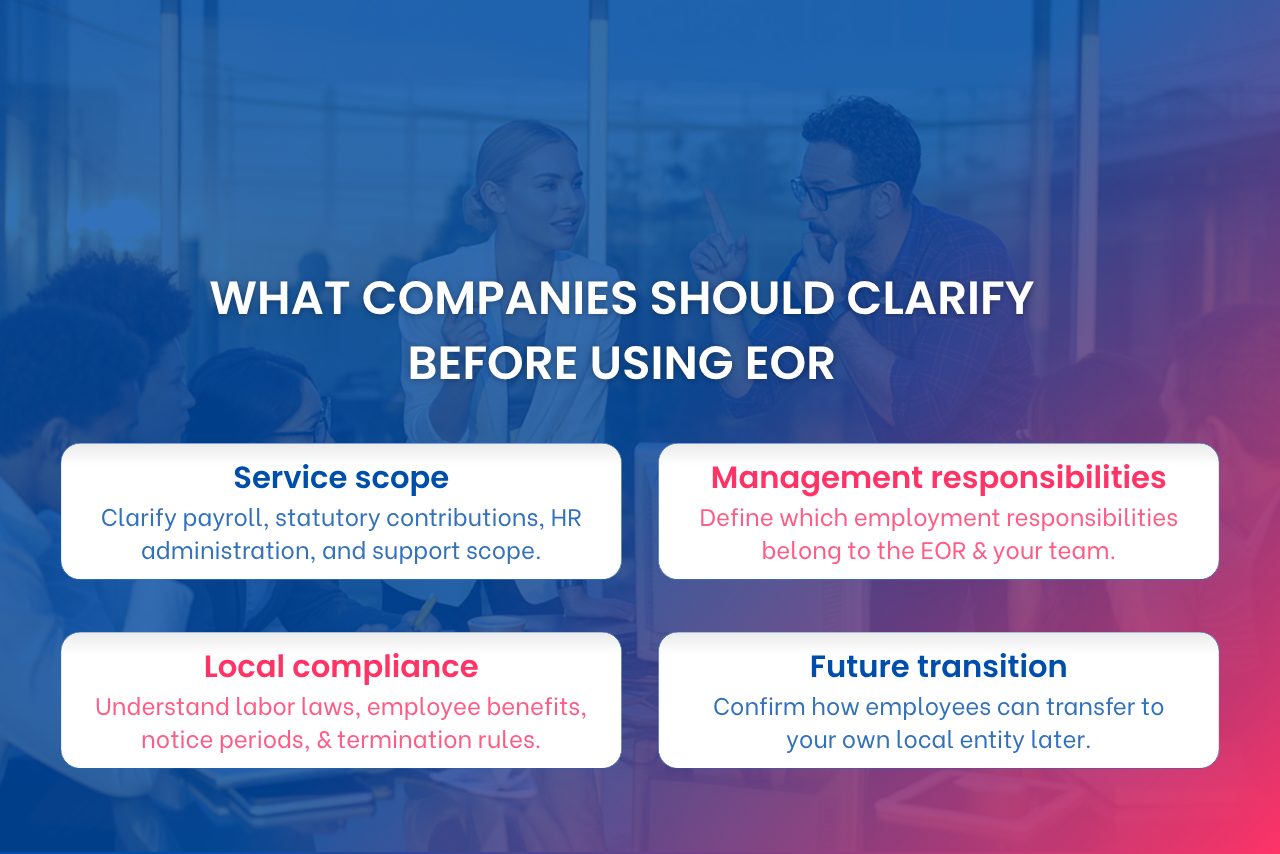
Businesses should define EOR responsibilities, compliance scope, included services, and future employee transition options before signing an agreement.
Direct Hiring vs EOR in ASEAN: First-Year Comparison
Both direct hiring and an EOR can help businesses build a local team in ASEAN, but they support different expansion priorities. The table below compares the two workforce models across the key factors businesses should evaluate during the first year of ASEAN expansion.
| Criteria | Building A Local Team (Direct) | Hiring Through EOR |
| Setup speed | Slower due to entity setup and hiring. | Faster because hiring can start before entity setup |
| Initial investment | Higher costs for setup, recruitment, and HR. | Lower initial commitment with service-based pricing. |
| Legal employer | The company’s local entity | The EOR provider |
| Compliance | The company remains responsible | The EOR provider manages employment-related compliance as the local legal employer |
| Operational control | High control over employment structure and HR policies | High control over daily work, with HR administration handled by the EOR |
| Workforce flexibility | Better for long-term workforce planning. | Easier to scale hiring as business needs change. |
| Payroll and statutory contributions | Managed internally or outsourced, but responsibility remains with the company | Managed by the EOR provider |
| Best suited for | Long-term presence, larger teams, direct operations | First hires, market testing, small teams, pre-entity hiring |
No workforce model is the right choice for every business. The most suitable approach depends on expansion goals, investment horizon, workforce size, and operational priorities during the first year. Evaluating these factors early helps businesses choose a model that supports both immediate execution and long-term growth.
How to Choose the Right Workforce Model for Year 1
Every business enters ASEAN with different priorities. The most suitable workforce model depends on expansion objectives, hiring needs, and how quickly local operations are expected to grow.
Choose direct hiring when
Direct hiring works best when the business is committed to long-term expansion rather than short-term market testing. It requires more investment at the beginning but provides greater control as local operations grow.
Choose direct hiring if the business:
- Plans a long-term presence in the target market
- Expects ongoing hiring and workforce growth
- Needs full control over HR policies and employment decisions
- Has internal HR and legal capabilities to manage compliance
- Is establishing permanent operations, such as offices, manufacturing, or local business functions
Choose EOR when
An EOR is best suited for businesses that prioritize speed and flexibility during the first year of expansion. It allows companies to build a local team without making an immediate long-term commitment.
Choose an EOR if the business:
- Needs to hire employees without setting up a local entity
- Plans to test market demand before making larger investments
- Requires a small team quickly to support early operations
- Wants to reduce compliance and administrative complexity
- Is expanding into multiple ASEAN markets without establishing entities immediately
Use a hybrid approach when
Some businesses do not need to choose one workforce model over the other. Instead, they start with an EOR and transition to direct hiring as their ASEAN operations become more established. This approach combines faster market entry with a clear path toward long-term workforce development.
The transition to a local entity is often appropriate when:
- Headcount grows, and direct employment becomes more cost-effective
- Long-term market commitment has been confirmed
- Direct contracts and local operations require a company-owned entity
- HR and management become more complex as the organization expands
This phased approach allows businesses to adapt their workforce model as operational needs evolve, rather than committing to a permanent structure too early.
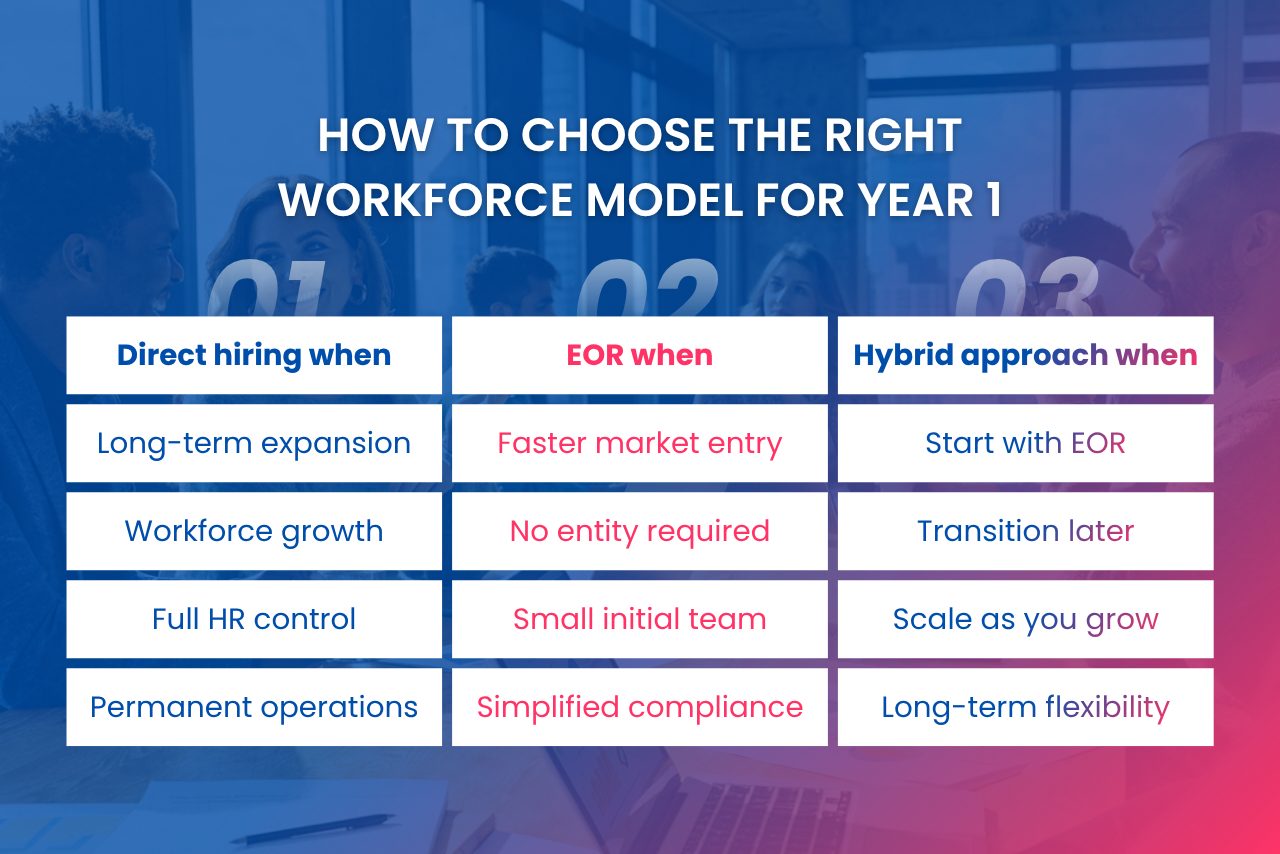
Workforce model selection depends on expansion goals, hiring speed, long-term commitment, compliance capacity, and expected business growth.
How Source Of Asia Supports Workforce Setup In ASEAN
Building a local team involves more than hiring employees. It requires the right workforce model, local compliance, and reliable operational support. At Source of Asia, we help businesses build and manage teams across ASEAN with solutions tailored to each stage of expansion.
- Build a local team through EOR: Hire local employees quickly and compliantly without establishing a legal entity, enabling faster market entry and business execution.
- Compliant hiring support: Ensure employment contracts, statutory contributions, payroll processes, and labor law requirements comply with local regulations in each ASEAN market.
- Recruitment and payroll coordination: Coordinate recruitment, onboarding, payroll administration, and employee documentation to support smooth day-to-day operations.
- Ongoing HR and operational support: Provide continuous HR guidance and help businesses transition from an EOR model to their own local entity when expansion plans become long-term.
Final Considerations
There is no one-size-fits-all approach to building a local team in ASEAN. The right approach depends on business goals, expansion timeline, workforce requirements, and long-term commitment. While some businesses establish a local entity from the beginning, many start with an EOR and transition to direct hiring as operations, headcount, and long-term plans become more established.
At Source of Asia, we help businesses build and manage local teams across Southeast Asia through our Corporate Services, supporting every stage of workforce setup and expansion. Our services include:
- Recruitment & coaching
- EOR / Wage hosting
- Payroll management
- PIT & insurance management
- HR and operational support
| 👉 Still deciding between direct hiring and hiring employees via EOR? Speak with our experts to evaluate the best approach for your first year in ASEAN. |
Frequently Asked Questions
Yes. Businesses can build a local team through an Employer of Record (EOR) without establishing a local entity. The EOR becomes the legal employer and manages payroll and compliance, while the business retains control over employees’ daily work, performance, and business objectives.
An EOR can be a suitable option for first-year market entry, especially when businesses need to hire quickly, test market potential, or start with a small team. The suitability depends on business goals, workforce needs, and expansion plans.
A company may consider setting up a local entity when it has a long-term commitment to the market, expects workforce growth, needs direct contracts, or requires more control over local operations and HR management.
In many cases, businesses can transition employees from an EOR to their own local entity. The process depends on the country’s regulations, employment arrangements, and agreements between the company and the EOR provider.