Introduction
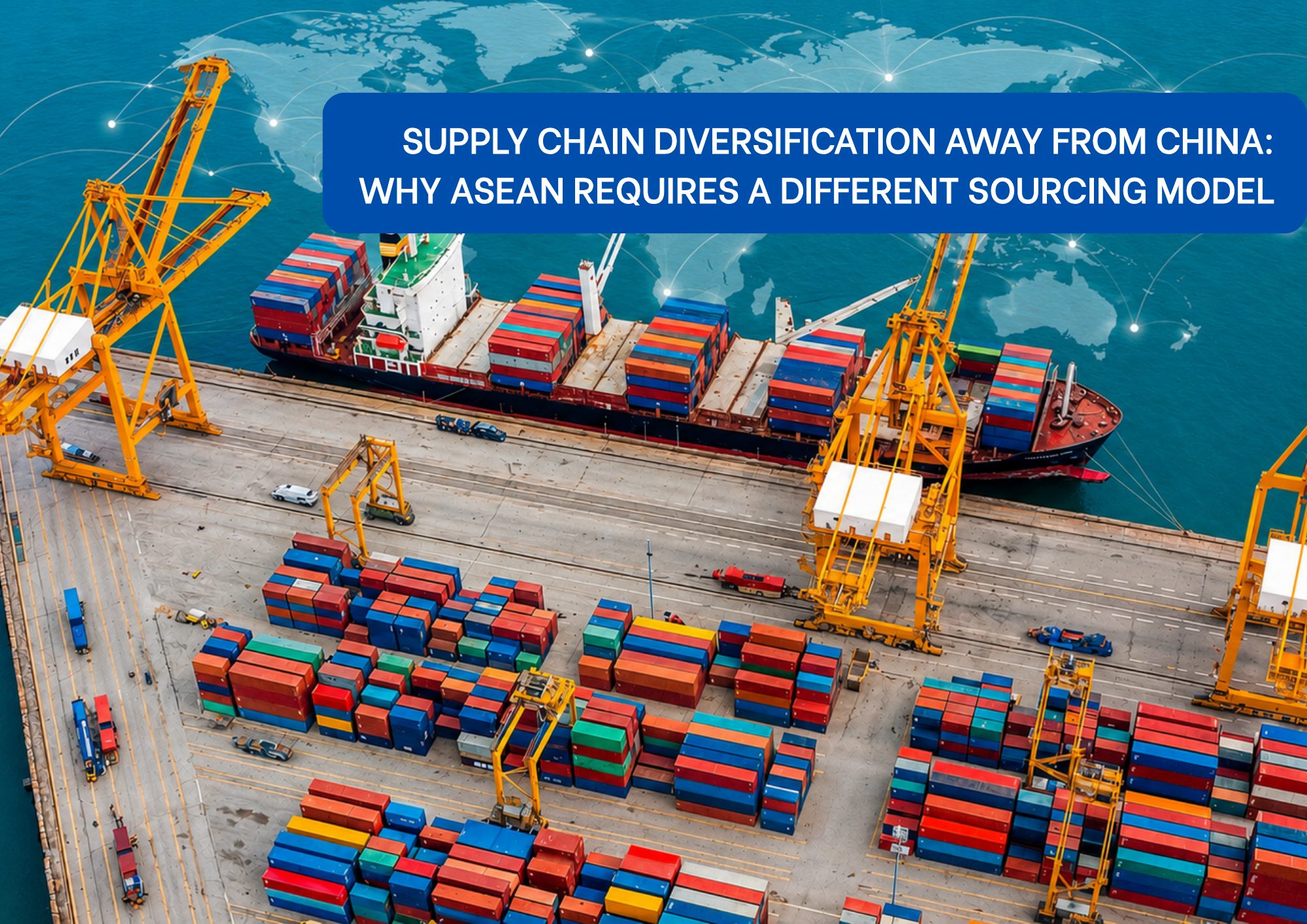
Supply chain diversification away from China has become a priority for companies looking to reduce concentration risk, manage trade uncertainty, and build more resilient production networks. This is driving many companies to add ASEAN alternative suppliers or production sites through a China+1 supply chain strategy.
However, moving sourcing or production to Southeast Asia is not simply about replacing Chinese suppliers. China’s deep manufacturing ecosystem integrates components, machinery, materials, logistics, and technical support, whereas ASEAN capabilities are dispersed across countries and industries.
For companies planning a China+1 strategy in ASEAN, the key question is not only where to source, but how to adapt sourcing and supplier management to a more fragmented market. This article answers that question by showing what needs to change, from supplier qualification and quality control to logistics and supplier management.
Key Insights
- China+1 reduces concentration risk, but it does not mean replacing China across the entire supply chain.
- ASEAN works as a network of complementary sourcing markets rather than a single-country replacement for China.
- Supplier depth, infrastructure, and production capabilities vary significantly across ASEAN markets and product categories.
- China dependencies often remain in components, tooling, materials, and technical inputs even after production moves to ASEAN.
- Successful diversification requires a phased sourcing model built around dependency mapping, supplier qualification, and shared performance standards.
 Add Source of Asia as a preferred source on Google
Why Companies Are Diversifying Supply Chains Away from China
For many companies, relying heavily on China creates concentration risks when tariffs, geopolitical tensions, longer lead times, or supply disruptions affect production. This is why China+1 is becoming a supply chain resilience strategy. Instead of leaving China, companies add production or sourcing capacity elsewhere to reduce dependence on one market and maintain supply continuity.
According to Reuters, General Motors has been pressing its parts suppliers to move their supply chains out of China, showing how major OEMs are increasingly pushing suppliers to reduce China dependency. While this example comes from the automotive sector, it reflects a broader concern among manufacturers: reducing exposure to China-linked supply disruptions without losing critical supplier capabilities.
ASEAN is attractive because it offers alternative production bases, growing export capacity, and expanding manufacturing capabilities. However, diversifying away from China is not as simple as choosing another country and shifting one’s supplier list there. China often connects components, materials, machinery, packaging, testing, and technical support within one ecosystem, while ASEAN capabilities are spread across different countries.
Consequently, a China+1 strategy is often a phased diversification process rather than a complete replacement of China.
| 👉 For a broader view of how ASEAN fits into this shift, see our guide to ASEAN’s Role in Global Supply Chain Rebalancing |
The Sourcing Operating Model Gap Between China and ASEAN
For companies diversifying their supply chains away from China, a sourcing operating model defines how they identify suppliers, qualify vendors, manage components, control quality, coordinate logistics, and track supplier performance across markets.
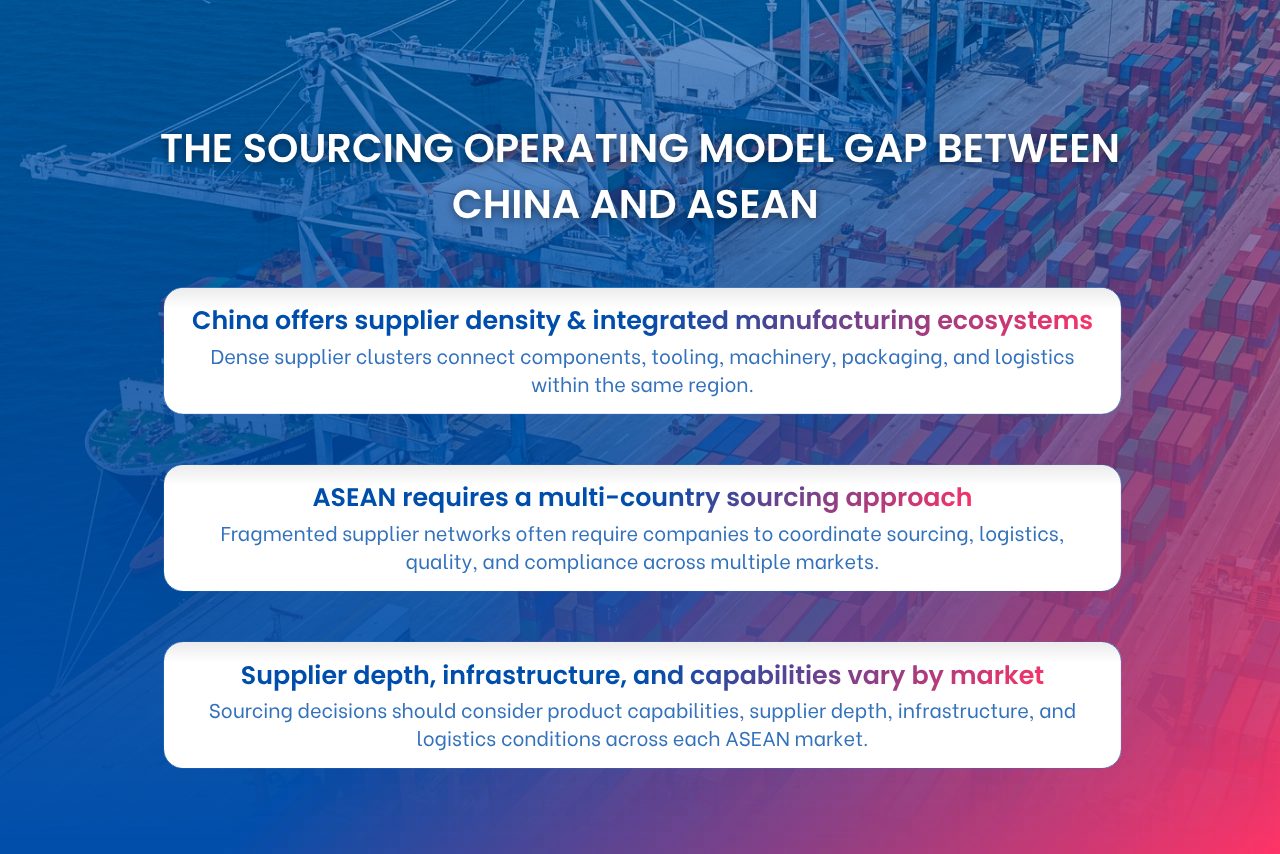
China relies on dense supplier ecosystems, while ASEAN requires coordination across multiple sourcing markets and networks.
China offers supplier density and integrated manufacturing ecosystems
China’s manufacturing advantage goes beyond individual factories. Dense supplier networks and integrated manufacturing ecosystems connect component suppliers, tooling specialists, machinery providers, packaging manufacturers, and logistics services within established industrial clusters. This allows companies to source multiple inputs within the same region and access specialized suppliers more easily.
As a result, buyers can often shorten sourcing cycles and solve production issues faster. A change in specifications, for example, may be easier to manage when tooling, component, and production suppliers are located nearby. For companies used to sourcing in China, this level of supplier density can become the expected standard.
ASEAN requires a multi-country sourcing approach
Unlike China’s dense supplier clusters, ASEAN supplier networks are more fragmented and geographically dispersed. One country may not have sufficient supplier depth for every product layer, so companies may need to source inputs from multiple markets.
For example, a company may combine suppliers across Vietnam, Thailand, and Malaysia based on production requirements. This creates additional needs for:
- Supplier coordination across multiple markets
- Cross-border logistics between production locations
- Quality management across different suppliers
- Compliance and documentation for different markets
As a result, companies managing supply chain diversification away from China need to treat ASEAN as a connected sourcing network, rather than simply looking for one country to replace China.
Supplier depth, infrastructure, and capabilities vary by market
Even within ASEAN, supplier capabilities vary by country, product category, and production stage.
- Vietnam has strong electronics and textile manufacturing, for example, but some advanced components and industrial tooling still rely on external suppliers.
- Thailand has deeper industrial supply networks, while Indonesia offers scale in selected raw materials and consumer goods.
Infrastructure also varies by location. Power reliability, port capacity, road connectivity, and logistics infrastructure can affect production and delivery performance. Companies therefore need to assess supplier capabilities and local infrastructure together before selecting a sourcing location.
*The verdict:
A China sourcing model often fails in Southeast Asia when companies expect the same supplier density, speed, infrastructure, and centralized control. This is one reason why copying the China sourcing model can create friction in ASEAN. Actually, ASEAN can support supply chain diversification. However, it requires companies to redesign how they source, qualify suppliers, manage quality, and coordinate production across multiple countries.
Why Alternative Suppliers in ASEAN Are Harder to Build
Supply chain diversification away from China involves more than finding an alternative supplier with production capability. China dependencies, supplier depth, qualification requirements, and logistics can all affect whether an ASEAN supplier is truly viable.
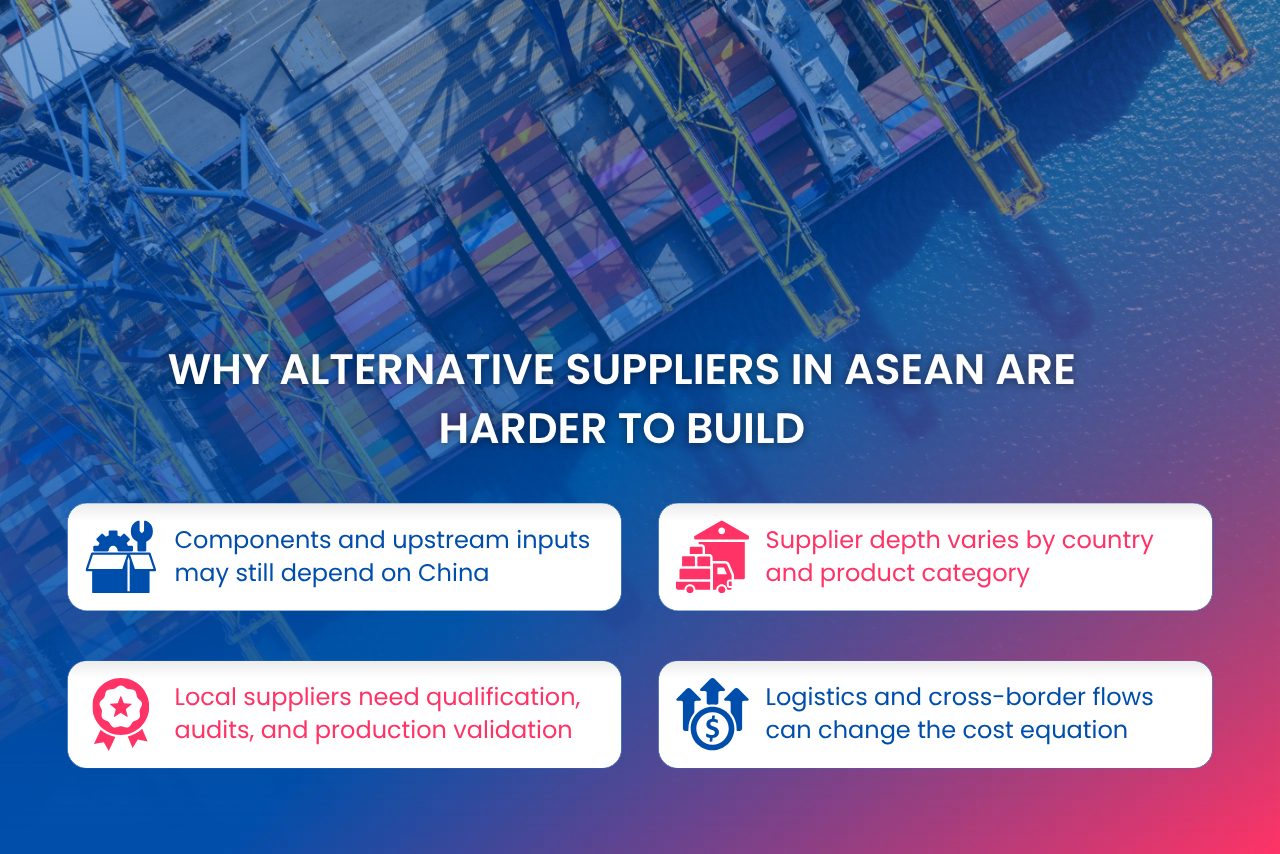
Building alternative ASEAN suppliers requires assessing China dependencies, capabilities, qualification needs, and logistics.
Components and upstream inputs may still depend on China
Moving final assembly to ASEAN does not always remove China dependency. Upstream inputs can remain tied to Chinese suppliers, especially when local alternatives are limited or still developing.
Common dependencies may include:
- Molds and tooling used for ASEAN production
- Specialty materials with limited local alternatives
- Electronic components sourced from established Chinese suppliers
- Technical hardware and production inputs that require specific capabilities
Thus, supply chain diversification away from China may be partial rather than complete. Companies should map these dependencies by component and supplier tier before deciding what to shift, retain, or localize. This helps them avoid investing in ASEAN capacity while leaving critical China dependencies unchanged.
Supplier depth varies by country and product category
Not every ASEAN market has the same supplier depth across product categories. The right sourcing location depends on what you need to produce, as supplier availability, technical capabilities, and production capacity can differ significantly by country.
For example, companies may find more supplier options for electronics and assembly in Vietnam, deeper automotive and industrial supplier networks in Thailand, and stronger supply options for selected raw materials and consumer goods in Indonesia.
This makes supplier identification more than finding a company name and contact. Companies need to verify capability, certifications, capacity, quality standards, and fit with their requirements before considering a supplier a viable alternative.
Local suppliers need qualification, audits, and production validation
Unlike established China sourcing networks, ASEAN suppliers may require more direct qualification before they can meet your production and compliance requirements. A supplier may have the right capacity but lack relevant certifications, foreign buyer experience, or quality processes that match your standards.
A structured qualification process can include:
- Factory audits to verify facilities and production conditions
- Capability assessments to confirm equipment, capacity, and technical skills
- Sample production to test quality against your specifications
- Production validation before moving to larger volumes
This process takes time, but it helps reduce quality and supply risks before scaling. The timeline depends on the product, supplier maturity, and validation requirements, so companies should build qualification into the diversification plan from the start.
Logistics and cross-border flows can change the cost equation
Sourcing across ASEAN can add logistics and cross-border costs that are easy to miss during supplier selection. Different customs procedures, documentation requirements, import duties, and shipping routes can increase both lead times and coordination work.
For this reason, companies should compare suppliers based on total landed cost, not unit price alone. A lower-cost supplier may become more expensive after adding freight, customs clearance, inventory buffers, and compliance costs. Assessing these factors early helps companies choose suppliers that are commercially viable as the network scales.
What Happens When Companies Replicate the China Model in ASEAN
Companies often enter ASEAN with a sourcing model built around China’s supplier density, speed, and centralized coordination. However, when the same model is applied across more fragmented markets, several operational issues can emerge.
| What goes wrong | Why it happens |
|---|---|
| Slower execution | More countries, suppliers, approvals, and exceptions to manage |
| Higher-than-expected costs | Logistics, imported inputs, compliance, and coordination costs increase |
| Supplier quality issues | Alternative suppliers may not yet meet required capacity or quality standards |
| Compliance delays | Each ASEAN market has its own documentation, certification, and customs requirements |
| Limited visibility | More supplier nodes make performance tracking and issue detection harder. |
| Fragmented supplier management | Country teams may manage suppliers differently without shared standards |
These issues do not mean ASEAN is unsuitable for diversification. They show that the sourcing model needs to match the local operating environment. Companies can reduce these risks by setting shared standards, strengthening supplier qualification, and building clear coordination across markets.
How to Adapt the Supply Chain & Sourcing Model for ASEAN Execution
For companies diversifying away from China, the most effective approach is usually phased. Instead of moving everything at once, companies can identify critical dependencies, select suitable activities for diversification, and build alternative capacity step by step.
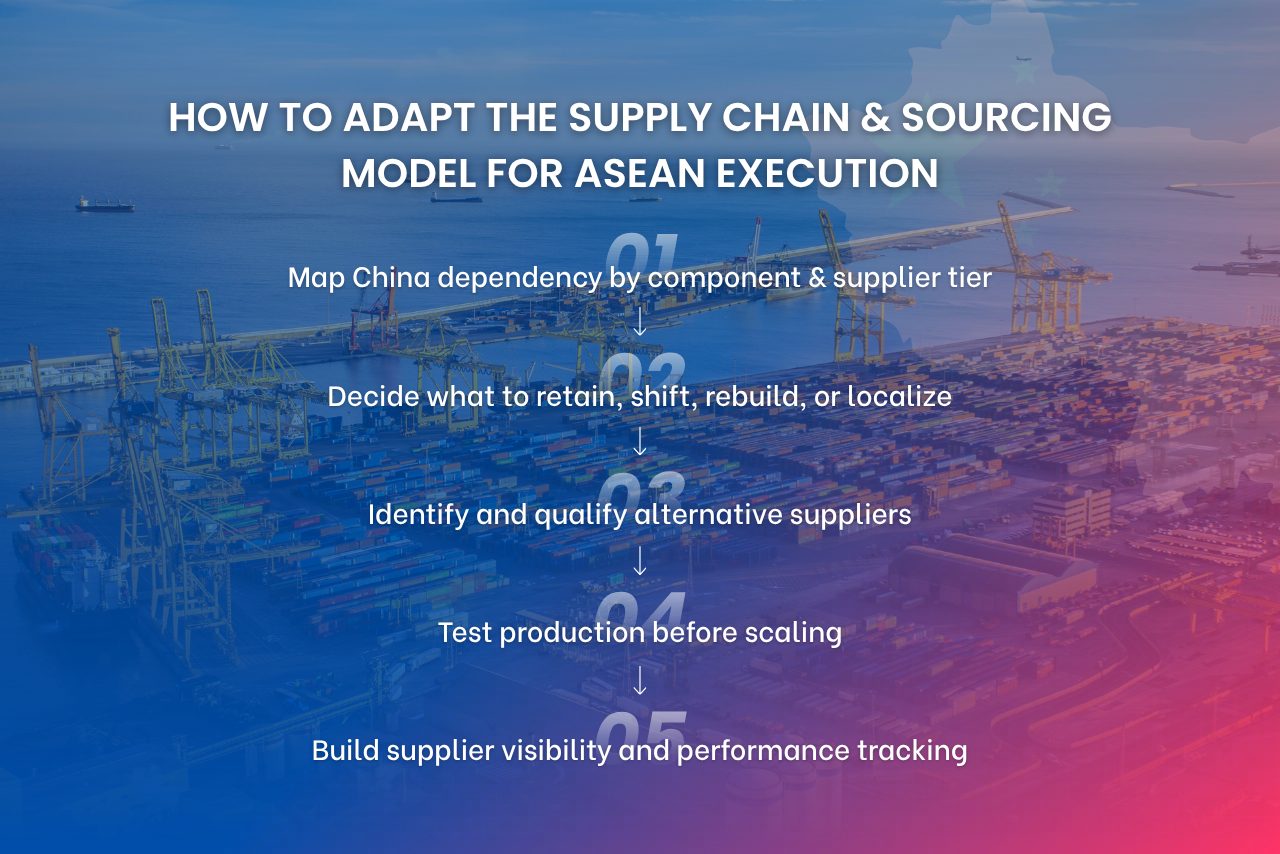
A phased ASEAN sourcing model helps companies map dependencies, qualify suppliers, shift activities, and build capacity over time
Map China dependency by component and supplier tier
Start with your existing supply chain, not potential replacement suppliers. Look beyond direct suppliers to identify the key components, materials, tooling, and inputs behind each product and where they are manufactured.
For each component, consider:
- Who supplies it?
- Where is it manufactured?
- Which supplier tier does it sit in?
- Is there a qualified alternative in ASEAN?
- How difficult would it be to replace?
- What happens if the current source is disrupted?
This creates a factual basis for deciding what to retain, shift, rebuild, or localize. Without this baseline, diversification decisions can rely on assumptions rather than the actual structure of your supply chain.
Decide what to retain, shift, rebuild, or localize
Not every part of the supply chain should move at the same speed. Once you understand your China dependencies, classify each part based on replacement feasibility, supply risk, and business needs.
| Decision | What it means | Example |
|---|---|---|
| Retain in China | Keep suppliers or capabilities that remain difficult to replace | Specialized components, molds, machinery, technical inputs |
| Shift to ASEAN | Move selected production stages or product lines | Final assembly, packaging, selected labor-intensive processes |
| Rebuild locally | Develop new supplier relationships in ASEAN | Local materials, packaging, secondary suppliers, basic components |
| Localize over time | Gradually increase ASEAN supplier depth and reliability | Supplier training, audits, quality improvement, dual sourcing |
This approach is more practical than trying to remove all Chinese suppliers at once. For example, a company may retain Chinese suppliers for specialized inputs while moving final assembly to Vietnam or another ASEAN market.
Over time, companies can qualify additional suppliers and reduce China dependency where local alternatives become technically and commercially viable.
Identify and qualify alternative suppliers
Supplier identification should start with your product requirements, not a preferred country. Define specifications, quality standards, production volume, target cost, certifications, and delivery expectations before building a supplier pool across suitable ASEAN markets.
Then qualify suppliers against the same criteria through:
- Capability and financial checks
- Certification and documentation review
- Factory audits and production assessments
- Sample development and quality testing
- Cost and capacity comparison
This helps companies compare suppliers on verified capabilities, not initial claims. It also shows which suppliers can meet current requirements and which need further development before they can become reliable alternatives.
Test production before scaling
Do not move directly from supplier selection to full production. A sample run or pilot batch can reveal issues that a supplier evaluation may miss, including yield, tolerances, material availability, packaging, lead times, and communication.
Where possible, start with a manageable order or less critical product line. Measure actual performance against agreed requirements before increasing volume. Confirm that the supplier can consistently meet:
- Product specifications and quality standards
- Required production volume and delivery schedules
- Packaging and documentation requirements
Build supplier visibility and performance tracking
A multi-country supply network needs shared standards and consistent reporting. Without them, country teams may use different supplier criteria, quality processes, and escalation methods, making performance harder to compare across markets.
Set common KPIs and review them regularly, including:
- On-time delivery and lead-time stability
- Defect rates and corrective actions
- Production capacity
- Cost changes
- Compliance status
These standards do not require complex technology. They require consistent data, regular supplier reviews, and clear communication between local teams and central procurement. As the network grows, supplier management should become a repeatable process rather than separate country-level practices.
Working on supply chain diversification away from China?
For companies evaluating supply chain diversification away from China, the key challenge is not only identifying a new country, but also validating whether suppliers, components, quality standards, logistics, and local execution can support the transition.
Source of Asia supports companies across Vietnam and Southeast Asia with supplier identification, qualification, factory audits, sourcing strategy, and on-the-ground validation to help build more reliable ASEAN supply networks.
👉 Send us your specific questions about supply chain projects to find the right approach for your business.
Final Thoughts
Supply chain diversification away from China is not simply a matter of adding an ASEAN supplier. China+1 requires a phased operating model that maps China dependencies, evaluates supplier depth, validates alternative suppliers, and coordinates sourcing across multiple markets. Companies also need to account for qualification, quality, logistics, and supplier performance before scaling.
At Source of Asia, our Sourcing Services help companies evaluate sourcing opportunities, identify suitable suppliers, and improve supply chain performance across ASEAN. We assess local supplier capabilities and sourcing ecosystems to help companies build practical diversification strategies.
👉 Speak with our sourcing team to assess your supplier options and transition plan.
Frequently Asked Questions
China benefits from dense supplier networks and integrated manufacturing clusters. ASEAN capabilities are more distributed across countries, so companies often need different suppliers, logistics routes, and management processes.
China+1 can reduce concentration risk, but it does not remove supply chain risks. Companies still need to qualify ASEAN suppliers, validate production, manage cross-border logistics, and address remaining China dependencies.
Companies may face slower execution, higher costs, quality issues, compliance delays, and limited supplier visibility. ASEAN diversification works better when companies adapt sourcing and supplier management to the region’s fragmented structure.