Companies often search for “top consulting firms” when they need support with strategy, transformation, market entry, international expansion, or local execution. However, rankings alone do not show which consulting partner is the right fit for a specific project.
Global strategy firms such as McKinsey & Company, Boston Consulting Group, and Bain & Company are known for corporate strategy and transformation, while Big Four firms such as Deloitte, PwC, EY, and KPMG provide broad expertise in tax, risk, transactions, technology, and compliance. Boutique consulting firms, regional specialists, and local partners can be more relevant when a project requires specialized expertise or hands-on execution in a specific market.
This article explains four practical factors for choosing the right consulting partner: business problems, target region, project scope, and level of local execution required. It also provides an overview of global consulting firms and regional or local partners across key international markets to help companies identify the support model that best fits their expansion needs.
Key insights
- Global management consulting firms are generally well suited to corporate strategy, transformation, operating models, and large-scale change programs.
- Big Four advisory firms are particularly relevant for tax, audit, risk, transactions, technology, and compliance.
- Boutique consulting firms can provide specialized industry, functional, or geographic expertise.
- Regional and local consulting partners are often better positioned for market entry, sourcing, recruitment, partner search, business setup, and local execution.
- International expansion may require a combination of strategic advisory, regional coordination, and local implementation.
- In short, there is no single consulting firm that is best for every project.
Four Criteria to Compare Consulting Firms Beyond Rankings
Rankings can help companies identify established firms, but they should not be the only decision factor. A more practical comparison starts with four questions about business problems, target region, project scope, and level of execution needed.
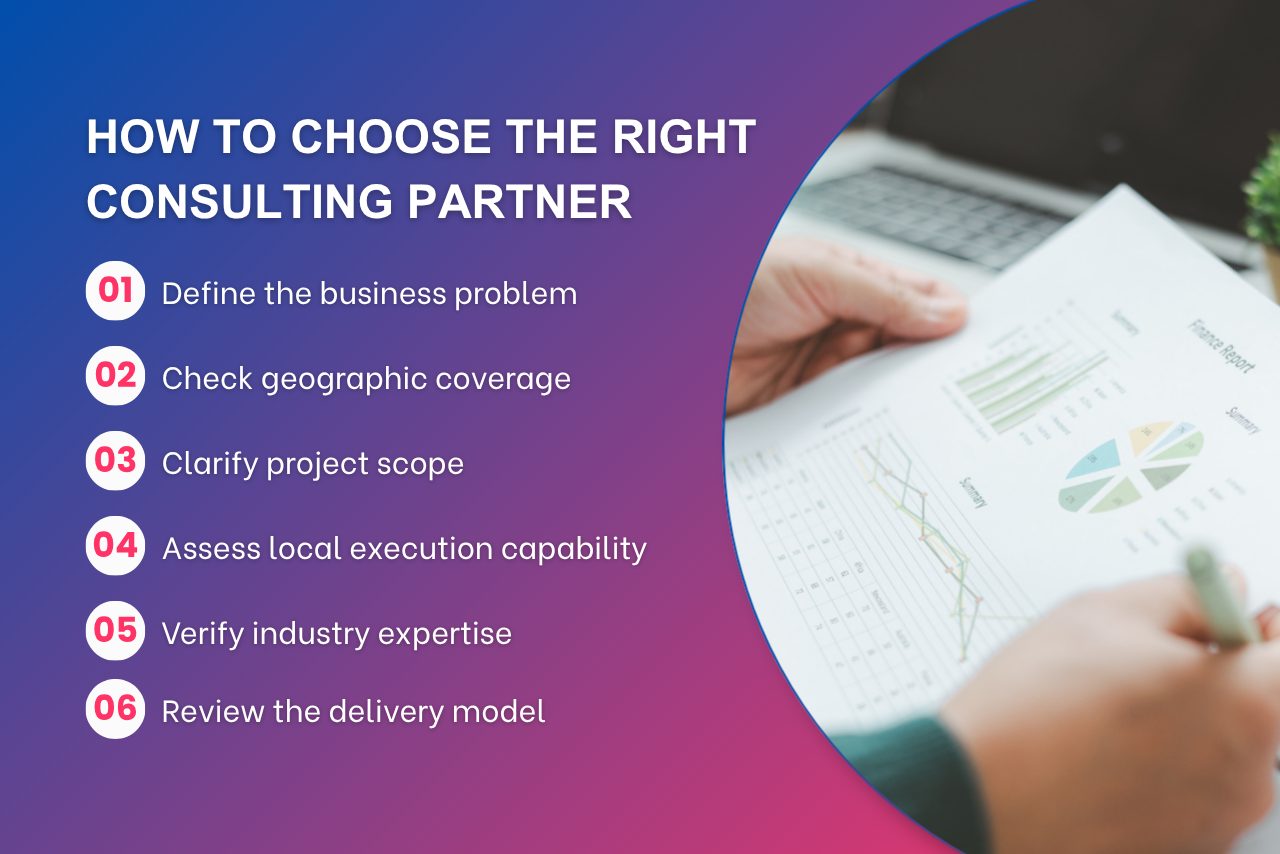
Companies should evaluate more than reputation alone when selecting a consulting partner for international expansion.
What problem does the company need to solve?
First, start by defining the problem.
A company looking for corporate strategy does not need the same partner as a company trying to find suppliers, recruit a local team, set up a subsidiary, or validate distributors in a new market. This matters because consulting firms have different strengths.
- Global strategy firms are often stronger in growth strategy, transformation, and operating model design.
- Big Four firms are often stronger in tax, audit, risk, compliance, and transactions.
- Regional and local partners are often stronger in market entry, business development, partner search, setup, and operational support.
Clarifying the business problem helps companies choose the right type of partner instead of relying only on brand reputation.
Where will the project take place?
Geography matters, especially in international expansion consulting.
Regulations, customer expectations, business practices, hiring conditions, distribution structures, supplier ecosystems, and administrative requirements can vary significantly from one country to another. A consulting firm may have a strong global reputation without necessarily having the same level of market access or execution capability in every country.
Before selecting a consulting partner, companies should therefore examine its actual coverage in the target region. Does the firm have its own local team? Does it have an established partner network? Can the team work directly with local stakeholders? The answers help determine whether the project requires a global firm, a regional specialist, a local consulting partner, or a combination of these models.
What does the project need to deliver
The third criterion is project scope.
- Some projects primarily require advisory output, such as market analysis, strategic recommendations, benchmarking, financial modeling, or operating model design.
- Other projects require tangible implementation activities, such as supplier visits, distributor screening, recruitment, company setup, payroll coordination, business development, or partner meetings.
A company should define these expected deliverables before choosing its consulting partner. For example, a market study may identify Vietnam, India, China, Japan, or Singapore as a priority market. However, that recommendation does not automatically identify qualified distributors, validate suppliers, recruit local employees, or establish the required business structure. Therefore, clear project scope helps companies determine whether they need recommendations, implementation support, or both.
Who will execute the strategy locally?
The final criterion is execution capability. Companies should separate two questions:
- Who can define the strategy?
- Who can implement it in the target market?
If a project primarily involves strategic direction, a global consulting firm may be sufficient. However, projects involving local meetings, supplier assessments, partner qualification, recruitment, business setup, commercial follow-up, or stakeholder coordination require people who can act in the market.
This is where international expansion projects can become difficult. Thus, the distinction between strategy and execution is one of the most important factors when comparing consulting partners.
Global Consulting Firms Are Best Suited for Strategy and Advisory
Global consulting firms are often selected when companies need high-level strategy, enterprise transformation, operating model design, risk advisory, transaction support, or large-scale change programs. Their main value lies in structured methodology, global benchmarks, senior advisory experience, and cross-functional expertise.
This group includes global strategy firms such as McKinsey & Company and Boston Consulting Group, as well as Big Four advisory firms such as Deloitte, PwC, EY, and KPMG.
- Strategy consulting firms are usually stronger for corporate strategy, growth strategy, transformation, market prioritization, performance improvement, and board-level advisory.
- Big Four firms are often more relevant for tax, audit, risk, compliance, transactions, finance transformation, advisory technology, and cross-border structure.
However, global firms may not always be enough for country-specific execution. A strategy may identify the right market, but companies still need to validate local partners, assess suppliers, understand hiring conditions, manage setup requirements, and coordinate follow-up on the ground. For this reason, companies should verify not only the firm’s global reputation, but also its local implementation capacity, country-specific expertise, team structure, and delivery model.
Regional and Local Consulting Partners Are Better Suited for Execution
Regional and local consulting partners play a different role. They are often closer to the market, more involved in execution, and better positioned to support operational needs after the strategy has been defined. This can make them particularly relevant for market entry consulting and business expansion consulting, where the company needs more than a strategic recommendation.
Below are examples of regional and local partners that support international companies across different markets.
| Recommended Firms | Markets | Key Strengths | Official contact |
|---|---|---|---|
| Source of Asia | Vietnam, ASEAN, South Korea, broader Asia | Market entry, sourcing, corporate services, HR, M&A, partner search, local execution | Contact page |
| Expandys | APAC region | Business development, HR, payroll, subsidiary setup, local administration | Contact page |
| Pramex International | Singapore, India, China, Hong Kong, Europe, United States | Subsidiary setup, accounting, tax, HR, reporting, cross-border M&A | Contact page |
| PMC Japan | Japan | Market entry, business development, localization, recruitment, local implementation | Contact page |
| VVR International | China | Business development, partner management, sourcing, supply chain, recruitment, operational support | Contact page |
| Valians International | Poland, Central & Eastern Europe | Market intelligence, partner search, sourcing, representation, recruitment, subsidiary creation | Contact page |
| TTE Gulf | Gulf and Middle East | Market entry, trade missions, B2B meetings, representation, stakeholder coordination | Contact page |
| vif Solutions | France and Germany | Cross-border business development, M&A, recruitment, subsidiary management, tax and legal coordination | Contact page |
Source of Asia: Vietnam, ASEAN, South Korea, and broader Asia execution support
Source of Asia supports companies expanding across Vietnam, Southeast Asia, South Korea, and broader Asian markets.
SOA supports international companies with market expansion and on-the-ground execution across Southeast Asia and broader Asian markets.
Its service portfolio includes market expansion, sourcing and supply chain, corporate and HR solutions, and M&A support. Its market expansion services include market diagnostics, competitor analysis, partner identification, B2B meetings, commercial representation, recruitment, and local establishment support.
Companies may consider Source of Asia when a project requires local market validation and continued execution rather than research alone.
Relevant needs include:
- Vietnam and ASEAN market entry
- Sourcing and supplier qualification
- Local partner search
- Business development support
- Corporate and HR solutions
- M&A support
- On-the-ground project coordination in Asia, etc.
Expandys: APAC region
Expandys supports international companies expanding into APAC region, with services covering business development, HR, payroll, and subsidiary setup and management. Its recent materials also address international HR and payroll outsourcing companies hiring in these markets.
Expandys supports international expansion through business development, HR, payroll, and local establishment services across APAC markets.
This type of support can be relevant when expansion moves beyond market research and requires a more structured local presence.
Best fit:
- APAC region
- Business development
- Local hiring and HR support
- Payroll outsourcing
- Subsidiary setup and management
- Local operational administration, etc.
Pramex International: international subsidiary setup and management
Pramex International focuses on the creation and management of international subsidiaries and cross-border M&A.
Its services include subsidiary creation, administrative and financial management, accounting, tax, HR support, and M&A. Pramex states that it has a local presence in 13 countries, including Singapore, India, China, Hong Kong, the UK, Germany, and the United States.
Companies may consider this model when they need structured support after deciding to establish a legal presence abroad.
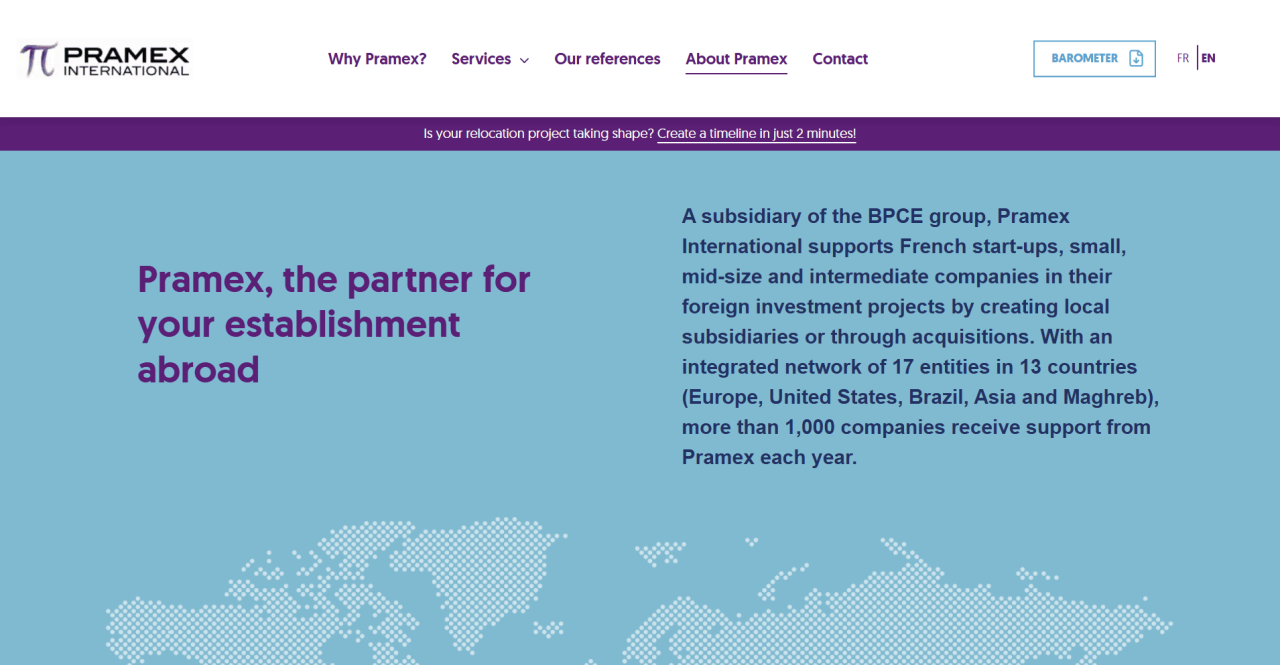
Pramex International helps companies establish and manage subsidiaries abroad through administrative, financial, HR, and corporate support.
Relevant needs include:
- Subsidiary creation
- Subsidiary administration
- Accounting and tax operations
- HR administration
- Local reporting
- Cross-border M&A
- Coordination between local entities and headquarters, etc.
PMC Japan: Japan market entry and business development
PMC Japan is a Tokyo-based company supporting foreign businesses with market entry, commercial acceleration, local services, recruitment, and business development in Japan.
Its market-entry approach includes market analysis, product-market fit assessment, competitive analysis, localized growth planning, regulatory considerations, and support for establishing a local presence.

PMC Japan provides local market entry and business development support for companies expanding into Japan.
Companies may consider PMC Japan when Japan-specific market conditions require local knowledge and execution.
Best fit:
- Japan market entry
- Market validation
- Business development
- Commercial acceleration
- Localization
- Local implementation
- Recruitment and HR support, etc.
VVR International: China market entry and operational support
VVR International supports European companies with industrial and commercial development in China.
Its capabilities include strategic diagnosis, commercial development, supply chain and distribution, buying and quality, recruitment and incubation, and M&A. VVR also describes an implementation model covering partner identification, negotiation, local team recruitment, and ongoing operational follow-up.
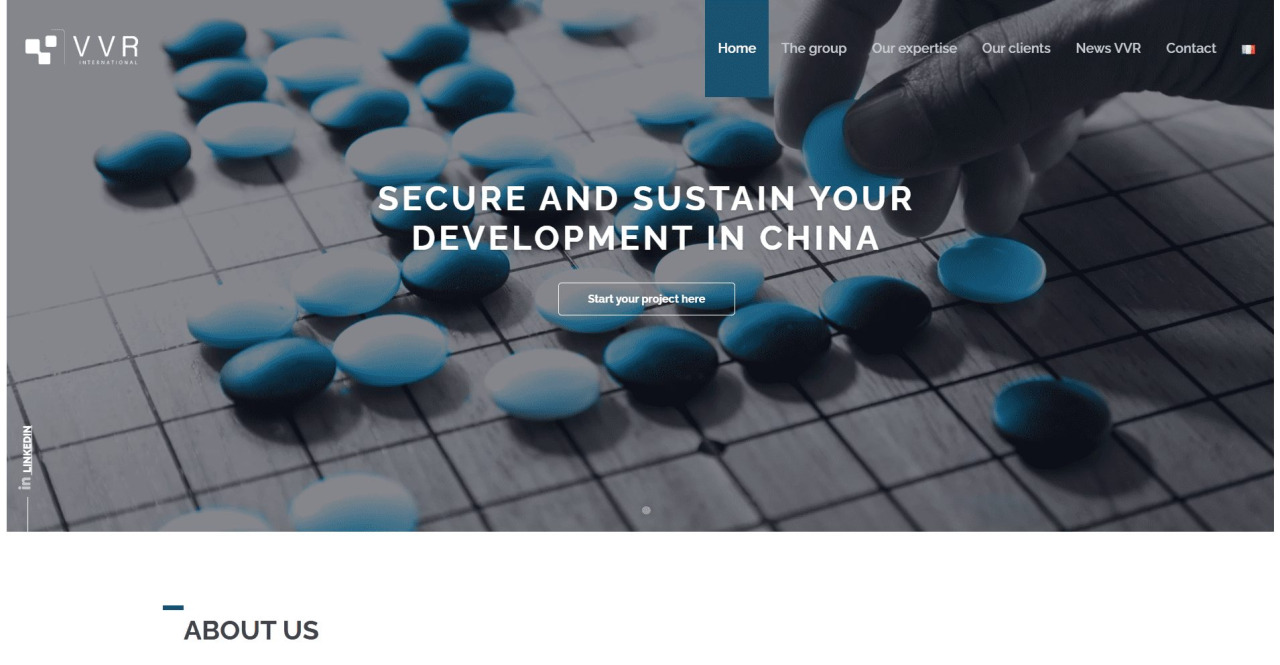
VVR International supports foreign companies with market entry, local teams, sourcing, supply chain, and operational execution in China.
Best fit:
- China market entry
- Strategic diagnosis
- Business development
- Local partner identification
- Recruitment and local team support
- Sourcing and supplier management
- Supply chain and distribution
- M&A, etc.
Valians International: Poland and Central & Eastern Europe
Valians International supports companies expanding in Poland and other Central and Eastern European markets.
Its services include market intelligence, distribution and partnership development, business development, sourcing, industrial investment and M&A, subsidiary creation, recruitment and payroll, and local representation. Its stated regional presence covers Poland, the Czech Republic, Slovakia, Hungary, Romania, Bulgaria, Ukraine, the Baltic states, and the Balkans.
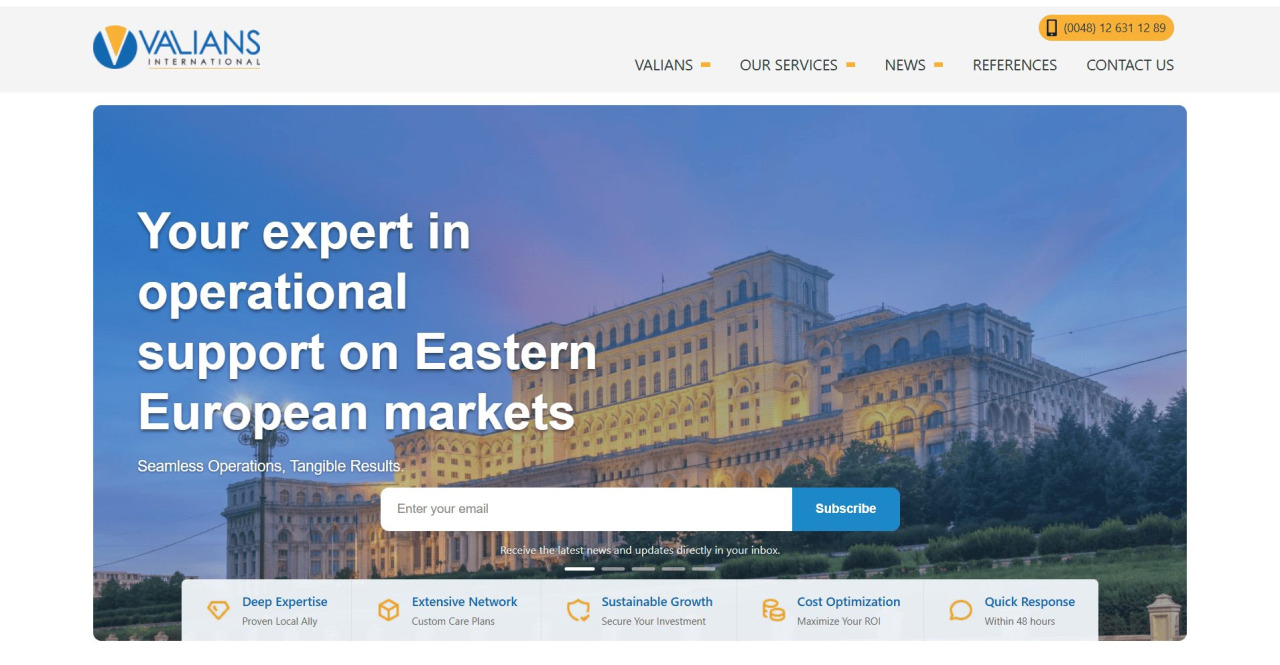
Valians International helps companies expand in Poland and Central and Eastern Europe through local business development and operational support.
Relevant needs include:
- Poland and CEE market entry
- Market intelligence
- Distributor and partner search
- Business development
- Local commercial representation
- Recruitment and payroll
- Sourcing
- Subsidiary creation, etc.
TTE Gulf: Gulf and Middle East market entry support
TTE Gulf supports international companies entering or expanding across the Gulf and wider Middle East region. Its activities include market entry support, business missions, B2B meetings, local representation, and commercial development.
Companies may consider TTE Gulf when they need to assess market opportunities, identify local stakeholders, organize business missions, or develop an initial commercial presence in Gulf markets.
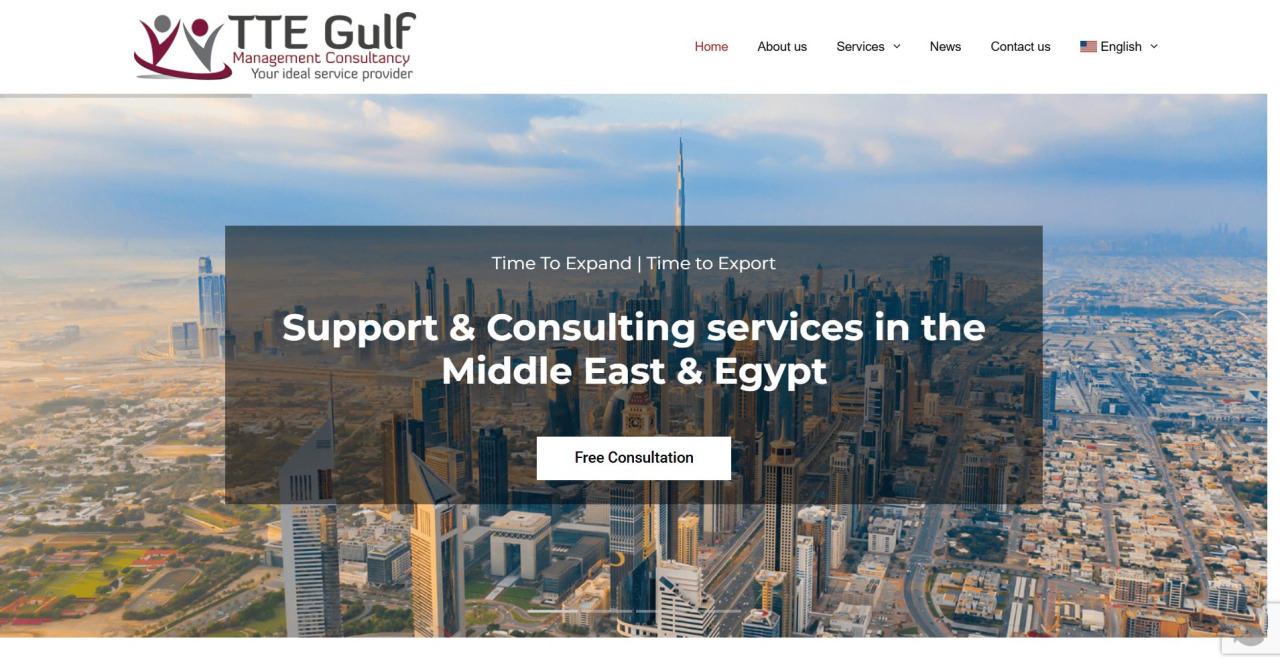
TTE Gulf supports companies with market entry, business development, and local consulting services across Gulf and Middle Eastern markets.
Best fit:
- Gulf market entry
- Business development
- Trade and business missions
- B2B meetings
- Local representation
- Market validation
- Stakeholder coordination
vif Solutions: France-Germany cross-border business support
vif Solutions supports French and German companies with cross-border business development and operational projects between the two markets. Its expertise covers business development, M&A, recruitment, subsidiary management, and related tax, legal, accounting, and communication support.
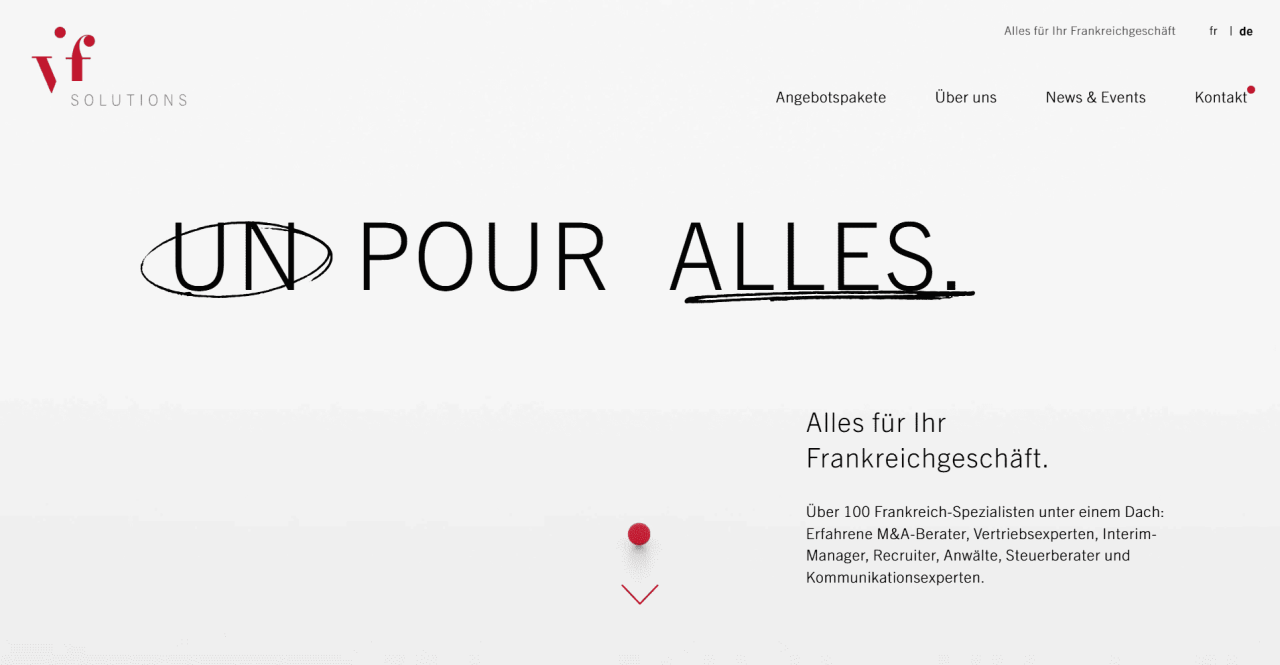
vif Solutions supports French-German expansion projects across business development, M&A, recruitment, subsidiary management, and related services.
Companies may consider vif Solutions when they need local support for commercial development, recruitment, subsidiary operations, or cross-border growth between France and Germany.
Relevant needs include:
- France-Germany business development
- Cross-border expansion
- M&A and external growth
- Recruitment
- Subsidiary management
- Tax, legal, and accounting coordination
- Operational support
Global Firm, Local Partner, or Both: Which One Fits Your Business Need?
The right support model depends on the problem the company is trying to solve.
* The framework below should be treated as a starting point rather than a fixed rule. Some firms combine several capabilities, while others specialize deeply in one area.
| Business Need | Typical Best Fit | Why | What to Verify |
|---|---|---|---|
| Corporate strategy | Global strategy firm | Strong methodology, benchmarks, and board-level advisory | Industry experience, implementation support, team seniority |
| Business transformation | Global consulting firm or Big Four | Broad enterprise advisory and change management capacity | Local execution capacity and transformation track record |
| Tax, audit, risk, and compliance | Big Four or technical advisory firm | Strong regulatory and technical expertise | Country-specific coverage and local advisory team |
| Market entry validation | Regional or local partner | Requires local market knowledge and on-the-ground research | Local presence, network quality, market experience |
| Sourcing and supplier qualification | Local sourcing partner | Requires supplier search, factory visits, audits, and validation | Supplier database, audit process, category experience |
| Recruitment and local HR | Local HR or corporate services partner | Needs labor market knowledge and employment compliance | Local HR expertise, payroll capability, recruitment track record |
| Entity setup and administration | Local corporate services partner | Requires country-specific procedures and documentation | Compliance process, accounting, tax, payroll support |
| M&A target search | Regional or local partner | Needs market access, local relationships, and target screening | Deal sourcing capability and local due diligence support |
| Multi-country expansion | Global + regional/local partner model | Combines strategic direction with local execution | Coordination model, reporting standards, partner accountability |
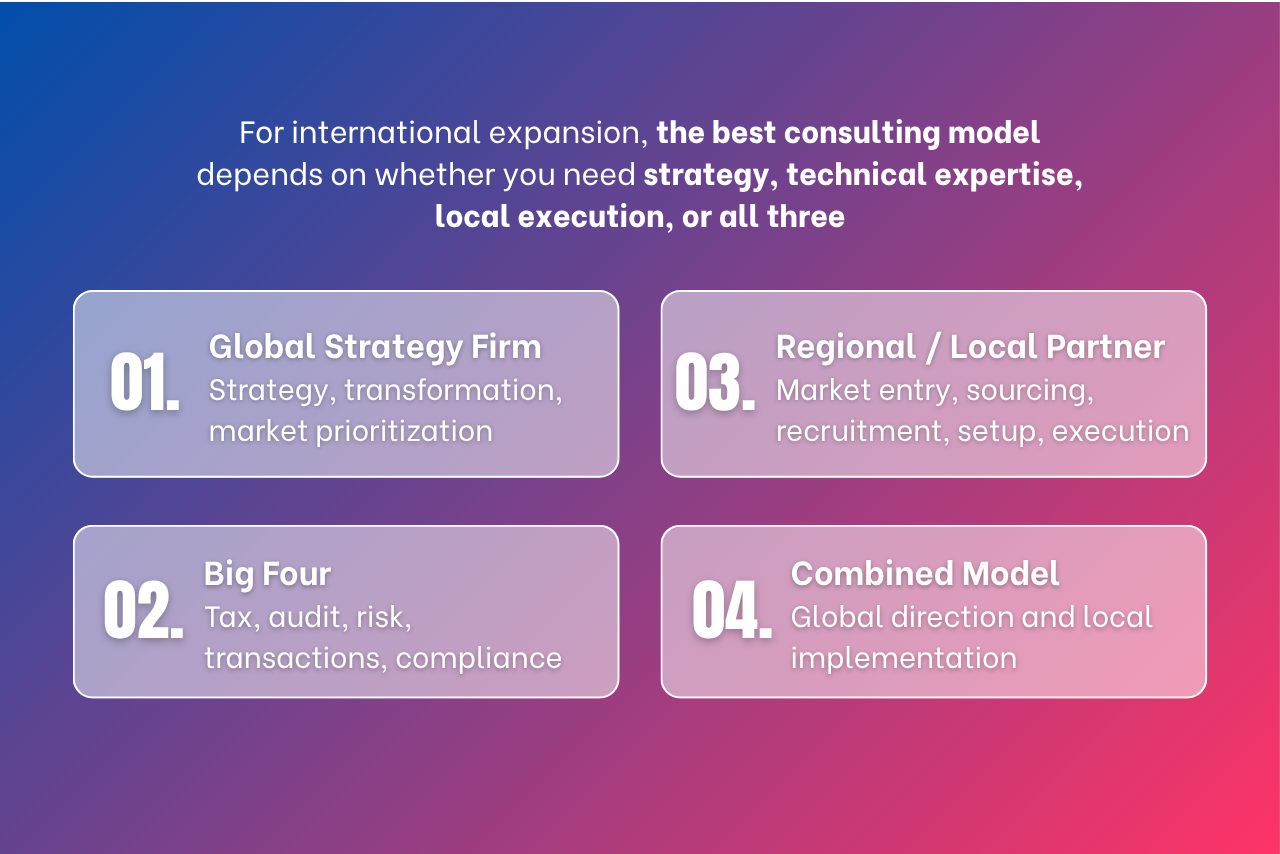
The right consulting model depends on whether a company needs strategic direction, technical expertise, local execution, or a combination of all three.
The verdict
In practice, companies can use simple decision logic.
- Choose a global strategy or management consulting firm when the main challenge is enterprise-level strategy, transformation, market prioritization, or operating model design.
- Choose a Big Four or technical advisory firm when tax, audit, transactions, finance, risk, regulatory requirements, or compliance are central to the project.
- Choose a boutique consulting firm when specialized sector, functional, or geographic expertise matters more than global scale.
- Choose a regional or local consulting partner when the project depends on country-level execution, such as market validation, sourcing, recruitment, partner search, entity setup, business development, or operational coordination.
- Use a combined model when the company needs both strategic direction and local implementation.
Final Thoughts
The top consulting firms are not necessarily the same for every business challenge.
Global management consulting firms can bring strategic frameworks, benchmarks, and enterprise-level expertise. Big Four firms provide deep capabilities in technical and regulatory areas. Boutique consulting firms offer specialization, while regional and local consulting partners can provide the market access and execution capabilities required for international expansion.
For many international expansion projects, the answer may not be one consulting firm alone. Combining global or regional strategy with local execution can give companies both the broader perspective and the market-specific support required to move forward.
Looking for practical support in Vietnam, Southeast Asia, South Korea, or broader Asian markets? Source of Asia helps international companies and partners move from market analysis to local execution through market expansion, sourcing and supply chain, corporate services, and other on-the-ground support. Share your business needs with us!
Frequently Asked Questions
The right firm depends on the project. Global strategy firms are generally suited to high-level strategy and transformation, while Big Four firms provide tax, risk, transaction, and compliance expertise. Boutique, regional, and local consulting partners can be more suitable when international expansion requires specialized market knowledge and hands-on execution.
Global consulting firms typically offer broad capabilities, international resources, standardized methodologies, and experience with large organizations. Boutique consulting firms tend to specialize in particular sectors, functions, or markets and may offer deeper expertise or more direct involvement in a specific area.
Companies should choose based on their objectives and project scope. A global consulting firm may be more suitable for corporate strategy or large transformation programs. A local partner may be better positioned for market entry, sourcing, recruitment, business development, company setup, or other activities requiring direct access to a specific market.