Introduction
Employer of Record (EOR) solutions help companies hire employees across ASEAN markets without establishing local entities. As businesses expand, changing EOR providers often becomes necessary when existing solutions no longer match workforce needs, compliance requirements, or operational complexity.
However, an EOR transition is not simply a provider replacement. Employment contracts, payroll, benefits, and statutory obligations are connected across countries. Without proper coordination, businesses may face delays, compliance gaps, or employee concerns.
In this guide, we – Source of Asia, explain how companies maintain employment continuity during an EOR transition. It covers key risks, preparation steps, and practical considerations for managing the process across ASEAN markets.
Disclaimer: This article provides general guidance only. EOR transitions should be reviewed with local legal, payroll, and compliance specialists in each jurisdiction.
Key Insights
- Changing EOR providers can affect contracts, payroll, benefits, statutory registrations, and employee communication.
- EOR transitions require jurisdiction-specific planning across ASEAN due to different labor laws and statutory systems.
- Payroll cutover, parallel testing, and overlap periods are critical to prevent payment and compliance errors.
- Workforce structure, immigration status, and contractual obligations must be assessed before initiating transition.
- Controlled data migration with validated records ensures continuity of payroll, benefits, and compliance across providers.
Why Employment Continuity Is Complex When Switching EOR Providers
When companies change EOR providers, the change affects more than HR administration. The EOR is the legal employer, which means it manages key employment responsibilities such as contracts, payroll processing, and local compliance requirements. Transitioning these responsibilities to a new provider requires careful planning to avoid gaps in employee support.
This becomes more challenging when employees are located across multiple countries. Employment is fragmented across different jurisdictions, where labor rules, registration processes, and transition timelines can vary significantly. A process that works in one market may create issues in another if local requirements are not reviewed early.
Furthermore, employment operations rely on several connected systems. Contracts, payroll, benefits, and statutory systems are connected, so changes in one area can affect the others. A successful transition requires proper coordination between providers, internal teams, and local requirements to maintain a stable employee experience.
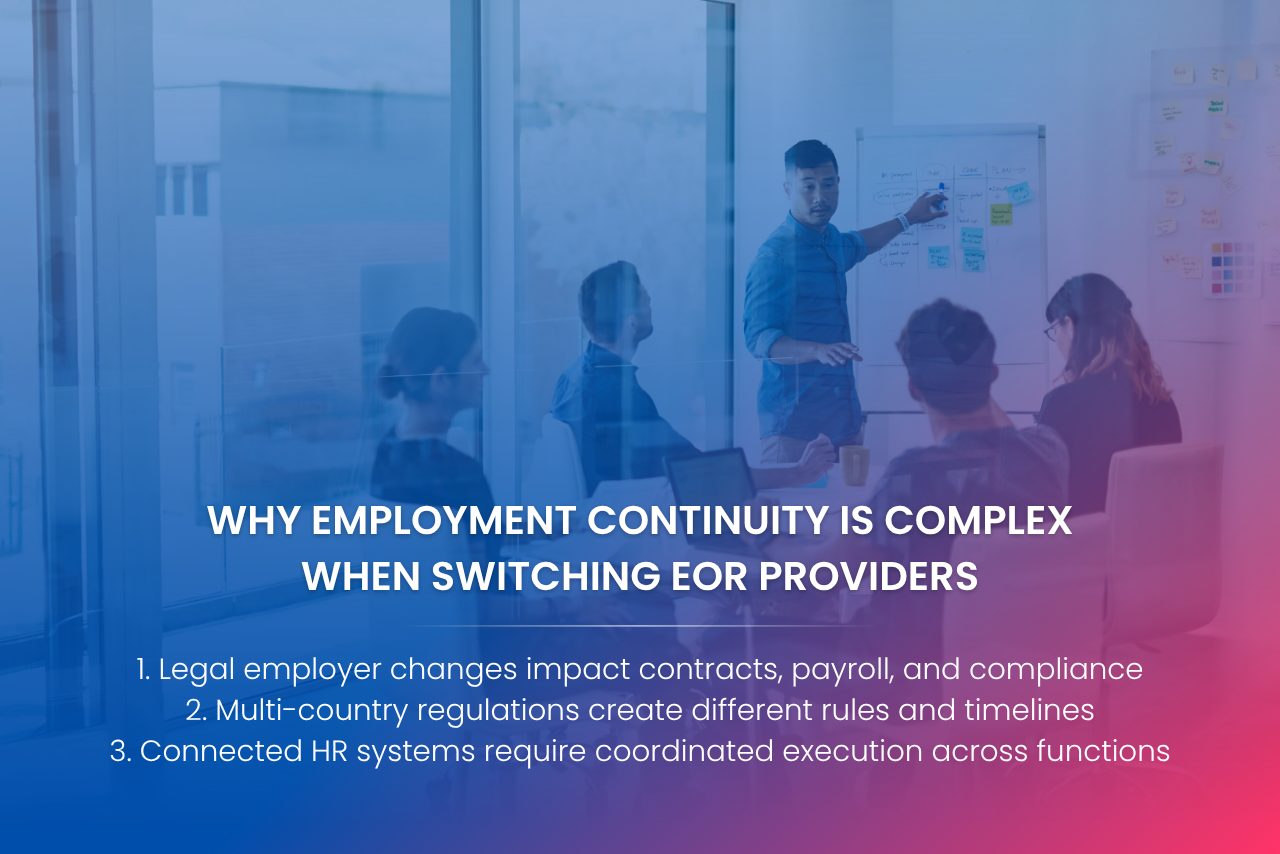
Employment continuity becomes complex when contracts, payroll, and compliance systems operate across multiple countries with different regulatory requirements.
Why Do Companies Change EOR Providers
When a company enters a new market, an EOR provider enables fast hiring without establishing a local entity. This works effectively in the early stage, but as operations expand, limitations often emerge. Companies typically reassess their setup due to four key factors:
- Growth beyond current EOR operational capacity
At the initial stage, EOR providers focus on basic hiring and onboarding. However, as headcount increases, operational complexity rises significantly. Companies then require:
- Faster HR coordination across multiple teams and countries
- More detailed workforce reporting and real-time visibility
- Scalable processes that can support higher employee volumes without delays
When these capabilities are insufficient, daily operations slow down, signaling misalignment between the provider’s capacity and business growth needs.
- Compliance limitations across multi-country operations
Each ASEAN market operates under distinct labor laws, payroll systems, and statutory requirements. A provider that performs well in one jurisdiction may not deliver the same level elsewhere. Common gaps include inconsistent compliance execution, limited local expertise in certain markets, and delayed adaptation to regulatory updates. These issues increase regulatory exposure during regional expansion.
- Cost structure and scalability constraints
As the workforce expands, cost evaluation shifts from unit pricing to overall efficiency at scale. Companies often assess:
- Whether pricing remains competitive at higher employee volumes
- If cross-country expansion remains cost-efficient
- The level of internal effort required to manage the provider
The focus moves from short-term affordability to long-term scalability, prompting consideration of alternative providers better aligned with growth trajectories.
- Poor employee experience or slow support
EOR providers directly manage payroll, contracts, and benefits. Weak service quality quickly impacts employee experience. Common issues include delayed HR or payroll responses, inconsistent communication across regions, and unclear employment guidance. Over time, these gaps reduce workforce confidence and operational stability.
What Should Companies Assess Before Initiating an EOR Transition?
Before initiating an EOR transition, companies need to assess key workforce, compliance, and operational factors to ensure employment continuity is properly structured before the provider change.
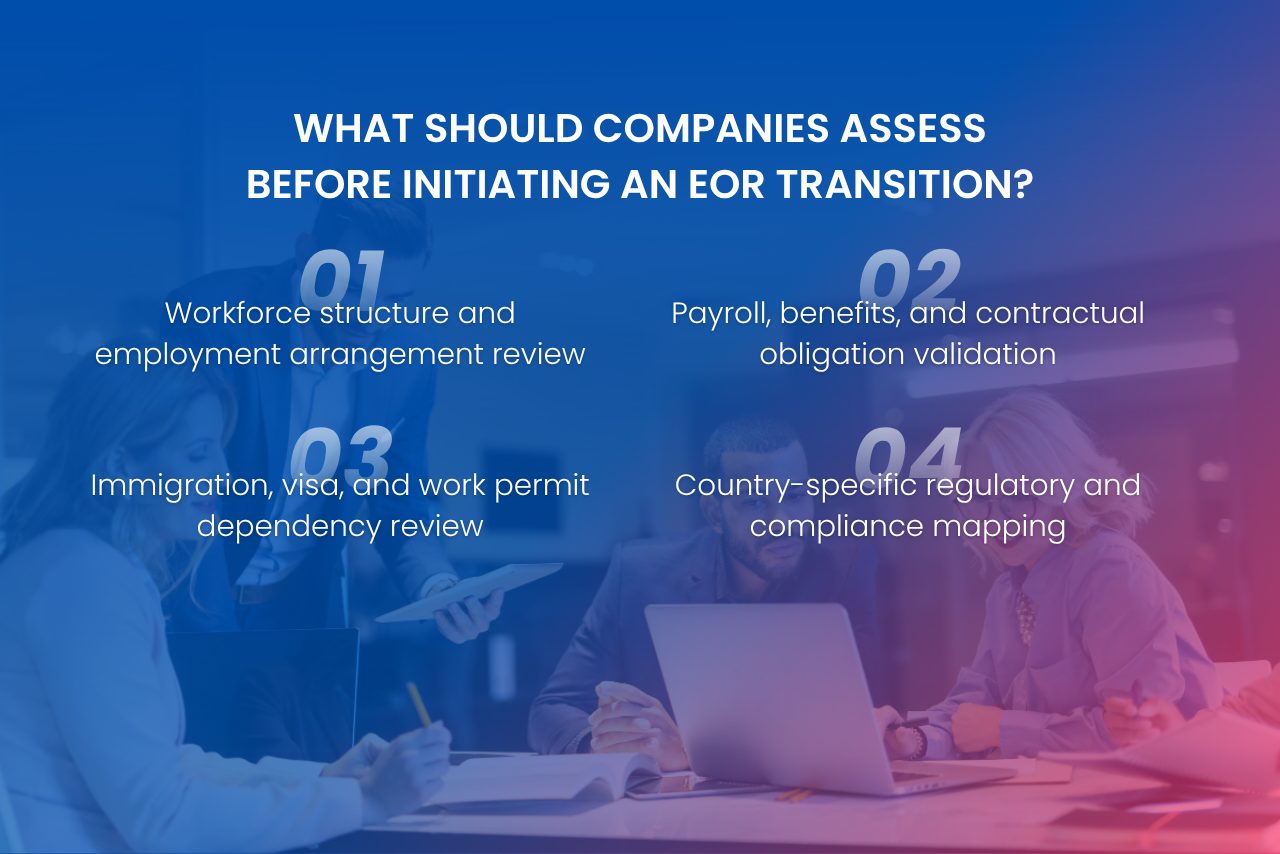
Companies must review workforce structure, payroll obligations, and compliance dependencies to reduce transition risks before changing.
Workforce structure and employment arrangement review
Before an EOR transition, companies must conduct a detailed workforce structure assessment to ensure compliance accuracy and operational continuity across all jurisdictions. This step clarifies how each employee is legally and operationally engaged.
- Employee mapping by country and legal status
- Contract types (employee, contractor, fixed-term, part-time)
- Compensation and payroll structure
- Special arrangements (equity, bonuses, incentives)
- Accrued benefits and tenure-linked entitlements
This review enables companies to identify transition risks, documentation gaps, and classification issues before migration begins. It also ensures the incoming EOR can assume responsibility without disrupting payroll, benefits, or contractual obligations across different regulatory environments.
Payroll, benefits, and contractual obligation validation
Payroll, benefits, and contractual obligations become most critical at the point of EOR transition. At this stage, administrative continuity must be preserved across both providers. Any inconsistency at this stage can directly affect compliance status and employee experience across different jurisdictions.
Before changing EOR providers, companies should validate several core components:
- Employment contract continuity: Terms, renewal clauses, notice periods, and termination requirements
- Compensation obligations: Accrued leave, pending bonuses, commissions, and incentive payments
- Statutory compliance records: Social insurance, tax filings, and pension contributions
- Employee benefits coverage: Health insurance, insurance schemes, and jurisdiction-specific entitlements
- Transition coordination requirements: Alignment between outgoing and incoming EOR systems
For example, in multi-country ASEAN operations, social security and health insurance registrations often require formal handover between providers. When these steps are not properly synchronized, compliance gaps may emerge even if payroll execution appears uninterrupted.
Immigration, visa, and work permit dependency review
In an EOR transition, immigration and work permit dependency create risk when the legal employer change is not aligned with sponsorship structures, affecting work authorization continuity.
Key dependency areas include:
- Employer-linked visa structures: Work permits tied to the current EOR may require reassignment or reapplication
- Sponsorship transfer requirements: The incoming EOR may need to submit new filings or notifications
- Work authorization continuity: Timing gaps can temporarily impact legal employment status
- Regulatory approvals: Some jurisdictions require labor or immigration authority clearance
Without proper coordination, even smooth payroll migration can still lead to compliance breaks in work eligibility, especially during cross-border transitions in ASEAN markets.
Country-specific regulatory and compliance mapping
During an EOR transition, regulatory requirements vary significantly across ASEAN markets, affecting how employment continuity is documented, statutory obligations are updated, and employee records are migrated or reissued.
A compliant transition requires companies to review three key areas:
- Employment structure: Termination rules, rehire requirements, and contract continuity
- Statutory compliance: Social contributions, registrations, and reporting obligations
- Administrative timing: Government updates, payroll cut-offs, and transition sequencing
Each market requires a tailored transition approach based on its regulatory framework and operational requirements. The table below highlights the key statutory systems companies should consider when changing EOR providers across ASEAN markets.
| Country | Statutory systems | Key transition consideration |
| Malaysia | EPF, SOCSO, EIS | Employer registration updates and contribution continuity |
| Singapore | CPF | New employer setup and CPF contribution alignment |
| Indonesia | BPJS Ketenagakerjaan, BPJS Kesehatan | Re-registration under the new employer structure |
| Philippines | SSS, PhilHealth, Pag-IBIG | Coordination across multiple statutory agencies |
| Vietnam | Social insurance, health insurance, and unemployment insurance | Employer updates and social insurance record continuity |
| Thailand | Social Security Office (SSO) | Employer account updates and contribution continuity |
How Can Companies Ensure Stable Employment During EOR Transition?
Ensuring stable employment during an EOR transition requires coordinated execution across stakeholders, communication, compliance, and operational handover processes.
Early alignment of HR, legal, and finance stakeholders
An EOR transition involves multiple internal teams, and misalignment between HR, legal, finance, and business functions can create delays or compliance gaps during execution. Effective coordination focuses on three key areas:
- Cross-functional alignment: Ensure all stakeholders understand transition scope, responsibilities, timelines, and expected outcomes before implementation begins.
- Information readiness: Consolidate employee records, contract details, payroll data, and compliance documents to avoid missing information during provider handover.
- Clear ownership structure: Assign a dedicated transition owner to coordinate provider communication, manage approvals, resolve issues, and maintain execution consistency across teams.
Structured sequencing of employee communication
Employee communication during an EOR transition requires clear, consistent, and timely messaging. Even when the operational change is properly managed, unclear information can create uncertainty and affect employee confidence.
- What changes: Legal employer details, contract arrangements, payroll administration, and HR support channels.
- What remains unchanged: Employee roles, salary, benefits, reporting structure, and recognized employment continuity where applicable.
- Who to contact: A designated transition contact who can handle questions and provide accurate guidance.
Consistent communication across all countries is equally important, as different messaging quality between markets can create unnecessary concerns during the transition.
Local compliance validation in each market
Three areas usually determine the success of local compliance validation during an EOR transition.
Legal sequencing is the first priority. Employment changes must follow the correct order, including contract updates, provider handover, and statutory registrations. A missed step can create compliance gaps even when the transition appears complete.
Local employment requirements are the second factor. Each ASEAN market applies different labor rules, documentation standards, and administrative procedures. Practices that work in one country may not apply in another.
In-country compliance knowledge supports execution quality. Local advisors or HR specialists help validate requirements, reduce misinterpretation risks, and ensure the transition follows each jurisdiction’s specific framework.
Controlled data migration and provider handover
Data migration is a critical part of an EOR transition because incomplete records can create payroll errors, benefit gaps, or compliance issues after the switch.
The most common risks come from:
- Complete data migration: Employment records, payroll history, benefits, and statutory filings must be verified before cutover.
- Handover coordination: Both providers should align on data format, timelines, responsibilities, and confirmation steps.
- Validation period: A short overlap allows teams to reconcile records and fix discrepancies before they affect employees.
For example, missing social insurance records during an ASEAN EOR change can delay benefit updates even when payroll continues normally. A structured handover helps maintain continuity and reduce transition risks.
Payroll cutover, parallel testing, and overlap period
Payroll cutover is a critical stage in an EOR transition because errors can directly affect employee payments and compliance accuracy.
First, payroll validation should be completed before the switch. Companies need to review existing payroll data, tax calculations, statutory contributions, and employee records to ensure the incoming provider works from accurate information.
Next, parallel testing helps identify issues before the first live payroll cycle. Running a comparison payroll allows teams to detect differences in salary calculations, deductions, and reporting requirements before employees are impacted.
Finally, a controlled overlap period supports smoother handover. Both providers can reconcile records and resolve unexpected issues, reducing risks such as delayed payments or incorrect statutory filings during the transition.
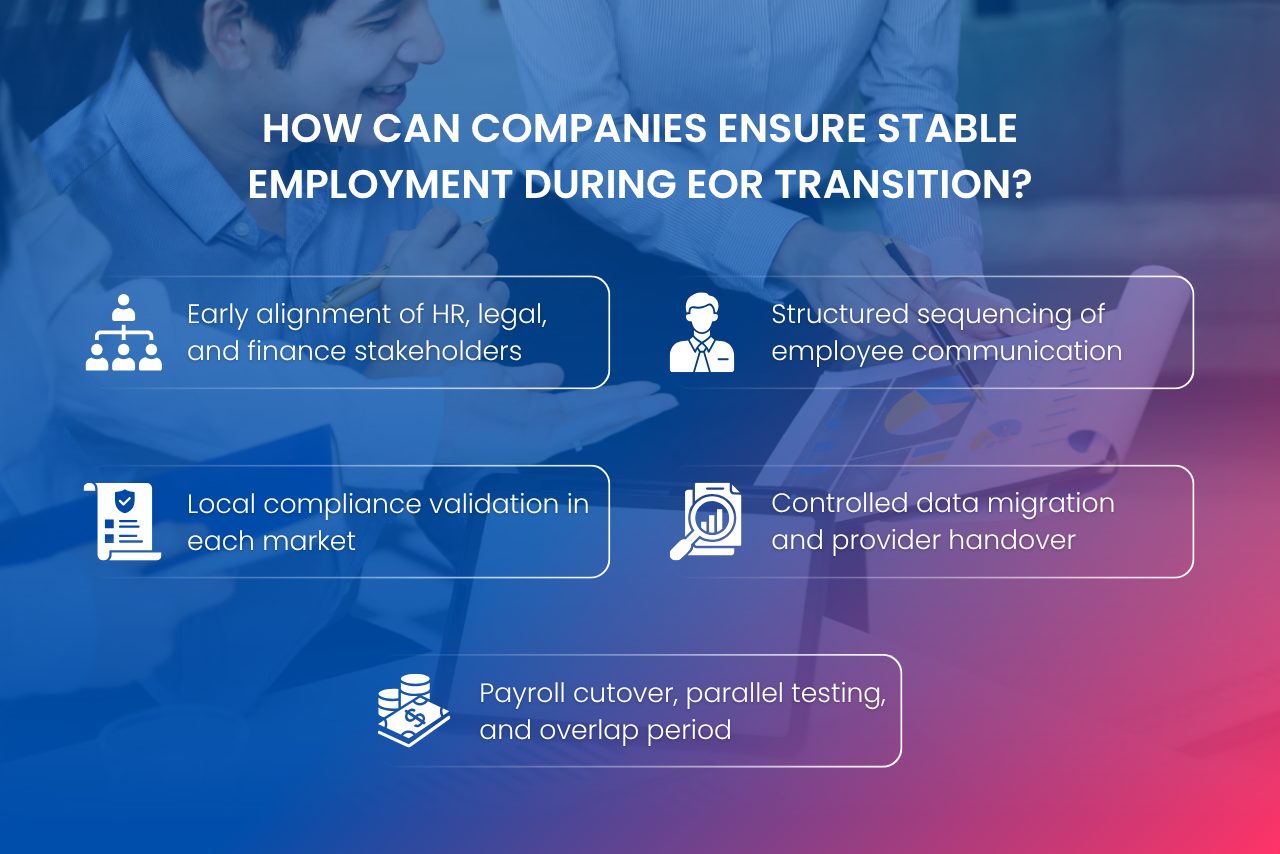
Stable employment during EOR transition requires coordinated execution across HR, legal, finance, communication, and local compliance teams.
How SOA Supports EOR Transition Continuity
During an EOR transition, companies face risks across payroll, compliance, visas, work permits, and workforce management. Source of Asia supports EOR transitions by helping businesses maintain continuity across each area.
Payroll validation and payment continuity
Payroll disruption is one of the most sensitive risks in an EOR transition because it directly affects employee trust, statutory compliance, and operational continuity.
Common issues include incorrect salary calculations, delayed payments, missing payroll records, and misaligned statutory contributions. These problems often arise when payroll data is not fully reconciled between outgoing and incoming providers before cutover.
To mitigate these risks, SOA coordinates payroll validation and data reconciliation across providers, ensuring contribution schedules remain continuous and payment cycles stay aligned throughout the transition period.
Country-specific compliance coordination
Compliance exposure arises during EOR transitions because each ASEAN market applies different labor laws, statutory processes, and documentation requirements. Misalignment can lead to legal gaps in termination, rehire, or registration procedures.
For example, delayed employee registration or incorrect sequencing of contract changes in some countries can trigger regulatory follow-ups or corrective filings from local authorities.
SOA supports this process by ensuring each transition follows in-country compliance requirements, maintaining legal sequencing, statutory accuracy, and consistent execution across all jurisdictions.
Employment data and documentation handover
Inconsistent employment data is a key risk during EOR transitions because records must be accurately migrated, verified, and reconciled between providers across contracts, payroll history, and statutory filings. Even small gaps can disrupt payroll processing, benefits administration, and compliance reporting.
Missing or outdated employee documents can directly affect payroll accuracy and statutory obligations, creating operational delays after cutover. SOA addresses this by structuring documentation handover and validating data completeness before transition, ensuring consistency across all markets.
Workforce stability and employee communication
Workforce instability is a key risk during EOR transitions because employees may perceive uncertainty when employment arrangements change across providers and jurisdictions. Even when processes are legally correct, unclear execution can affect confidence and retention. Key issues such as:
- Delayed payroll updates
- Contract reissuance without clear communication
- Unclear benefit changes
- Immigration-dependent roles affected by work permit continuity
SOA supports this by ensuring visa and work permit continuity, local HR coordination, and structured employee transition management across ASEAN, helping maintain workforce stability and reduce unnecessary attrition during the transition process.
| 👉 Explore our Corporate Services to ensure smooth EOR transition execution across ASEAN. |
Conclusion
Employment continuity during changing EOR providers depends on coordinated execution across legal, payroll, and compliance systems. Most risks come from poor sequencing of contracts, payroll cutover, statutory updates, and communication rather than from the provider change itself. In ASEAN, country-by-country execution and local validation are essential to maintain uninterrupted employment.
At Source of Asia, we support companies in managing EOR transitions across ASEAN, including payroll and compliance coordination, workforce structuring, visa and work permit continuity, and local HR support. Our team helps ensure alignment between operational execution and local regulatory requirements to reduce disruption and maintain employment stability.
| 👉 Planning EOR transitions in ASEAN? Contact our experts to ensure employment continuity across ASEAN. |
Frequently Asked Questions
Not always. The process depends on the country and transition structure. In some cases, employees may be re-onboarded under a new EOR agreement without a formal resignation. In other cases, local labor rules may require resignation, termination, and rehire or new employment documentation.
It depends on jurisdiction and how the transition is structured. Where employment is legally continuous, tenure may be preserved. However, in some markets, a contract break between providers can reset or partially affect statutory tenure recognition.
Most transitions take around 4–12 weeks. The timeline depends on the number of countries involved, the complexity of payroll and compliance systems, visa dependencies, and the time required for data migration, validation, and local authority procedures.
Yes, payroll can continue without interruption if the transition is planned before cutover, including payroll cutover planning, parallel testing, and data reconciliation between providers. Without these controls, risks include delayed payments, calculation errors, or misaligned statutory contributions.