Introduction
ASEAN is a diverse business region, where language, hierarchy, religion, communication, and local business practices shape how companies work. These differences can create cultural misalignment when regional strategies meet different local ways of working.
The challenge is mismatched expectations in execution. Headquarters may expect fast decisions and direct feedback, while local teams prefer internal consultation. Partners may sound positive in meetings, while still needing internal review before moving to concrete next steps. Therefore, decisions can be delayed, reporting can become less accurate, and local execution can fall short of expectations.
In this guide, Source of Asia explains when cultural differences become misalignment, how they create operational risks, and what businesses can do to build better alignment between regional strategies and local execution.
Key Insights
- Misalignment is not cultural difference; it is the failure to translate differences into shared operating rules.
- Its impact appears across business operations, from decision-making and reporting to escalation, partner management, and execution.
- Regional strategies can fail when headquarters and local teams interpret urgency, authority, feedback, or commitment differently.
- Regional standards should stay consistent, while communication and execution practices can adapt to local conditions.
- Early local validation helps identify cultural friction before it becomes an operational or market entry problem.
 Add Source of Asia as a preferred source on Google
Cultural Difference vs Cultural Misalignment in ASEAN Operations
Cultural differences are part of working across ASEAN. They become cultural misalignment when different expectations about communication, decisions, or execution start affecting how work gets done.
What cultural misalignment looks like
Cultural misalignment occurs when teams from different business environments have different expectations about how work should be communicated, managed, or executed.
It can happen between headquarters and local teams, regional managers and country offices, or international companies and local partners. For example, HQ may expect direct feedback, fast decisions, and immediate escalation, while a local team may prefer internal discussion before raising concerns.
Neither approach is necessarily wrong. The problem arises when each side assumes the other follows the same expectations. Over time, this can affect reporting, decision-making, partner management, and project timelines.
When cultural differences become operational issues
Cultural differences are normal when teams work across ASEAN. They become an operational issue when teams cannot align their expectations and still execute toward the same business objectives.
In practice:
- Cultural differences can be managed when teams understand different ways of working and adjust accordingly.
- Cultural misalignment occurs when these differences repeatedly cause misunderstandings, conflicting decisions, delayed actions, or unresolved issues.
Companies do not need to make every market work in the same way. Instead, they should set clear expectations and shared objectives, while allowing local teams to adapt how they communicate and execute.
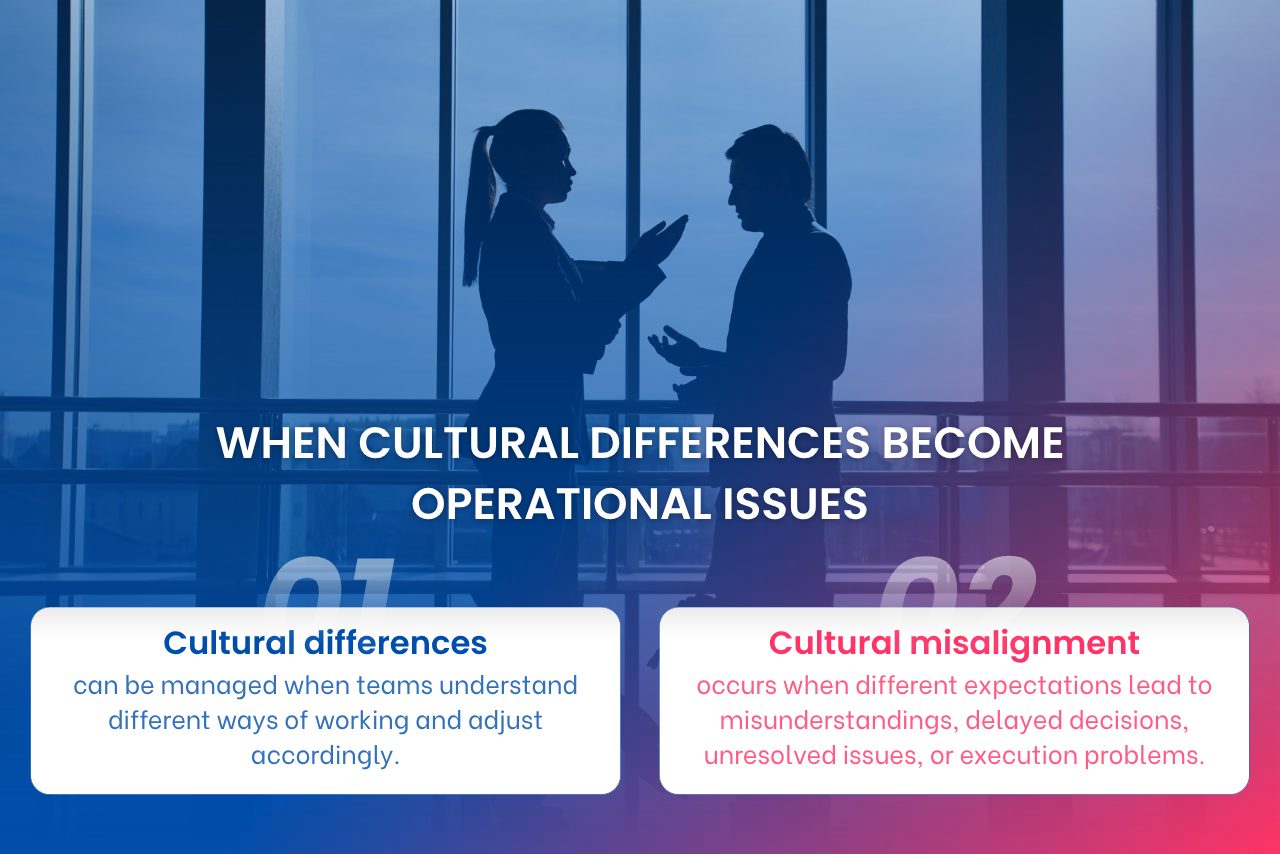
Cultural differences become operational issues when teams cannot align expectations and meet shared business objectives.
Why Cultural Misalignment Is Harder to Manage Across ASEAN
ASEAN markets operate under different business norms, so regional strategies may not translate directly into local execution. These differences can affect how teams communicate, interpret situations, and apply common processes.
Regional strategies meet different local business norms
ASEAN is not a single operating environment. Differences in language, religion, hierarchy, communication, and economic development can affect how regional policies are understood and applied.
For example, these differences may shape:
- Language: Reporting, documentation, and meeting interpretation.
- Religion: Working schedules, business meals, and public holidays.
- Hierarchy: Decision approval, delegation, and escalation.
- Communication: Feedback, disagreement, and risk reporting.
- Economic development: Digital tools, infrastructure, and workforce capabilities.
Therefore, companies do not need a separate operating model for every market. Instead, regional objectives and controls can remain consistent, while meeting routines, follow-up methods, partner communication, and escalation practices adapt to local conditions.
Headquarters and local teams may interpret situations differently
Cultural misalignment can arise when HQ and local teams use different expectations to assess the same situation. HQ may expect direct feedback, fast decisions, and immediate escalation, while local teams may follow more consultative or hierarchical practices. As a result, urgency, authority, feedback, or commitment may be understood differently.
For example, in a distributor search project, a local partner may avoid giving direct negative feedback. HQ may see the discussion as progressing, while the local team understands that the partner has concerns about the terms or has lost confidence in the opportunity. Clear reporting criteria and local context can help both sides interpret these signals more accurately.
One operating approach may not work across markets
A process that works well in one ASEAN market may create friction elsewhere when it assumes teams have the same ways of working and decision-making expectations. For example, applying one meeting structure, escalation timeline, or feedback process across countries may produce different results, even when the process itself is clear.
A more practical approach is to standardize what protects business performance:
- Core objectives, compliance requirements, and decision rights
- Reporting and quality standards
- Escalation thresholds
At the same time, allow local teams to adapt meeting styles, communication channels, follow-up rhythms, and relationship management. This helps companies maintain regional consistency without making local execution unnecessarily rigid.
|
These differences are also reflected in how business is conducted in each market. Explore our practical guides for two key ASEAN markets: |
How Cultural Misalignment Affects Business Operations
Cultural misalignment can affect daily operations in several ways, from slower information flow and delayed decisions to unresolved concerns and weaker coordination between headquarters and local teams.
Communication gaps slow information flow
When teams have different expectations about directness, feedback, and escalation, the same message can be understood differently. For example, a local team may describe a project as “progressing” while still facing concerns from a partner. HQ may take this as a sign that the project is on track.
As a result, important issues may reach leadership too late. This can slow coordination, delay decisions, and make it harder for HQ and local teams to respond before a problem affects the project. Clear reporting rules and escalation criteria help ensure that both sides have the same view of operational progress.
Conflicting expectations delay decisions
Decision-making can slow when teams have different expectations about authority, autonomy, and consultation. HQ may expect a country manager to approve an action independently, while the local team may believe senior management should review it first. Neither side may see the delay as a problem.
Over time, this can create uncertainty about who has authority and who is responsible for the next step. The impact can extend to market entry projects, negotiations, hiring, procurement, supplier changes, and customer commitments. Defining decision rights and approval processes early helps prevent different expectations from becoming unnecessary bottlenecks.
Unspoken concerns leave problems unresolved
Employees or partners may avoid direct disagreement, especially when raising concerns about senior colleagues, customers, or sensitive business decisions. Instead, they may communicate hesitation indirectly or wait until they have more information.
If HQ does not recognize these signals, the concern may remain unaddressed. According to Harvard Business Review, differences in cultural assumptions and communication norms can increase miscommunication and weaken trust across international teams.
Consequently, issues are detected later, when they are harder to correct. A small concern about a supplier, partner, or project can become a larger operational problem if no one raises it early. Clear escalation rules and practical feedback channels can help teams surface concerns before they affect execution.
Trust gaps weaken local coordination
Repeated misunderstandings can gradually reduce confidence between headquarters and local teams. HQ may question local performance when results fall short of expectations, while local teams may become less willing to rely on HQ decisions that seem disconnected from market realities.
Over time, this can affect how teams work together, not just how they communicate. Local managers may spend more time defending decisions instead of solving issues, while HQ may rely more heavily on central control. Clear roles, local input, and regular alignment can help maintain effective coordination.
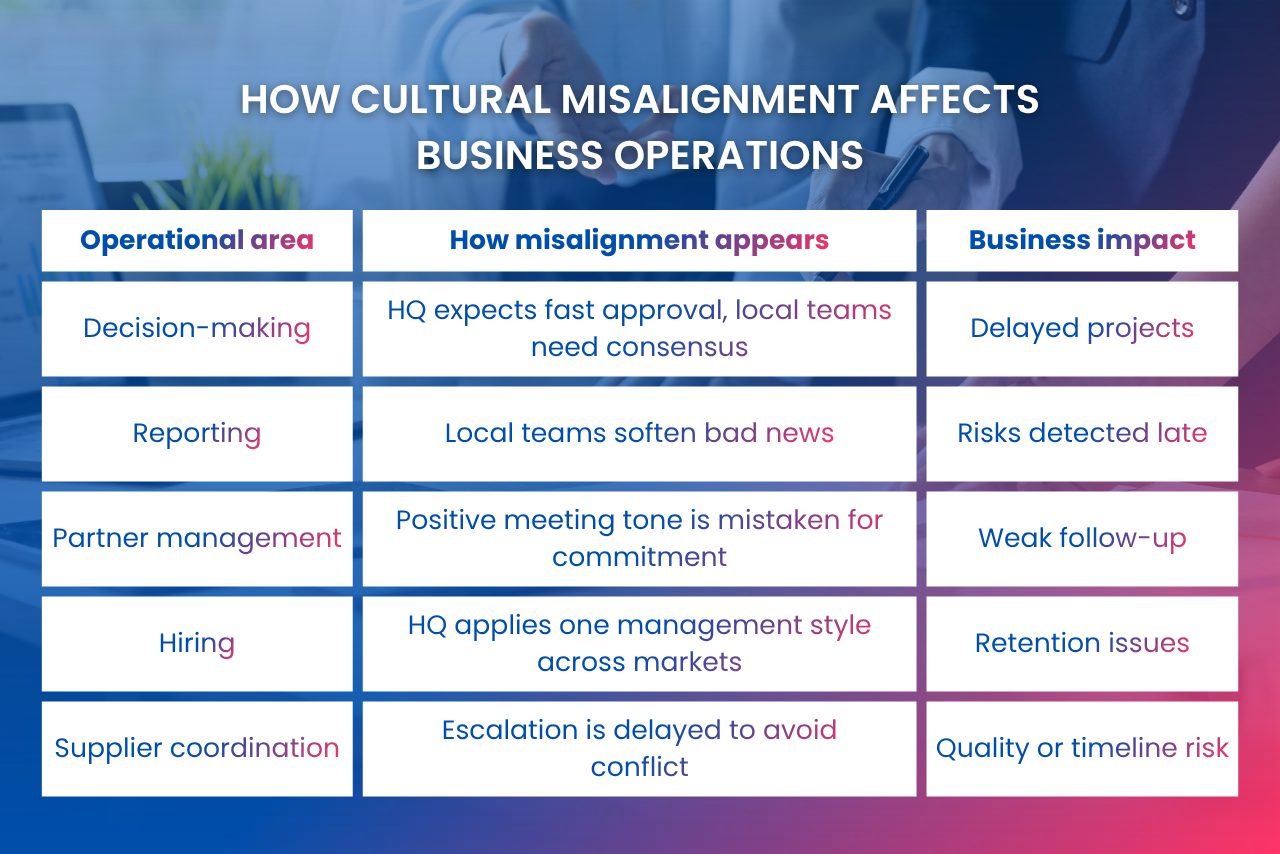
Cultural misalignment can slow information flow, delay decisions, leave concerns unresolved, and weaken coordination.
Warning Signs of Cultural Misalignment in ASEAN Operations
Cultural misalignment is not always visible in day-to-day operations. In many cases, teams continue to meet targets and report progress, while small differences in communication and decision-making create problems underneath. Repeated patterns are often a stronger warning sign than a single incident.
Look for signs such as:
- Local teams rarely challenge HQ assumptions, but execution slows, or agreed actions are repeatedly delayed.
- Partners agree in meetings but do not move to concrete next steps, while positive language is treated as commitment.
- Issues are escalated too late, becoming visible only after deadlines, costs, or customer expectations are affected.
- Reports remain positive while operational problems continue, creating a gap between reported performance and local reality.
- HQ interprets silence as agreement, while local teams see it as caution or a need for further discussion.
- Decision rights are unclear between regional and local teams, causing people to wait for approval or avoid taking responsibility.
One sign alone does not confirm cultural misalignment. However, patterns that repeat across teams, projects, or markets are worth reviewing before they become larger execution problems.
How Businesses Can Build Better Cultural Alignment
Building cultural alignment requires more than adapting to local differences. Companies also need clear regional standards, local validation, feedback channels, and practical support before execution.
Validate local expectations before execution
Cultural alignment should start before a regional process is introduced, not after execution problems appear. First, define what must remain consistent across markets, then check how those requirements fit local ways of working.
Core standards may include:
- Business objectives and compliance requirements
- Reporting responsibilities and decision rights
- Quality standards and escalation thresholds
However, these standards still need local clarification. For example, if a risk must be escalated within 24 hours, confirm who receives it, what information is required, and how the local team is expected to raise sensitive issues. This helps turn regional policies into clear operating practices rather than assumptions.
Adapt local practices without losing control
Localization does not mean giving each market complete freedom. Instead, companies should keep core objectives, compliance requirements, and reporting standards consistent while allowing local teams to adapt how they are applied.
Local adaptation may involve:
- Meeting rhythm and follow-up style
- Negotiation approach and escalation language
- Communication channels and documentation support
- Relationship management
For example, a company can apply the same supplier quality standards across ASEAN while allowing each local team to adjust how corrective actions are communicated to suppliers. The goal is one regional operating framework that works across different markets, not separate systems for every country.
Build feedback loops between local teams and headquarters
Cultural alignment should work in both directions. HQ needs clear visibility into local challenges, while local teams need a practical way to explain when regional processes do not fit market conditions.
Useful feedback loops can include:
- Regular reviews of recurring operational issues
- Clear channels for local teams to challenge assumptions
- Tracking repeated delays, escalations, and communication problems
- Updating regional processes based on recurring local feedback
This helps distinguish between execution problems and process problems. Over time, local teams can contribute market knowledge while HQ maintains consistent standards and regional control.
Use local partners to validate assumptions before execution
Local partners can help companies test their assumptions before execution, especially when entering an unfamiliar ASEAN market. Their market knowledge can clarify how local stakeholders communicate, make decisions, and respond to commercial proposals.
Before applying a regional process, companies can validate:
- Who influences or approves decisions
- How concerns and disagreements are communicated
- When escalation is appropriate
- Whether proposed timelines are realistic
- How partners interpret commercial commitments
This does not mean giving local partners control over the operating model. Instead, local input helps identify potential friction early, when processes can still be adjusted before they affect customers, employees, suppliers, or business partners.

Clear standards, local adaptation, and feedback loops help businesses build stronger cultural alignment across ASEAN.
Final Considerations
Cultural misalignment becomes an operational risk when different expectations affect communication, decision-making, escalation, partner management, or execution. Across ASEAN, companies need to recognize local differences without treating each market as a completely separate operating environment. Clear regional standards, defined decision rights, local adaptation, and early validation can help reduce these risks.
At Source of Asia, we help international companies navigate cultural differences across ASEAN through our Market Expansion services. Our teams help businesses bridge cultural gaps, align with local expectations, and translate regional strategies into practical, on-the-ground actions that work effectively in each market.
| 👉 Facing cultural misalignment in ASEAN? Speak with Source of Asia to align regional strategies with local business realities. |
Frequently Asked Questions
Cultural misalignment happens when teams have different expectations about communication, decision-making, authority, or execution. It becomes a business issue when these differences cause repeated misunderstandings, delays, or unclear responsibilities.
Cultural differences become an operational risk when they affect how teams make decisions, report issues, or coordinate work. For example, different escalation practices can cause problems to reach management too late.
Common signs include delayed decisions, late escalation, unclear reporting, limited challenge to HQ assumptions, and partners who appear positive but do not take concrete next steps.
Local execution support helps companies adapt regional processes to market conditions. It can also improve coordination with local teams and partners, clarify business practices, and identify operational issues before they affect performance.