Introduction
In 2026, ASEAN continues to attract global companies seeking new manufacturing bases, growing consumer markets, and more resilient supply chains. However, ASEAN expansion is not simply about entering one unified market. Behind the region’s growth potential are multiple countries with different regulations, business environments, customer expectations, and operating conditions.
Many expansion strategies become difficult after market entry. Businesses often discover that hiring, compliance, partner management, and commercial execution require different approaches from one country to another. As a result, execution becomes slower, more costly, and harder to manage across multiple markets.
In this guide, Source of Asia explains why execution is the hardest part of ASEAN expansion, how these challenges affect business strategy, and what global companies should do before expanding across ASEAN.
Key Insights
- ASEAN expansion often fails in execution because the region is not one unified operating environment.
- Regulations, customer behavior, business culture, talent availability, and local capabilities vary significantly by country.
- A strategy that works in Vietnam may require a different channel, pricing, or partnership model in Indonesia, Thailand, or the Philippines.
- Execution becomes harder when local teams, partners, suppliers, and reporting systems are built too late.
- Global companies need a regional strategy supported by country-level execution plans.
 Add Source of Asia as a preferred source on Google
The Real Challenge: ASEAN Is a Region, Not a Single Market
ASEAN is often discussed as one of the world’s most dynamic growth regions. Comprising 11 member states with a combined population of more than 700 million people, it offers attractive opportunities for manufacturing, investment, and business growth. However, ASEAN expansion does not take place in one unified market. While businesses may develop a regional strategy, execution happens country by country.
Each ASEAN market has its own regulations, business culture, infrastructure, customer behavior, and development priorities. These differences influence how businesses establish operations, hire employees, build partnerships, and reach customers. As a result, an approach that works in one country may not deliver the same results in another.
For this reason, a regional strategy alone is not enough. Businesses need country-level execution plans that reflect local market conditions while supporting a shared regional direction. This combination allows companies to expand more consistently across Southeast Asia
| 👉 To better understand these market differences, explore our insight on why ASEAN-6 markets operate differently within the same regional bloc. |
Why ASEAN Expansion Strategies Fail in Execution
Most ASEAN expansion strategies do not fail because market opportunities are weak. They fail when businesses underestimate country-level differences that shape execution, from regulations and operations to commercial practices and local capabilities.
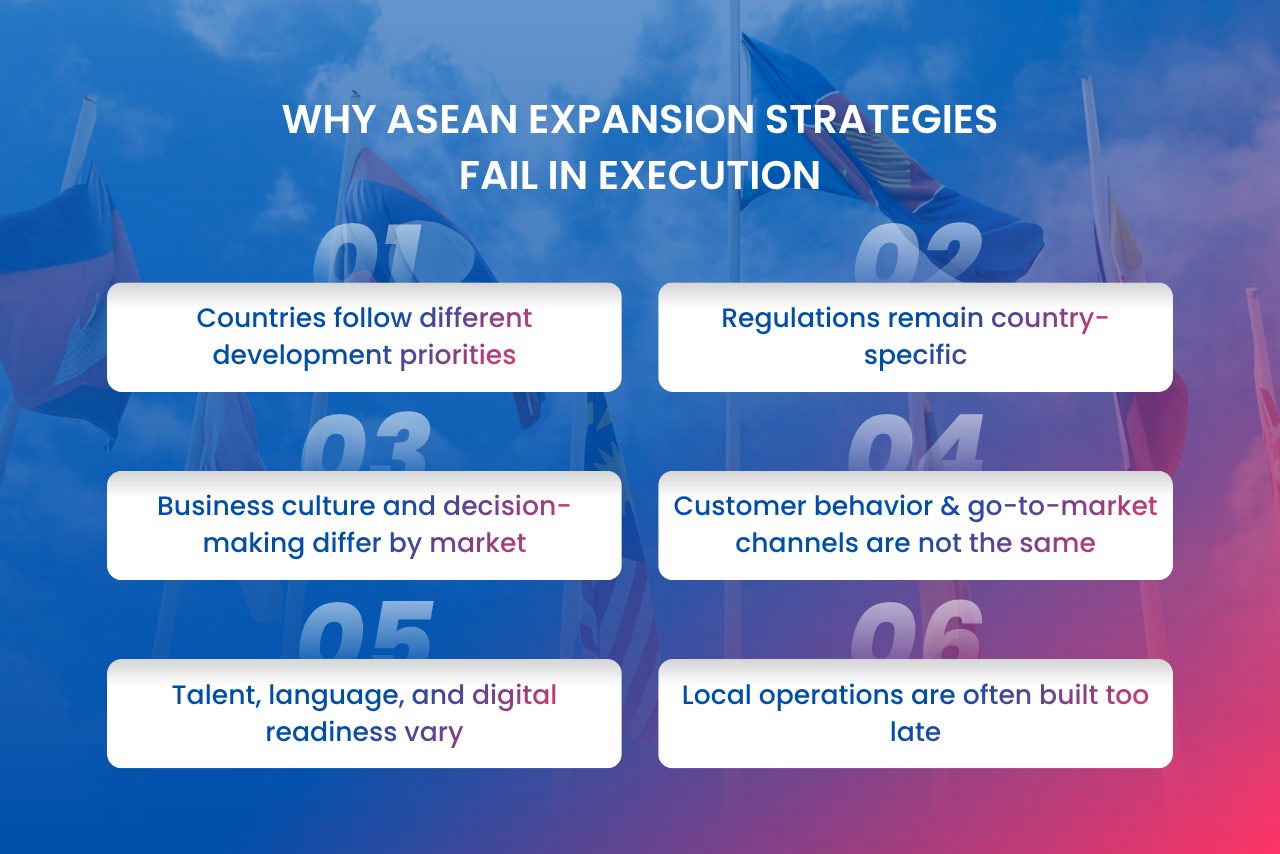
Country-level differences make regional expansion strategies harder to execute consistently across ASEAN.
Countries follow different development priorities
Although ASEAN promotes regional economic integration, each country follows its own development priorities based on its industrial strengths and long-term economic strategy. These priorities shape investment incentives, infrastructure development, workforce capabilities, and the industries governments actively support. Examples of national priorities and sector strengths include:
- Singapore: Finance, technology, biomedical sciences, and regional headquarters
- Vietnam: Export-oriented manufacturing and electronics
- Thailand: Electric vehicles, automotive production, medical services, and smart manufacturing
- Malaysia: Semiconductor manufacturing and high-value industries
- Indonesia: Downstream processing, battery materials, and critical minerals and large-scale domestic market opportunities
As a result, the same market entry strategy rarely works across every ASEAN market. Businesses should assess local industry priorities and ecosystem readiness before deciding how to execute expansion in each country.
Regulations remain country-specific
Although ASEAN continues to strengthen regional integration, businesses still need to execute country by country. The region’s single-market ambition remains limited by differences in national regulations, implementation capacity, and local business conditions.
Each market has its own requirements for business incorporation, foreign ownership, licensing, taxation, employment, and ongoing compliance. Hence, businesses expanding across multiple ASEAN countries often need to manage different regulatory processes and approval timelines simultaneously.
The table below illustrates how indicative setup timelines and foreign ownership conditions vary across major ASEAN markets.
| Market | Typical setup timeline* | Foreign ownership (general) |
| Singapore | ~1 week | Generally open in most sectors |
| Malaysia | 2~4 weeks | Generally open, with restrictions in selected sectors |
| Thailand | 1~2 months | Foreign Business Act restricts foreign ownership in certain activities |
| Vietnam | 1~3 months | Many sectors are open, while conditional industries require additional approvals |
| Indonesia | 1~2 months | Positive Investment List allows foreign investment, but conditions differ by sector |
| Philippines | 1~2 months | Certain industries remain subject to foreign ownership restrictions |
*The table is for general business planning only and should not be treated as legal or tax advice. Typical timelines are indicative only and vary depending on industry, investment structure, licensing requirements, and whether additional regulatory approvals are required.
Business culture and decision-making differ by market
Business relationships are built differently across ASEAN. Negotiation styles, communication preferences, procurement practices, and decision-making processes vary by country, influencing how quickly partnerships develop and commercial activities move forward.
For example, some markets prioritize relationship building before making business decisions, while others move quickly once commercial terms are agreed. Likewise, procurement may follow formal tenders in one market but depend on trusted networks or local partners in another.
Therefore, businesses should adapt how they engage with customers and partners, rather than applying one negotiation or management approach across every ASEAN market. This helps reduce execution delays and build stronger local relationships.
Customer behavior and go-to-market channels are not the same
Customer demand may exist across ASEAN, but buying behavior differs by market. Thus, a go-to-market model that performs well in one country may not deliver the same results elsewhere. For example:
- Some markets rely on local distributors, while others favor direct sales or e-commerce.
- B2B procurement processes and sales cycles can be shorter in some markets and more formal or relationship-driven in others.
- Customer expectations around pricing, service, and value.
Instead of replicating one commercial model across the region, businesses should validate local buying behavior before selecting sales channels and allocating commercial resources. This improves market fit and reduces the risk of investing in the wrong go-to-market approach.
| 👉 Explore our insight on B2B market segmentation in ASEAN to understand how businesses can avoid one-size-fits-all approaches and develop more targeted market strategies. |
Talent, language, and digital readiness vary
Workforce capability is another factor that differs across ASEAN. While the region offers a large labor pool, countries vary in English proficiency, technical expertise, management experience, and adoption of digital tools. These differences influence how quickly local teams can take ownership of daily operations.
Beyond recruitment, workforce readiness affects execution quality. CRM adoption, internal reporting, employee training, quality control, and after-sales support all depend on the capabilities of local teams and the maturity of business systems. Consequently, headquarters may face inconsistent data, limited operational visibility, and slower decision-making across markets.
Rather than assessing labor availability alone, businesses should evaluate whether local talent and digital capabilities can support their operating model. Building execution capability early helps create more consistent performance as regional operations expand.
Local operations are often built too late
Many businesses complete legal market entry before building the local capabilities needed for execution. Registering a company is only the first step. Sustainable growth also depends on having the right people, partners, suppliers, and operating processes in place from the beginning.
Common execution gaps include:
- Delayed hiring of local management
- Incomplete partner and supplier onboarding
- Unclear roles and reporting lines
- Limited local decision-making authority
Thus, headquarters often becomes involved in day-to-day decisions that should be handled locally. This slows execution, weakens local ownership, and delays commercial growth. Businesses that build local operations alongside market entry are better positioned to scale consistently across ASEAN.
How Execution Challenges Affect Business Expansion
Execution challenges do not only slow individual projects. They directly affect business performance across the region, making ASEAN expansion more costly, less predictable, and harder to scale. Common impacts include:
- Slower time-to-market: Delays in setup, licensing, hiring, or partner onboarding can postpone product launches and revenue generation.
- Higher operating costs: Extra coordination between headquarters and local teams, repeated compliance work, implementation changes, and duplicated resources can significantly increase expansion costs.
- Inconsistent performance across countries: A business model that succeeds in one market may underperform in another if it is not adapted to local regulations, customer behavior, or operating conditions.
- Reduced visibility for headquarters: Different reporting standards, fragmented data, and unclear ownership make it more difficult to monitor progress, identify execution risks, and allocate resources across multiple markets.
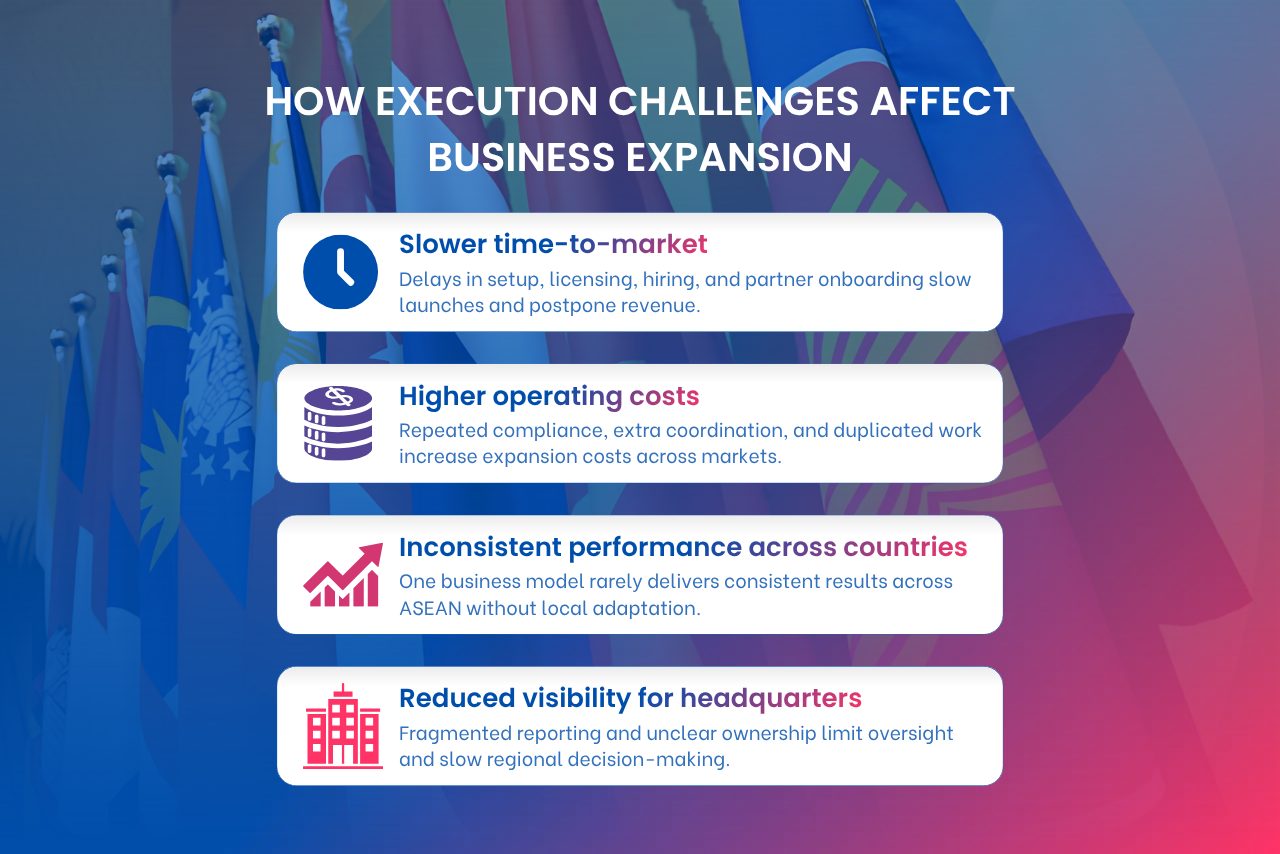
Execution challenges increase costs, delay growth, and reduce operational visibility across multiple ASEAN markets.
What Global Companies Should Do Before Expanding Across ASEAN
Successful ASEAN expansion depends on how effectively businesses translate regional strategies into local execution. This requires clear country-level planning, the right balance between standardization and flexibility, and strong local support.
Build country-level execution plans, not only regional strategy
A regional strategy shows where a business wants to grow, but execution planning defines how that growth will happen in each market. Before entering a new ASEAN country, businesses should evaluate both opportunities and operational readiness.
Key areas to assess include:
- Resource requirements: Local teams, partners, and operational capabilities
- Implementation timelines: Setup, hiring, licensing, and launch milestones
- Execution risks: Regulatory, commercial, and operational challenges
- Capability gaps: Areas requiring local support or additional investment
By aligning commercial goals with country-level execution plans, businesses can reduce uncertainty and create a more practical path for regional expansion.
Decide what should be regional and what must be local
Successful ASEAN expansion requires businesses to find the right balance between regional consistency and local flexibility. A single operating model rarely works across countries with different regulations, customer expectations, and business environments.
Businesses should standardize:
- Governance and reporting: Ensure consistent performance tracking and decision-making.
- Corporate standards: Maintain common policies, compliance requirements, and strategic direction.
Meanwhile, local teams should adapt execution in areas such as:
- Sales and customer engagement
- Partner management
- Recruitment and operations
- Market-specific activities
Validate partners and operating models early
Before scaling across ASEAN, businesses should validate whether their operating model can work effectively in each target market. Early testing helps identify gaps in partners, processes, and market assumptions before they become costly issues.
Key areas to evaluate include:
- Distributor capability: Assess partner networks, market reach, and ability to support sales execution.
- Supplier reliability: Review production capacity, quality standards, and long-term supply consistency.
- Local HR and employment setup: Confirm recruitment availability, employment requirements, and operational readiness.
- Logistics feasibility: Evaluate transportation, customs processes, and supply chain efficiency.
- Customer response: Test demand, pricing acceptance, and customer expectations before full market entry.
By validating these factors through pilot projects or phased launches, businesses can reduce execution risks and build a stronger foundation for ASEAN expansion.
Work with local execution partners
Managing ASEAN expansion from headquarters alone can be challenging because many execution decisions depend on local market conditions. Local execution partners help bridge the gap between regional strategy and on-the-ground implementation through:
- Regulatory support for company setup, compliance, and local administrative requirements.
- Talent and operational setup through recruitment, EOR, and local team development.
- Partner and supplier identification to build reliable business connections.
- Market coordination for project follow-up, stakeholder communication, and daily execution support.
With local expertise and market presence, businesses can execute expansion plans more efficiently while reducing coordination challenges across ASEAN.
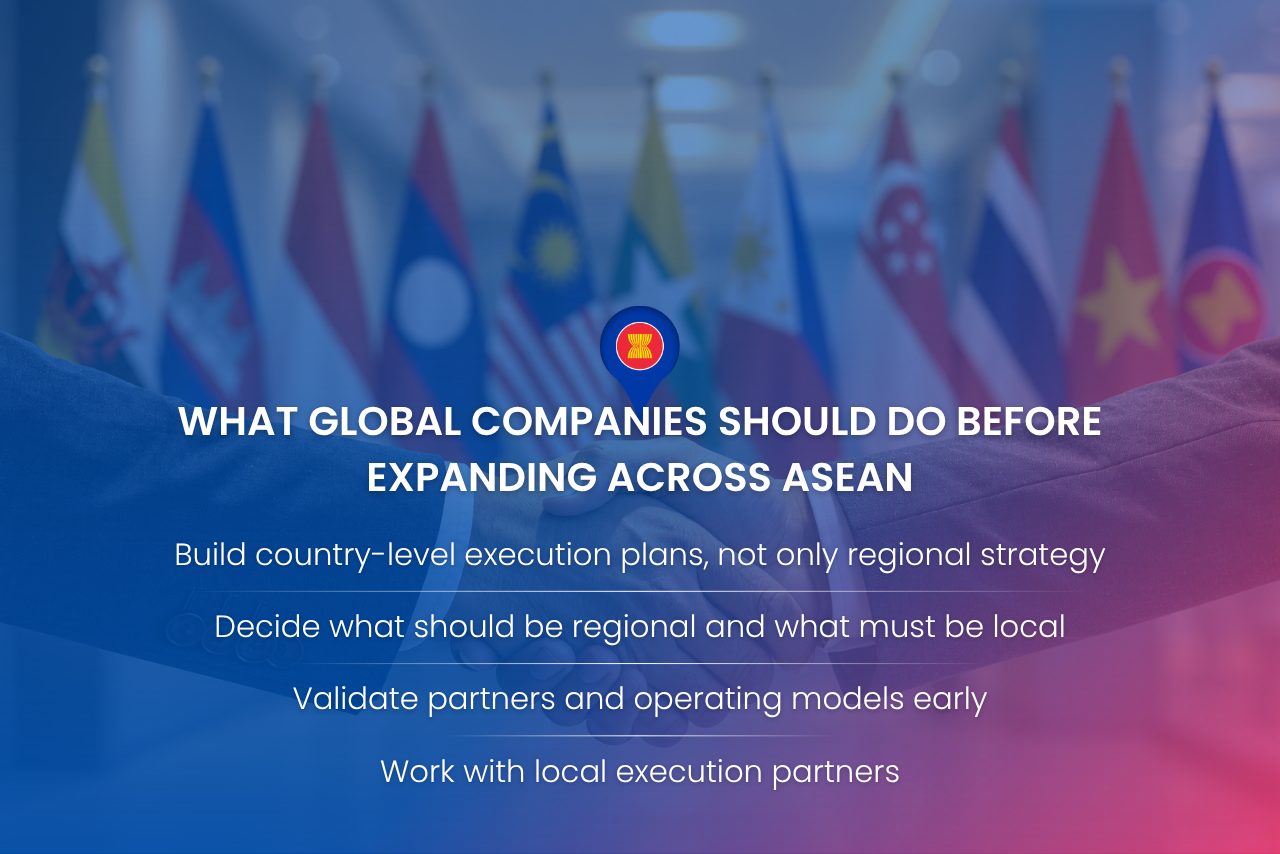
Country-level planning and local execution capabilities strengthen regional expansion across ASEAN.
Final Considerations
ASEAN expansion does not fail because market opportunities are weak. It often fails because businesses underestimate the execution challenges behind operating across multiple countries. Differences in regulations, business practices, customer behavior, talent availability, and local capabilities mean that a regional strategy alone is not enough. Instead, businesses need country-level execution plans that reflect local conditions while supporting a shared regional direction.
At Source of Asia, we support businesses throughout every stage of their Southeast Asia expansion journey through:
- Market entry and country comparison
- Company incorporation and regulatory coordination
- Employer of Record and recruitment
- Distributor, supplier, and partner search
- Sourcing and supply chain coordination
- On-the-ground operational support across Southeast Asia
| 👉 Facing execution challenges during ASEAN expansion? Contact our experts to develop a country-level expansion approach. |
Frequently Asked Questions
The biggest execution challenge is adapting a regional strategy to different country-level conditions. Businesses must manage variations in regulations, operating environments, customer behavior, talent availability, and local partnerships while maintaining consistent regional objectives.
A fully standardized operating model rarely works across ASEAN markets. Businesses should maintain consistency in governance and strategic direction while allowing local teams to adapt execution based on market-specific requirements.
Local adaptation helps businesses respond effectively to differences in regulations, customer expectations, business practices, and market conditions. It enables smoother execution, reduces operational risks, and supports more sustainable expansion across ASEAN.