Introduction
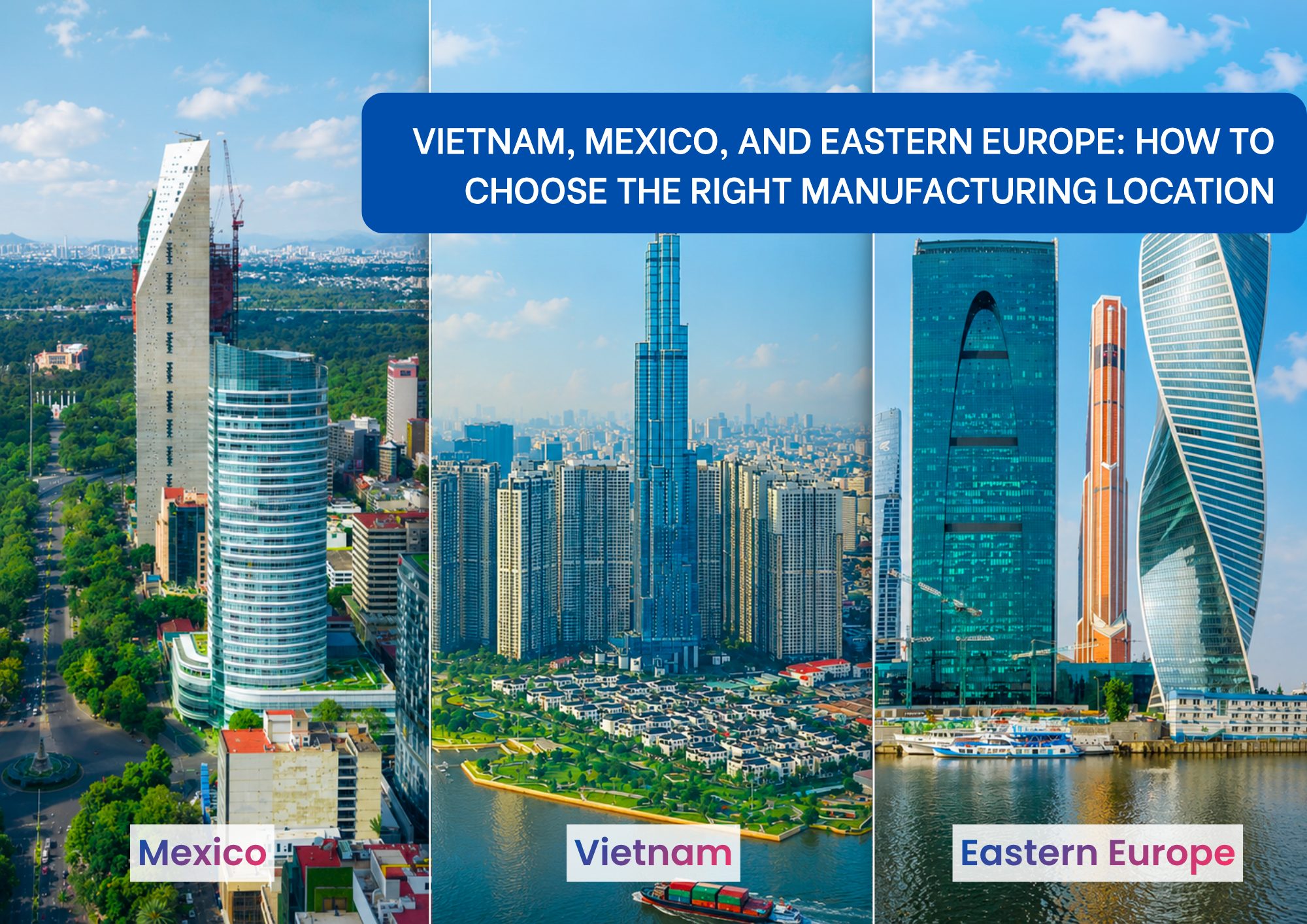
Choosing the right manufacturing location is becoming more strategic as global manufacturing moves beyond low-cost sourcing, and companies place greater weight on resilience, market access, and supply chain stability. Vietnam, Mexico, and Eastern European countries are all strong manufacturing options, but they serve different strategic needs.
Vietnam is best suited for companies pursuing China+1 diversification while staying close to Asian supply networks. Mexico is stronger for US-focused nearshoring, where proximity, lead time, and North American trade integration matter most. Eastern European countries are more relevant for companies that need access to European industrial value chains, technical capabilities, and proximity to EU customers.
The article below breaks down each model, and the key criteria you should assess before choosing a manufacturing location.
Key Insights
- Vietnam, Mexico, and Eastern Europe should not be compared based on manufacturing cost alone.
- Vietnam is best understood as a China + 1 and Asia diversification option.
- Mexico is strongest when production needs to serve the US or broader North American market.
- Eastern Europe is relevant for companies that need proximity to European customers, technical capabilities, and integration into EU value chains.
- The right choice depends on the target market, supply-chain dependencies, supplier depth, trade access, and total cost of ownership.
- Many companies may benefit from a multi-location strategy rather than replacing one manufacturing location with another.
 Add Source of Asia as a preferred source on Google
How Global Companies Are Rethinking Manufacturing Location Strategy
For many years, manufacturing location decisions were largely driven by production costs, particularly labor and operating expenses. Companies often prioritized locations that could deliver the lowest cost of production.
Today, companies take a broader view of manufacturing location strategy. They assess supply-chain resilience, logistics, trade exposure, workforce availability, infrastructure, and proximity to end markets before choosing where to produce.
For example, Vietnam has benefited from supply-chain diversification beyond China, while Mexico has gained from US-focused nearshoring. Eastern European countries remain closely connected to European industrial value chains, particularly in automotive, electronics, and other advanced manufacturing sectors.
As a result, choosing a manufacturing location is less about finding one universally “best” country. It is about matching production to target markets, supplier networks, and the supply-chain model your business needs.
| 👉 Read more: ASEAN’s role in global supply chain rebalancing to understand how these shifts are reshaping Southeast Asia. |
Vietnam Manufacturing (main SEA reference point): The China + 1 Model
Vietnam’s role as a China + 1 manufacturing location is shaped by its export base, supplier connections, and ability to support gradual strategic production diversification within Southeast Asia manufacturing.
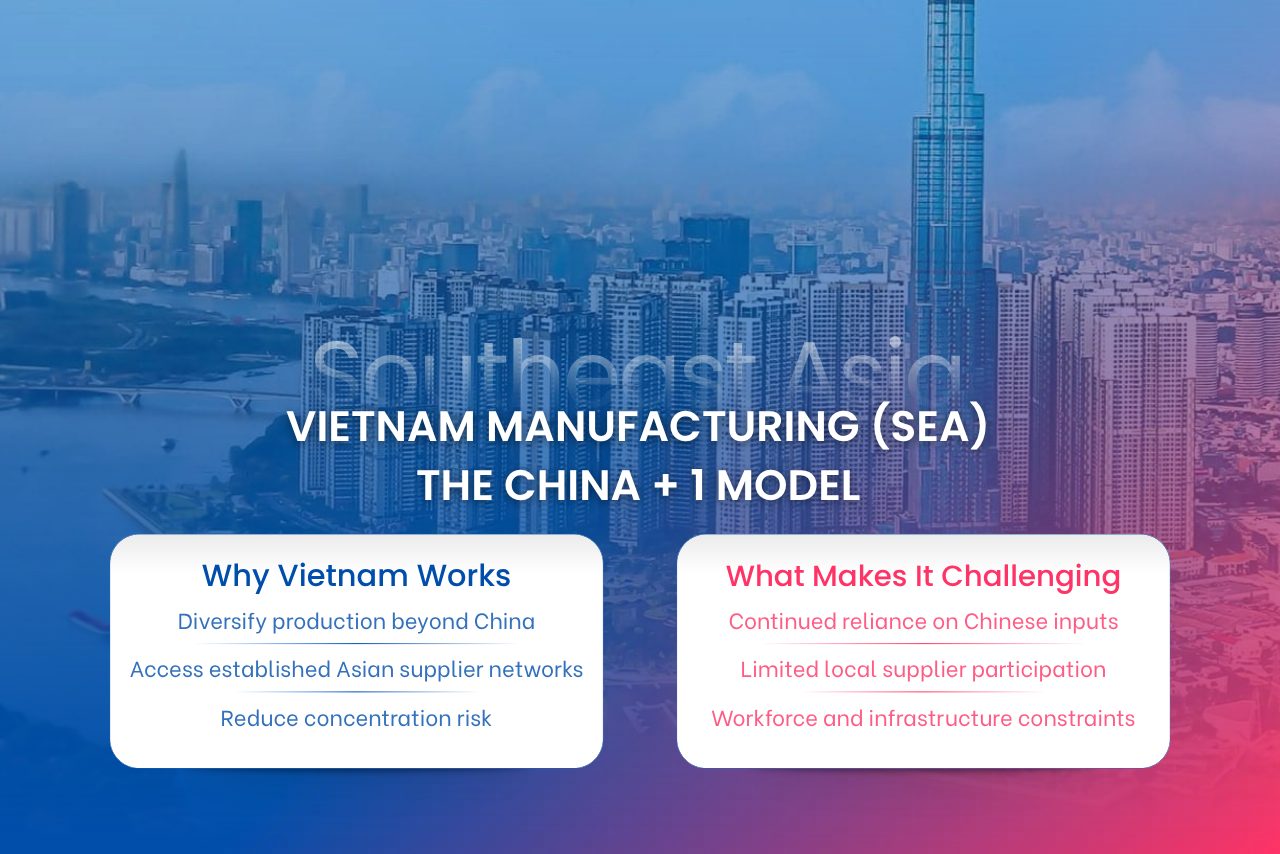
Vietnam: China + 1 manufacturing model supported by proximity to China and growing Asian supply networks.
How Vietnam became a major China+1 manufacturing destination
Vietnam has become a major manufacturing base for companies diversifying production across Asia. Its manufacturing sector covers electronics, machinery, apparel, furniture, and other export-oriented industries. According to preliminary data released by the General Statistics Office of Vietnam, goods exports reached approximately $475 billion in 2025, up 17% from the previous year.
Vietnam’s appeal extends beyond production costs. Its proximity to China allows companies to remain connected to established supplier networks while adding production capacity in Southeast Asia. This makes Vietnam a practical China + 1 option for companies seeking greater supply-chain diversification without immediately rebuilding their entire Asian manufacturing network.
Why companies are adding Vietnam to their China footprint
Vietnam allows companies to diversify production while staying connected to China’s established supplier and manufacturing ecosystem. This helps reduce concentration risk without requiring an immediate rebuild of the wider Asian supply chain. Key benefits include:
- Production diversification enables companies to add capacity, selected product lines, or final assembly in Vietnam while maintaining existing China operations.
- Supplier access allows companies to continue sourcing components, materials, and machinery from established China-based suppliers where local alternatives are not yet suitable.
- Risk diversification reduces dependence on one production base while creating a more flexible manufacturing footprint across Asia.
What makes China + 1 harder to execute in Vietnam
China + 1 does not automatically mean China-independent sourcing. In practice, companies may still rely on Chinese components, machinery, and suppliers, particularly when local alternatives are limited.
Vietnam’s manufacturing growth also remains strongly driven by foreign-invested companies. A few key factors make deeper localization more difficult:
- Limited local participation in global supply chains, which fell from 35% in 2009 to 18% in 2023.
- High FDI dependence, with foreign-invested enterprises, including crude oil, accounting for 77.3% of Vietnam’s total goods export turnover in 2025, according to Vietnam’s National Statistics Office.
- Supplier qualification and localization become more important when companies move beyond assembly and seek greater local sourcing.
- Workforce development and infrastructure also need to keep pace as production becomes more complex and volumes increase.
Mexico Manufacturing (LATAM): The US Nearshoring Model
Mexico’s nearshoring model is driven by its strong US market integration, geographic proximity, and cross-border manufacturing networks, while infrastructure and trade conditions remain important considerations.
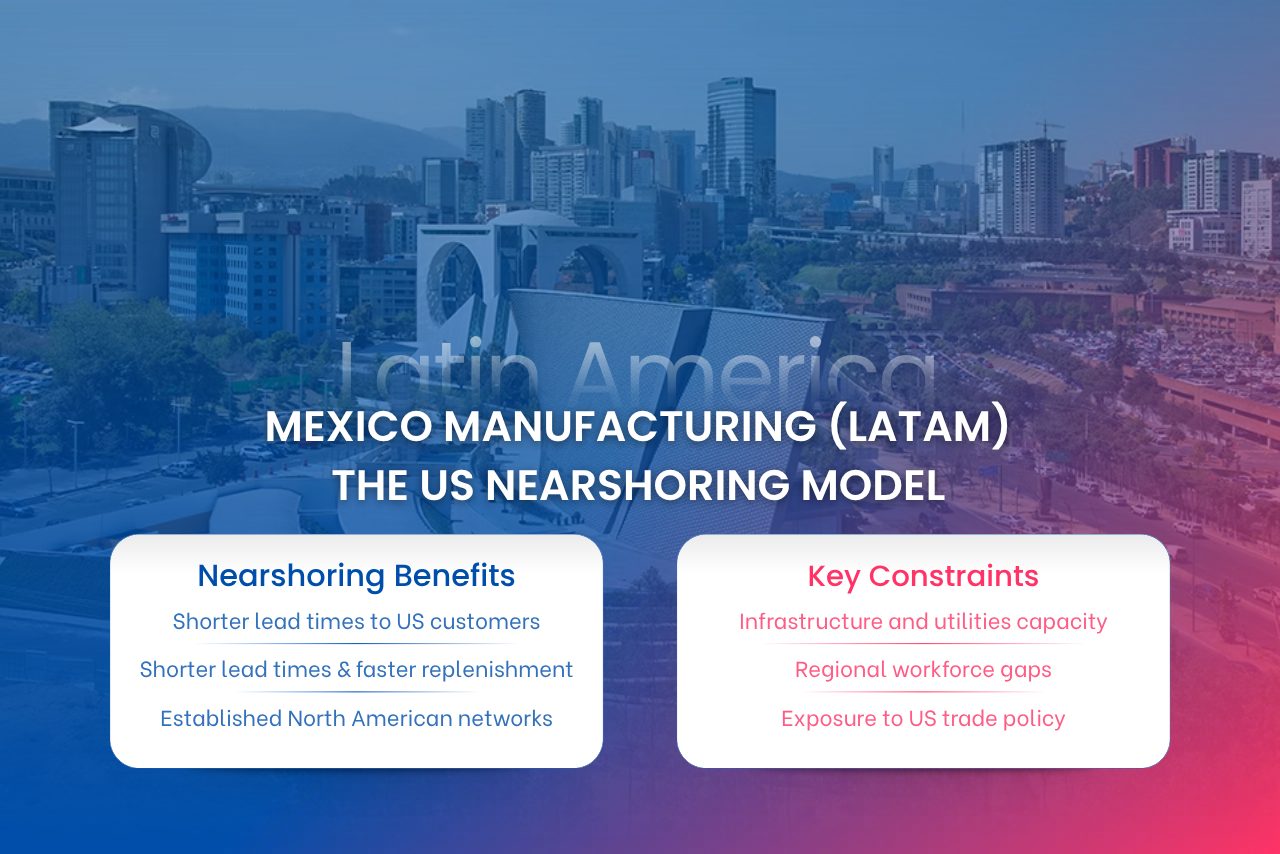
Mexico: US nearshoring model supported by geographic proximity and established North American manufacturing networks.
Why Mexico’s manufacturing base is tied to the US
Mexico’s manufacturing base is closely integrated with the US market. In 2024, more than 80% of Mexico’s goods exports went to the US, while automotive, electronics, medical devices, machinery, and textiles remain important cross-border industries.
Several factors reinforce this integration:
- Strong US market dependence makes Mexico key for North American customers.
- Established production networks link Mexican manufacturers with US suppliers and industrial clusters.
- USMCA, known as T-MEC in Mexico, enables tariff preferences and regional trade benefits.
- Geographic proximity allows production closer to US demand and shorter supply routes.
This makes Mexico particularly relevant for companies building a US-focused manufacturing or North American nearshoring strategy.
What US proximity gives manufacturers
Mexico’s main advantage is its geographic proximity to the US market. For US-focused production, this creates several practical benefits:
- Shorter lead times and faster replenishment for US customers, particularly when demand changes quickly
- Lower reliance on long trans-Pacific shipping routes, helping companies build more responsive supply chains
- Established cross-border manufacturing networks that combine Mexico’s proximity with competitive labor costs
For companies serving the US market, these advantages can make Mexico a stronger fit than a lower-cost manufacturing location farther from the target market.
Where Mexico’s nearshoring advantage can fall short
Mexico’s proximity to the US creates a strong nearshoring case, but geographic proximity alone does not guarantee that a location can support manufacturing expansion.
Several constraints can affect the business case:
- Infrastructure capacity: Roads, ports, industrial facilities, and logistics infrastructure may not keep pace with rising manufacturing demand in some regions.
- Utilities availability: Electricity and water supply can limit expansion, particularly in industrial areas where demand is increasing.
- Workforce capabilities: Manufacturers may face gaps in skilled labor and technical capabilities, depending on the sector and location.
- Trade policy exposure: Changes in US trade policy can affect the long-term cost and competitiveness of Mexico-based production.
Eastern Europe Manufacturing: The EU-Integrated Model
Eastern Europe* offers a different manufacturing model, combining access to European markets with established industrial networks, while requiring companies to balance higher operating requirements against strategic advantages.
(*In this article, Eastern Europe refers mainly to Central and Eastern European manufacturing locations linked to European industrial value chains, not a single unified market.)
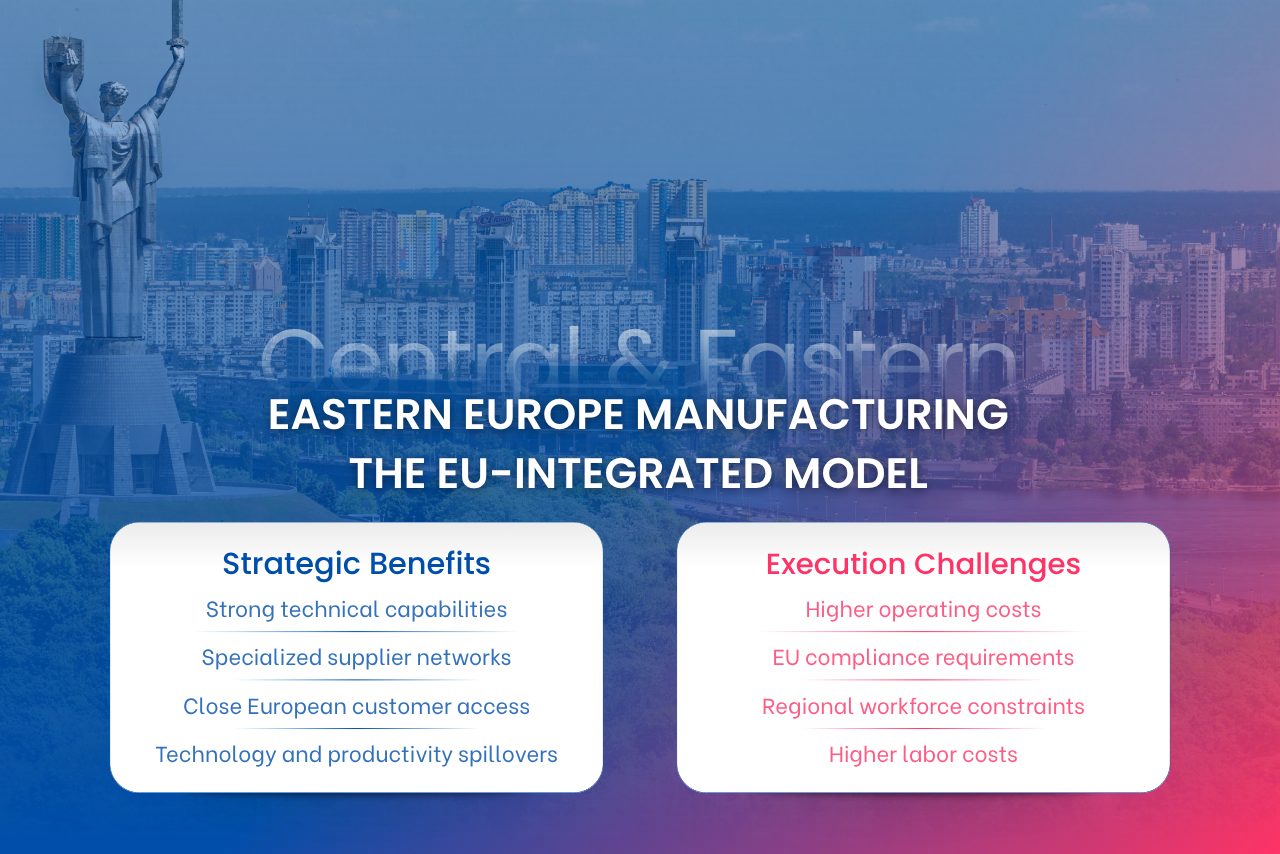
Eastern Europe: EU-integrated manufacturing model supported by technical capabilities and established European industrial networks.
How Eastern Europe connects to European industry
Eastern European manufacturing remains closely integrated with European industrial value chains, particularly in automotive, electronics, chemicals, and industrial components. Established supplier networks and cross-border production allow companies to serve customers across multiple European markets while staying connected to major industrial clusters.
This integration is supported by EU standards, infrastructure, and cross-border networks, especially in EU member states. As a result, the region’s manufacturing appeal is increasingly linked to supplier connectivity, technical capabilities, and proximity to European customers. Its strategic value therefore extends beyond lower labor costs and reflects its broader role within European production networks.
Why companies look beyond low manufacturing costs
Companies increasingly look beyond labor costs when manufacturing requires technical capabilities, skilled workers, specialized suppliers, and customer proximity. These factors are particularly important for automotive, electronics, machinery, and other higher-value industries.
Central and Eastern European manufacturers also benefit from established links with Western European partners. Through these networks, companies can gain productivity improvements, technology transfer, and process expertise while staying close to major industrial customers.
As a result, Eastern Europe can offer a stronger fit for technically demanding manufacturing, where quality, engineering support, and supplier capabilities often matter more than the lowest production cost.
What companies pay for European integration
European integration offers important manufacturing advantages, but it also comes with higher operating requirements that companies need to factor into their location decisions.
- Higher labor and operating costs: Manufacturing costs are generally higher than in many Asian production locations, particularly for labor-intensive industries.
- Compliance requirements: Companies need to meet EU regulations covering product standards, labor practices, environmental requirements, and reporting obligations.
- Labor availability: Workforce availability and wage pressure differ across Central and Eastern European markets, making location-specific assessment important.
However, the trade-off is higher operating costs in exchange for stronger access to European customers, established industrial ecosystems, and integration with EU supply chains.
Vietnam vs Mexico vs Eastern Europe: Key Structural Differences
Vietnam, Mexico, and Eastern Europe each support different manufacturing strategies and market needs. Therefore, the table below compares their core models, supply-chain advantages, workforce positioning, and key constraints to help companies assess which location best fits their expansion plans.
| Factor | Vietnam | Mexico | Eastern European countries |
|---|---|---|---|
| Core model | China + 1 diversification | US nearshoring | EU-integrated manufacturing |
| Primary market | Asia and global exports | US and North America | Europe and EU value chains |
| Main strategic value | Diversify beyond China | Move production closer to US demand | Integrate with European industry |
| Supply-chain logic | Complement China-based supply chains | Build within North American networks | Connect across European value chains |
| Supplier ecosystem | Growing, but local depth varies | Strong US-linked manufacturing base | Established industrial clusters in key markets |
| Trade integration | CPTPP, RCEP, EVFTA | USMCA, known as T-MEC in Mexico | EU single market* |
| Logistics advantage | Strong Asian connectivity | Short US transit and cross-border access | Proximity to European markets |
| Workforce positioning | Large manufacturing workforce; skills upgrading needed | Competitive manufacturing workforce; regional gaps remain | Strong technical capabilities; higher labor costs |
| Key constraint | Imported inputs and supplier depth | Infrastructure, utilities, and trade-policy exposure | Higher operating and compliance costs |
| Best fit | China + 1 diversification | US-focused manufacturing | European market expansion |
*EU single market applies to EU member economies; Eastern Europe should not be treated as a single regulatory market.
Manufacturing Location Decision Framework: Which Model Fits Your Strategy
Every manufacturing expansion has different priorities. The right location depends on your target market, supply-chain needs, product complexity, and how you plan to scale operations over time.
Manufacturing location decision framework
Before choosing between Vietnam, Mexico, or Eastern Europe, you should compare each location against the same decision criteria. This below table helps avoid choosing a market based only on labor cost or headline attractiveness, and gives leadership a clearer view of supply-chain fit, execution risk, and long-term scalability.
| Decision criteria | Question | Why it matters |
|---|---|---|
| Target market | Which end market are you serving? | The target market determines whether proximity, export capacity, or regional integration matters most. |
| Supply-chain dependency | Which inputs or production steps are difficult to move? | Some locations may look attractive but still depend heavily on existing suppliers, components, machinery, or technical processes elsewhere. |
| Product complexity | How technically demanding is the product? | More complex products require stronger skills, engineering support, quality control, testing capacity, and compliance readiness. |
| Trade access | Which trade agreements support the business case? | Trade agreements can affect tariffs, rules of origin, market access, and landed cost. |
| Total cost of ownership | What is the real cost beyond labor? | Labor cost alone can be misleading if logistics, duties, compliance, energy, or quality control costs are high. |
| Scalability | Can the location support future growth? | A location may work for pilot production but become harder to scale if infrastructure, labor, or supplier capacity is limited. |
| Execution readiness | Can the company manage the location in practice? | Even a strong location can fail without local follow-up, supplier qualification, quality supervision, and operational coordination. |
Choose Vietnam when
Vietnam works well when China + 1 diversification is the priority. It allows companies to reduce concentration risk while staying close to China-linked supply chains and established Asian production networks.
Consider Vietnam when the company:
- Reduces reliance on China while maintaining access to its supplier ecosystem.
- Produces goods that fit Vietnam’s and ASEAN’s manufacturing capabilities.
- Accesses to established Asian suppliers and production networks.
- Accepts longer transit times to Western markets.
- Diversifies production without fully replacing its China operations.
Choose Mexico when
Mexico works well when US or North American market access is the priority. Its proximity to the US supports shorter lead times and stronger integration with regional supply chains.
Choose Mexico if the company:
- Primarily serves the US or North American market.
- Needs shorter lead times and faster replenishment.
- Benefits from proximity to US customers and suppliers.
- Meets USMCA/T-MEC rules of origin.
- Is prepared to meet North American trade and operational requirements.
Choose Eastern Europe when
Eastern Europe works well when European market access and supply-chain integration are the priority. Its value is stronger when production requires technical capabilities, established industrial clusters, and close customer coordination.
Consider Eastern Europe when the company:
- Primarily serves European markets
- Needs access to technical capabilities and established manufacturing clusters
- Values EU supply-chain integration despite higher operating costs
- Needs proximity to European customers, engineering teams, or industrial buyers
- Requires strong compliance, quality, and technical standards
Consider multiple locations when
A single manufacturing base may not be enough when your business serves different markets or relies on regional supplier ecosystems. A multi-location model can help balance cost, proximity, and resilience across the supply chain.
Consider multiple locations when:
- One region cannot efficiently serve all key markets.
- Different production stages benefit from different regional strengths.
- Customers are distributed across Asia, North America, and Europe.
- Supplier ecosystems remain regional even after production is diversified.
- Lower concentration risk justifies the added coordination required.
For example, a company may maintain China while adding Vietnam, or combine Mexico with Asian production to serve different customer markets more efficiently.
Final Considerations
Manufacturing location strategy is not simply about finding the lowest-cost country. Instead, the right choice depends on target markets, supplier networks, trade access, total cost, and long-term scalability. At Source of Asia, we support companies evaluating Vietnam and Southeast Asia opportunities through our Sourcing Services. Our experts provide:
- Supplier identification
- Manufacturing market assessment
- Sourcing strategy
- Local partner search
- Supply chain relocation planning
| 👉 Speak with our team to discuss the right location and operating model for your business. |
Frequently Asked Questions
China + 1 means adding a second manufacturing location alongside China to reduce concentration risk. Vietnam is a common option because it remains connected to Asian supplier networks while providing additional production capacity.
Mexico combines geographic proximity to the US with established cross-border manufacturing networks. Its location supports shorter lead times, faster replenishment, and closer coordination for companies serving the North American market.
Eastern Europe offers proximity to European customers, established industrial clusters, skilled labor, and technical capabilities. Its value is strongest for companies that prioritize European supply-chain integration and higher-value manufacturing over the lowest labor costs.
There is no universally best manufacturing location. The right choice depends on your target market, supplier dependencies, product complexity, trade access, total cost of ownership, infrastructure, and long-term scalability.
Not always. A multi-location strategy can improve resilience when customers and suppliers are spread across regions or when different production stages benefit from different locations. The decision should reflect supply-chain needs and the cost of added coordination.