Introduction
Supplier diversification is becoming a practical option for companies looking to reduce reliance on China and build a more resilient sourcing base. However, moving production is not simply about finding a lower-cost country. Supplier depth, component availability, quality systems, certifications, and export readiness can vary significantly across Asia sourcing markets.
Vietnam may suit China+1 manufacturing, while Malaysia is stronger for technical and quality-sensitive products. Thailand offers mature industrial networks, and Indonesia can be relevant for furniture and natural-material products. For companies comparing these sourcing alternatives, choosing the right market is only the first step. In this article, Source of Asia compares key sourcing markets in Asia and explains what to verify before qualifying suppliers and shifting production.
Key Insights
- Supplier diversification means building a broader supplier base, not replacing China in one move.
- Vietnam and Indonesia can be relevant for selected labor-intensive and material-driven categories, while Malaysia, Thailand, Singapore, the Philippines, and India may be stronger in specific technical, industrial, or higher-value segments depending on the product category.
- A China+1 strategy works best when product categories align with the right markets, supplier ecosystems, and capabilities.
 Add Source of Asia as a preferred source on Google
Top Markets for Supplier Diversification Beyond China
Each market has different strengths, costs, and supplier capabilities. These differences can help identify suitable sourcing alternatives for each product category before qualifying suppliers and shifting volume.
Vietnam sourcing
- Best for: China+1 assembly, furniture, textiles and apparel, footwear, and selected electronics. In particular, Vietnam has strong export-manufacturing experience in these sectors and suppliers familiar with international requirements.
- Not ideal for: Products requiring deep local component networks, specialized materials, or extensive upstream suppliers. Many manufacturers rely on imported inputs, so assembly in Vietnam may not significantly reduce China dependency.
- What to verify: Supplier capability, capacity, local content, imported components, export experience, certifications, and quality-control systems. Assess both the factory and its supporting supply chain.
- First move: Target established export categories such as furniture, apparel, footwear, and selected electronics. Compare suppliers, inspect operations, request samples, and run a pilot order before shifting significant volume.
The verdict: Vietnam is a practical Southeast Asian sourcing alternative to China for export-oriented assembly and light manufacturing, particularly for companies already sourcing similar products from China.
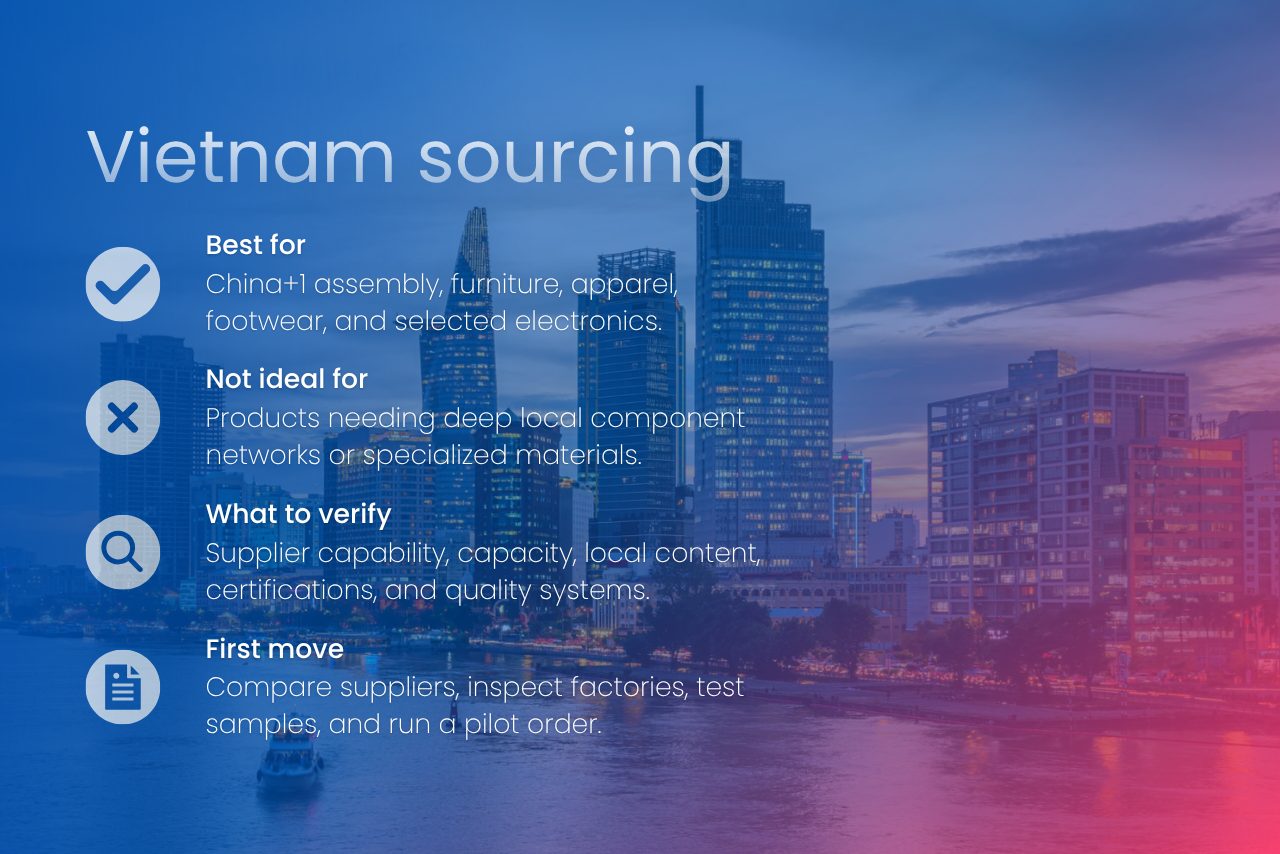
Vietnam supports China+1 sourcing for export manufacturing, including furniture, apparel, footwear, and selected electronics.
Malaysia sourcing
- Best for: Electronics and semiconductors, precision components, medical devices, machinery, and rubber and plastics. Malaysia has developed strong technical and manufacturing capabilities in these sectors.
- Not ideal for: High-volume, low-cost, labor-intensive production. Labor and operating costs are generally higher than in Vietnam or Indonesia, making Malaysia less suitable for thin-margin products where price is the main priority.
- What to verify: Supplier certifications, export documentation, production capacity, lead times, and quality-control systems. For regulated products, confirm that suppliers hold the certifications required in your target market. Check capacity early, as established suppliers may serve multiple international customers.
- First move: Begin with a technical or regulated category where quality, compliance, and capability matter more than the lowest unit cost, such as electronics, semiconductors, medical devices, or precision parts.
The verdict: Malaysia is a regional hub for semiconductors and other technical products where supplier maturity, quality, and compliance outweigh cost advantages.
| 👉 For deeper insights into Malaysia sourcing, explore the Malaysia sourcing categories buyers should consider. |
Thailand sourcing
- Best for: Automotive parts, electronics, machinery, plastics and rubber, and food processing. Thailand has one of Southeast Asia’s most established industrial supply chains, especially in automotive and industrial manufacturing.
- Not ideal for: Products where the lowest possible cost is the priority. Thailand competes more on supplier maturity, quality control, production capability, and infrastructure than on price.
- What to verify: Supplier depth, certifications, factory audit history, capacity, quality systems, and logistics performance. Exporters should assess how efficiently goods move from the factory to the port.
- First move: Start with automotive components, machinery parts, or other products supported by established local networks. Compare suppliers, review capabilities, and validate performance through samples or a pilot order.
The verdict: Thailand is a strong supplier diversification option for automotive and industrial sourcing, offering mature suppliers and dependable infrastructure for buyers who value consistency over rock-bottom pricing.
Singapore sourcing
- Best for: Advanced technology, precision engineering, specialty chemicals, medical devices, electronics, biomedical sciences, aerospace, and other high-value sourcing products. Singapore excels in R&D, quality control, regulatory compliance, and regional supply-chain coordination.
- Not ideal for: Mass manufacturing or highly cost-sensitive products. This is largely because high labor, real estate, and operating costs reduce competitiveness for low-margin goods, basic assembly, and price-driven categories.
- What to verify: Determine whether the supplier manufactures locally or manages production through facilities elsewhere in Asia. Some Singapore-based firms operate mainly as regional headquarters, engineering centers, distributors, or supply-chain coordinators.
- First move: Prioritize products where technical expertise, reliability, intellectual property protection, and consistent quality outweigh the lowest unit cost. Request certifications, production details, export experience, and partner-factory information.
The verdict: Singapore is best used as a regional hub for high-value sourcing, technical development, supplier management, and supply-chain coordination across Asia.
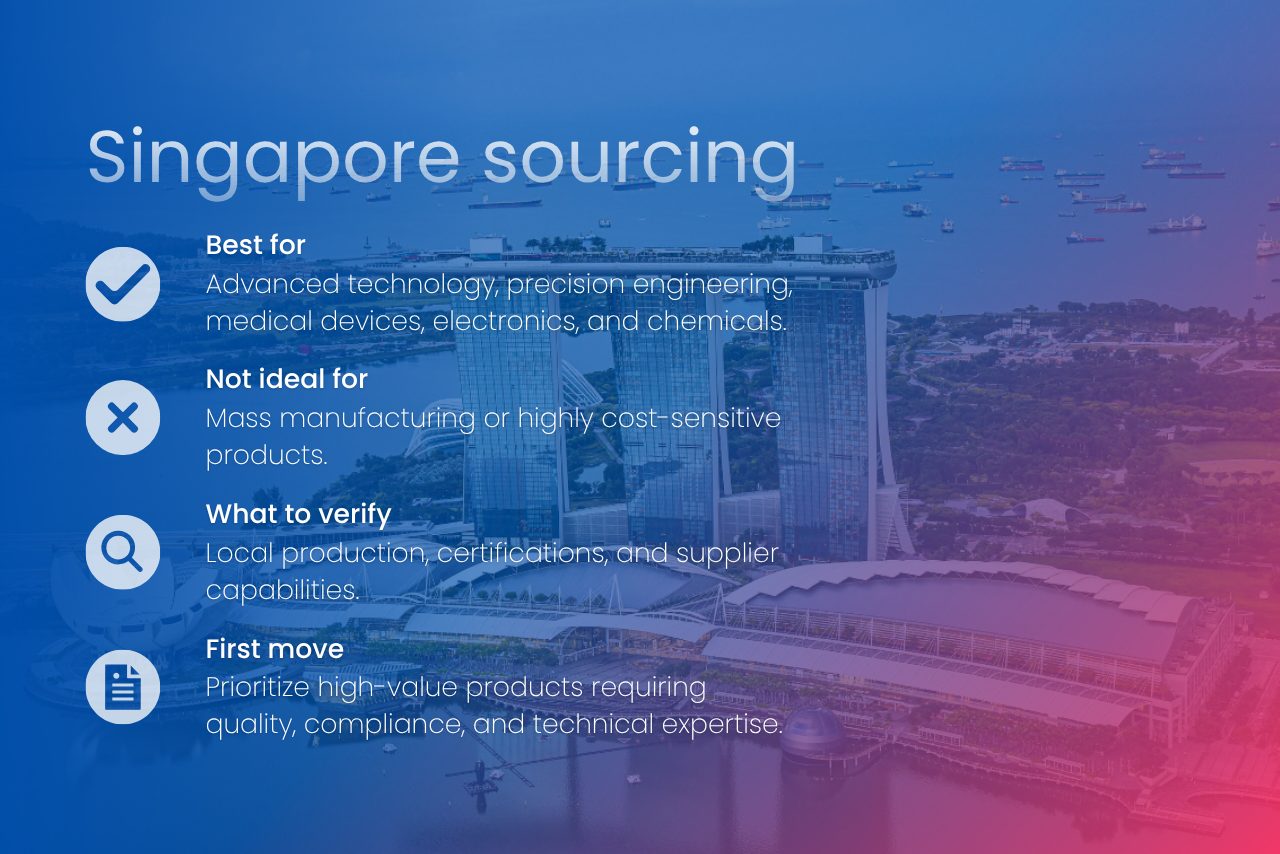
Singapore suits high-value sourcing where technical expertise, quality, compliance, and supply-chain coordination matter.
Indonesia sourcing
- Best for: Furniture, textiles and apparel, footwear, natural materials, and consumer goods. Indonesia’s workforce and resource base support labor-intensive, material-driven production.
- Not ideal for: Products that require tightly coordinated logistics from a single sourcing base. Its thousands of islands create regional differences in infrastructure, supplier capabilities, and shipping times.
- What to verify: Factory location, port access, production capacity, lead times, export experience, quality-control procedures, certifications, and references from international customers. Confirm who owns production and whether subcontracting is involved.
- First move: Explore furniture, footwear, and textiles in established clusters, especially on Java, where manufacturing and export infrastructure are strongest. Compare multiple suppliers and place a pilot order before committing substantial volume.
The verdict: Indonesia is a strong sourcing option for furniture and other labor-intensive products that benefit from local materials and a large workforce.
The Philippines sourcing
- Best for: Electronics assembly, selected components, wiring harnesses, and semiconductor testing. The Philippines has an established electronics manufacturing base, with export processing zones supporting international production.
- Not ideal for: Broad-based manufacturing outside electronics and selected niche categories. Supplier depth is more limited than in Vietnam, Malaysia, or Thailand for many product categories.
- What to verify: Check whether the supplier operates within an established export processing zone, its experience with international customers, production capacity, quality systems, and contingency plans for weather-related logistics disruptions. Also assess dependence on imported components.
- First move: Start with electronics assembly, wiring harnesses, or selected components where existing industry infrastructure and supplier experience reduce the need to build a new supply base from scratch.
The verdict: The Philippines is best used as a focused sourcing option for electronics-linked manufacturing rather than as a broad replacement for China.
India sourcing
- Best for: Textiles and apparel, pharmaceuticals, engineering goods, and electronics assembly. Reuters has reported that pharmaceuticals and mobile phones have been among India’s stronger-performing manufacturing sectors, highlighting the country’s potential in select categories.
- Not ideal for: Buyers that need fast supplier onboarding or highly predictable factory-to-port logistics. Infrastructure, documentation, and lead times can vary significantly by region and supplier.
- What to verify: Supplier maturity in the specific state or industrial cluster, export documentation, production capacity, quality systems, and realistic factory-to-port lead times. Regional differences can directly affect cost and delivery.
- First move: Start with a category where India has established export experience, such as textiles, pharmaceuticals, or engineering products. Shortlist suppliers within the relevant industrial cluster and validate them through factory audits, samples, and a pilot order.
The verdict: India is a large-scale option for supplier diversification beyond ASEAN, suited to buyers seeking broader manufacturing capacity and prepared for longer supplier qualification.
ASEAN Country Comparison for Supplier Diversification
Instead of focusing only on labor costs, consider supplier depth, quality, logistics, certifications, and production scale. The table below compares the main ASEAN markets to help identify the most suitable sourcing alternatives for different product categories.
| ASEAN Country | Key strengths | Key constraints | Best sourcing fits |
|---|---|---|---|
| Vietnam | Competitive costs; established export-oriented manufacturing base; strong China+1 potential | Supplier depth varies by category; supporting industries remain less developed than China in some sectors | Electronics, furniture, textiles & apparel, footwear, consumer goods |
| Malaysia | Strong technical capabilities; mature supplier ecosystem; quality and compliance strengths | Higher labor and operating costs; less suitable for highly labor-intensive sourcing | Electronics & semiconductors, precision components, medical devices, machinery, rubber & plastics |
| Thailand | Mature industrial ecosystem; established supplier networks; strong infrastructure | Cost advantages vary by category; less competitive for some labor-intensive products | Automotive, electronics, machinery, plastics & rubber, food processing |
| Singapore | Strong logistics and connectivity; high-value technical ecosystem; regional sourcing hub | High labor and operating costs; limited fit for low-cost mass manufacturing | Advanced technology, precision engineering, chemicals, medical technologies |
| Indonesia | Large workforce; strong resource base; potential for labor-intensive manufacturing | Geographic fragmentation; logistics and supplier capabilities vary by region | Furniture, textiles & apparel, footwear, natural materials, consumer goods |
| The Philippines | Strong electronics and semiconductor capabilities; skilled technical workforce; established export zones | More limited supplier depth outside key industrial clusters; logistics can vary by location | Electronics, semiconductors, electrical products, selected industrial manufacturing |
You can use this table as a starting point for market comparison, not as a final sourcing decision. Country-level strengths can help narrow your shortlist, but you should always verify supplier capabilities, capacity, quality systems, and export readiness at the factory level.
How to Approach Supplier Diversification Beyond China
Choosing a new country is only the first step. Instead, a structured supplier diversification approach helps companies evaluate sourcing alternatives, qualify suppliers, and reduce operational risks.
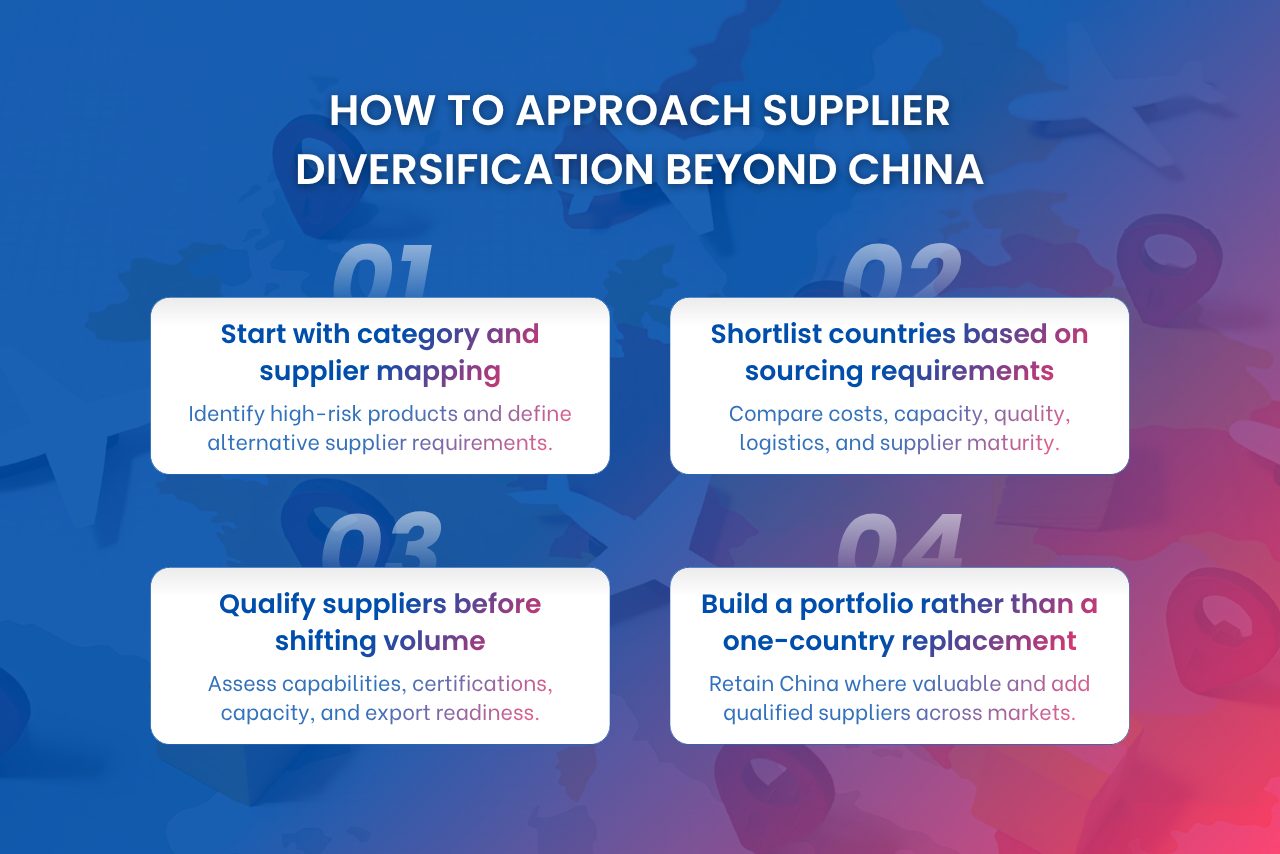
A structured approach helps companies compare markets, qualify suppliers, manage sourcing risks, and shift production with greater control.
Start with category and supplier mapping
Start by identifying which products carry the highest concentration risk. For example, this may come from dependence on one Chinese supplier, a specific region, or critical components and materials.
Map your current supply base by product category, supplier, country, production volume, lead time, tooling, certifications, and customer requirements. Then define the capabilities an alternative supplier must meet before comparing sourcing markets.
This gives your team clear diversification criteria and focuses efforts where alternative sourcing can reduce risk without introducing quality, cost, or capacity problems.
Shortlist countries based on sourcing requirements
Next, compare potential sourcing alternatives based on cost, capacity, quality, certifications, logistics, lead times, and supplier maturity. Choose the country with the strongest ecosystem for each product, not merely the most popular market.
For example, Vietnam may suit furniture and apparel, Malaysia technical electronics, Thailand automotive components, Singapore advanced manufacturing, and Indonesia natural-material products. This category-specific approach supports better sourcing decisions than relying on one country for your entire portfolio.
Qualify suppliers before shifting volume
After shortlisting suppliers, confirm that they can meet your product, quality, and volume requirements. Location or country reputation alone is insufficient. In addition, review their production capabilities, equipment, quality systems, certifications, export experience, available capacity, and subcontracting practices.
Test samples and place a controlled pilot order before transferring significant volume. This process reveals capacity, quality, and delivery risks early, helping you determine whether a supplier is suitable for long-term production.
Build a portfolio rather than a one-country replacement
The final objective is to build a balanced supplier portfolio, not replace China with another single-sourcing market. Therefore, retain Chinese suppliers where their supplier depth, component access, or production capabilities are difficult to replicate.
Add qualified suppliers in other markets to strengthen resilience, capacity, and commercial value. Distributing products and volumes across sourcing alternatives reduces concentration risk and provides greater flexibility when managing disruptions, capacity changes, and sourcing costs.
| 👉 Explore how ASEAN requires a different sourcing model from China. |
Final Considerations
Supplier diversification does not mean replacing China entirely. It means building a more balanced supplier base across markets that fit your product, cost, quality, and capacity requirements. Vietnam, Malaysia, Thailand, Singapore, Indonesia, the Philippines, and India each offer distinct sourcing opportunities. However, companies should verify each supplier’s capabilities before shifting production volume.
For companies looking to diversify their supplier base in Southeast Asia, Source of Asia helps:
- Compare sourcing markets and country fit
- Identify and qualify alternative suppliers
- Assess supplier capabilities and production risks
- Build a diversified sourcing strategy
Our approach helps businesses assess supplier capabilities and execution risks before making sourcing commitments. Connect with our sourcing team to explore sourcing alternatives beyond China.
Frequently Asked Questions
Supplier diversification means sourcing products, components, or materials from multiple qualified suppliers or markets instead of relying heavily on one country or supplier. It helps reduce concentration risk and improve supply continuity.
There is no single best country. Instead, Vietnam, Malaysia, Thailand, Indonesia, the Philippines, Singapore, and India suit different categories based on supplier depth, cost, quality, capacity, logistics, and product requirements.
Vietnam can be a strong China+1 option for furniture, textiles and apparel, footwear, consumer goods, and selected electronics. However, imported components and less-developed supporting industries can limit its suitability for highly integrated products.