Introduction
Managing teams across ASEAN becomes more complex as companies expand into multiple markets. Each country has different working practices, talent conditions, and business environments that can affect how teams operate and make decisions.
What works for a small team in Vietnam may not work when the team expands into Malaysia, Thailand, Indonesia, or Singapore. Without clear responsibilities, teams can duplicate work, delay decisions, and lose accountability. At the same time, a one-size-fits-all approach can limit local flexibility.
In this guide, we explain how to manage multi-country teams across ASEAN by setting clear responsibilities, aligning performance, improving communication, and balancing regional standards with local flexibility.
Key Insights
- Clear decision rights prevent duplicated work and help local teams act without unnecessary regional approvals.
- Regional standards and local flexibility should work together to reflect different labor conditions and business practices.
- Defined communication routines reduce missed information and coordination problems across countries and time zones.
- Shared KPIs with local targets make performance easier to track while accounting for market differences.
- Management structures should evolve with team size, shifting from direct oversight to regional governance and country accountability.
 Add Source of Asia as a preferred source on Google
Common Challenges When Managing Multi-country Teams
As companies grow across ASEAN, managing teams in different countries becomes more complex. For example, differences in work practices, talent conditions, communication styles, and team management expectations can affect coordination and performance.
Several challenges tend to appear as the regional team grows:
- Unclear roles and responsibilities
Regional and local teams may end up handling the same tasks, while important decisions are delayed because ownership is unclear. - Different working practices
Hiring conditions, employee expectations, working hours, and management practices differ across ASEAN. - Communication and cultural misalignment
When teams work across countries, important information can be lost or overlooked across different channels. Differences in communication styles and workplace culture can also create misunderstandings. - Inconsistent performance management
Different KPIs, reporting formats, and review systems make it harder to compare results and identify issues across markets. - Limited local flexibility
Applying the same process across every market can make local execution less responsive. In contrast, giving each country too much autonomy can also create inconsistent practices.
These challenges show why companies need a clear team management framework before scaling further across ASEAN.
To manage this complexity, companies need to move from ad hoc coordination to a more structured approach built around decision rights, communication routines, performance alignment, and local flexibility, which will be covered in the next section.
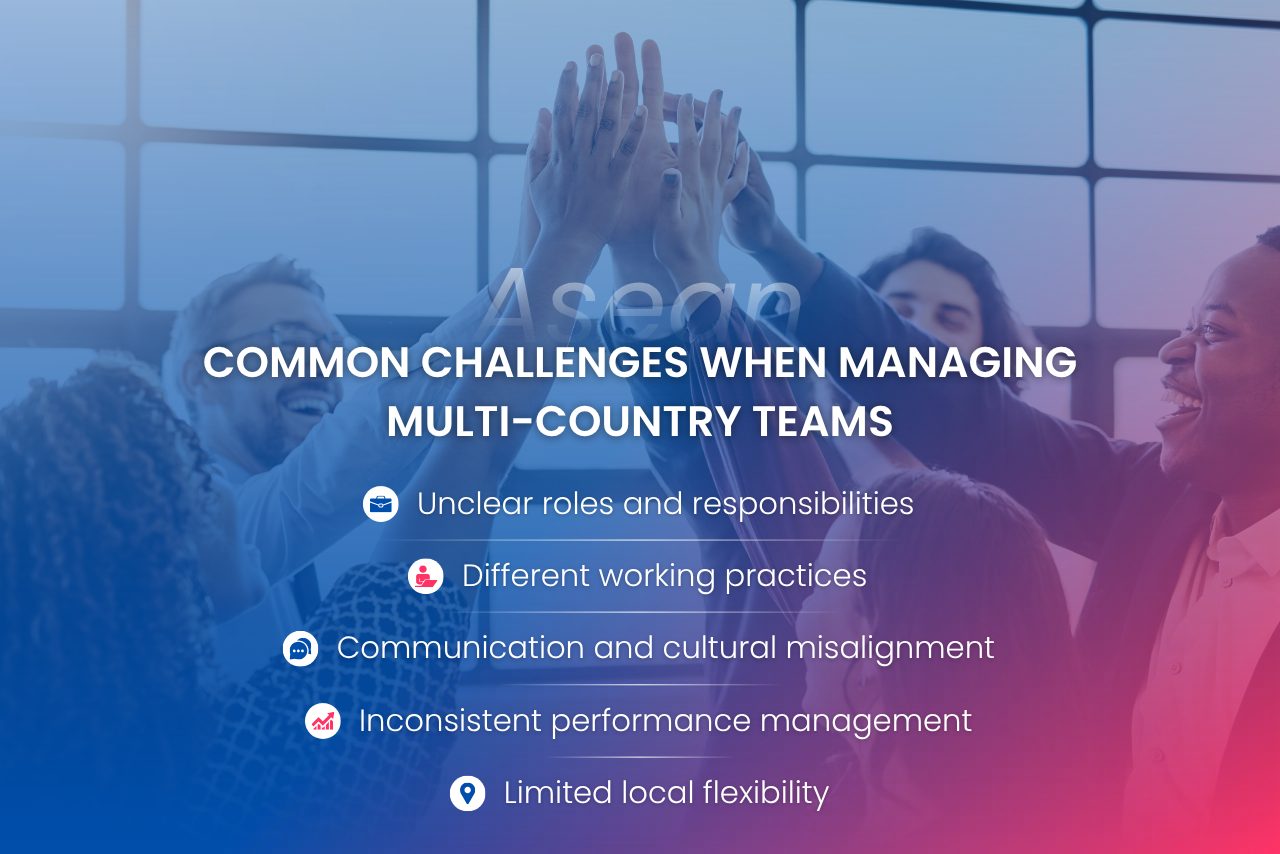
Common challenges when managing multi-country teams across ASEAN
How to Manage Multi-country and Remote Teams Across ASEAN
Managing remote teams across ASEAN requires more than regular communication. Clear responsibilities, flexible practices, and consistent performance systems help teams stay aligned as the regional footprint grows.
Define roles, decision rights, and escalation lines
Responsibilities can overlap more easily as teams expand across ASEAN. Clear ownership and decision rights help define who leads, who executes, and when an issue needs to be escalated.
Several key questions need to be answered:
- Who is responsible for regional coordination? Regional or functional leads should align priorities and coordinate work across countries.
- Who handles local execution? Country teams should manage customers, employees, suppliers, and market-specific activities.
- Who approves, executes, and escalates? Define approval levels and escalation points for each major decision.
- How do you avoid duplicated work? Assign one clear owner to each task, with supporting roles defined where needed.
- When can local managers decide independently? Set clear limits based on budget, risk, and business impact.
This structure helps prevent duplicated work and unnecessary approvals. At the same time, clear escalation lines allow local managers to act quickly without losing regional oversight.
| 👉 Read more: Local Decision-Making vs. Global Control in ASEAN Operations to understand how to balance local autonomy with regional control. |
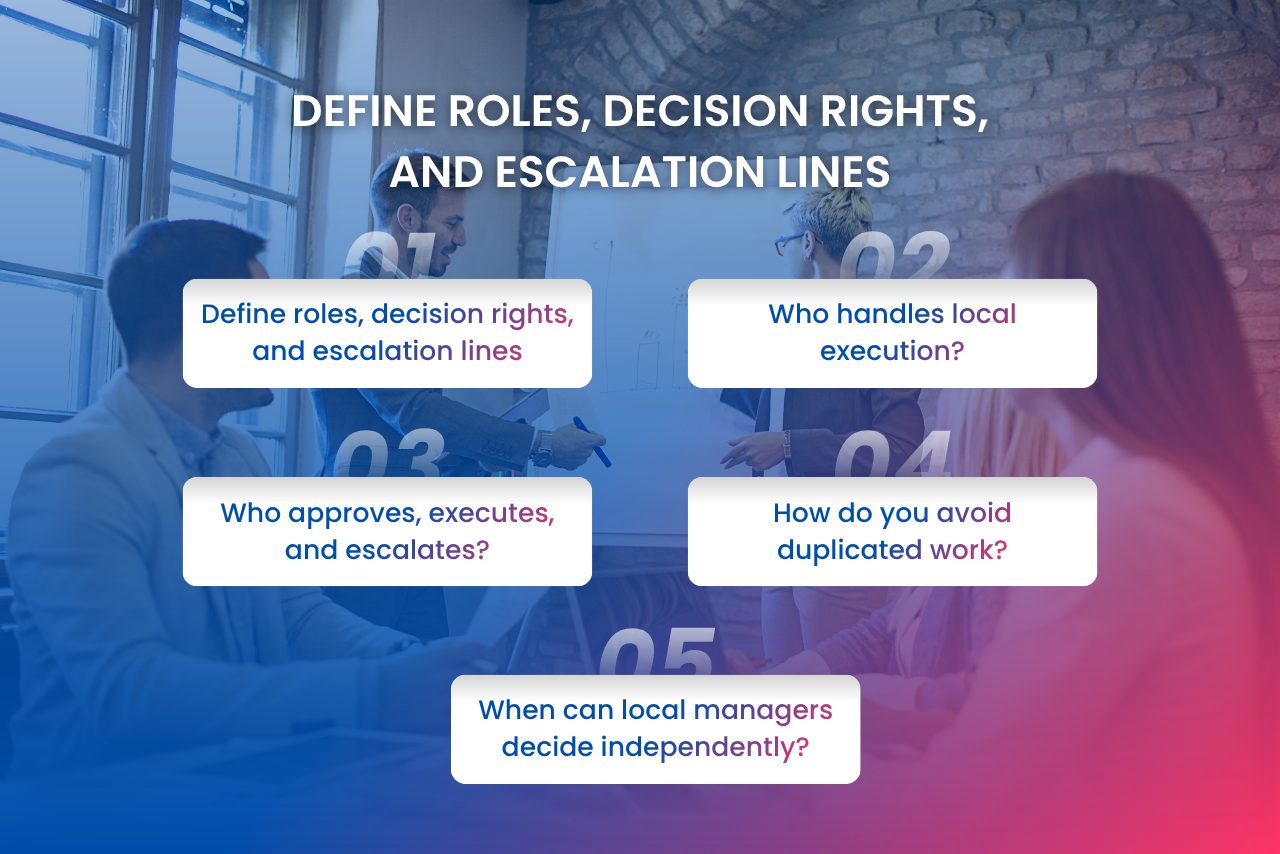
Clear decision rights define who coordinates, executes, approves, and escalates decisions across ASEAN teams.
Balance regional standards with local needs
Regional consistency helps companies manage teams across ASEAN with clearer expectations. However, local execution should not be forced into one rigid model. Labor conditions, talent availability, communication styles, and management practices can vary significantly between Vietnam, Thailand, Indonesia, Malaysia, Singapore, and other ASEAN markets.
A practical approach is to define what must remain consistent at the regional level and what can be adapted locally.
| Regional standards | Local adaptation |
|---|---|
| Company policies | Local implementation based on labor practices |
| Reporting requirements | Local reporting rhythm where needed |
| Core KPIs | Local targets based on market maturity |
| Performance review framework | Feedback style adapted to local working culture |
| Compliance requirements | Local HR and administrative execution |
| Strategic priorities | Market-level actions |
| Hiring standards | Sourcing channels adapted to each market |
For example, a company may keep the same regional KPI framework across ASEAN, such as revenue growth, lead conversion, employee retention, or service quality. However, the actual targets may need to differ between a mature market like Singapore and a newer market like Vietnam or Indonesia.
The same logic applies to recruitment. Core hiring standards can remain consistent, but sourcing channels may vary. A role that is easy to recruit through LinkedIn in one country may require local job boards, referral networks, or recruitment partners in another.
Performance reviews can also follow one regional cycle while allowing managers to adapt how feedback is delivered. This helps companies maintain fairness and consistency without ignoring local working norms. To sum up, the goal is not to choose between regional control and local flexibility. The goal is to define which decisions should be standardized and which should stay close to the market.
Build clear communication rhythms across countries
Communication structure becomes more important when managing teams across ASEAN. Team processes, reporting structures, and informal networks and communication are particularly relevant when teams operate across multiple countries.
Four practices are especially useful:
- Define ASEAN overlap hours: Set shared working windows for cross-country meetings, decision-making, and urgent alignment. This helps teams know when real-time collaboration should happen.
- Avoid unfair meeting routines: Do not make one country or team repeatedly take early morning or late evening calls. Rotate meeting times where needed, especially when working with teams outside ASEAN.
- Use asynchronous updates for non-urgent work: Project updates, weekly reports, meeting notes, and status tracking can often be shared through written updates instead of live meetings.
- Record decisions in shared documents: Important decisions should not stay only in calls or chat threads. Keep responsibilities, deadlines, next steps, and approval points in shared systems that all country teams can access.
Clear communication rhythms reduce duplicated discussions, missed information, and unnecessary meetings. They also help regional managers focus live meetings on decisions and problem-solving, rather than repeating updates that could have been shared in writing.
This is especially important for managing remote teams or virtual teams across ASEAN, where team members may not have daily face-to-face interaction. Without clear communication rules, small misunderstandings can quickly become delayed decisions, duplicated work, or accountability gaps.
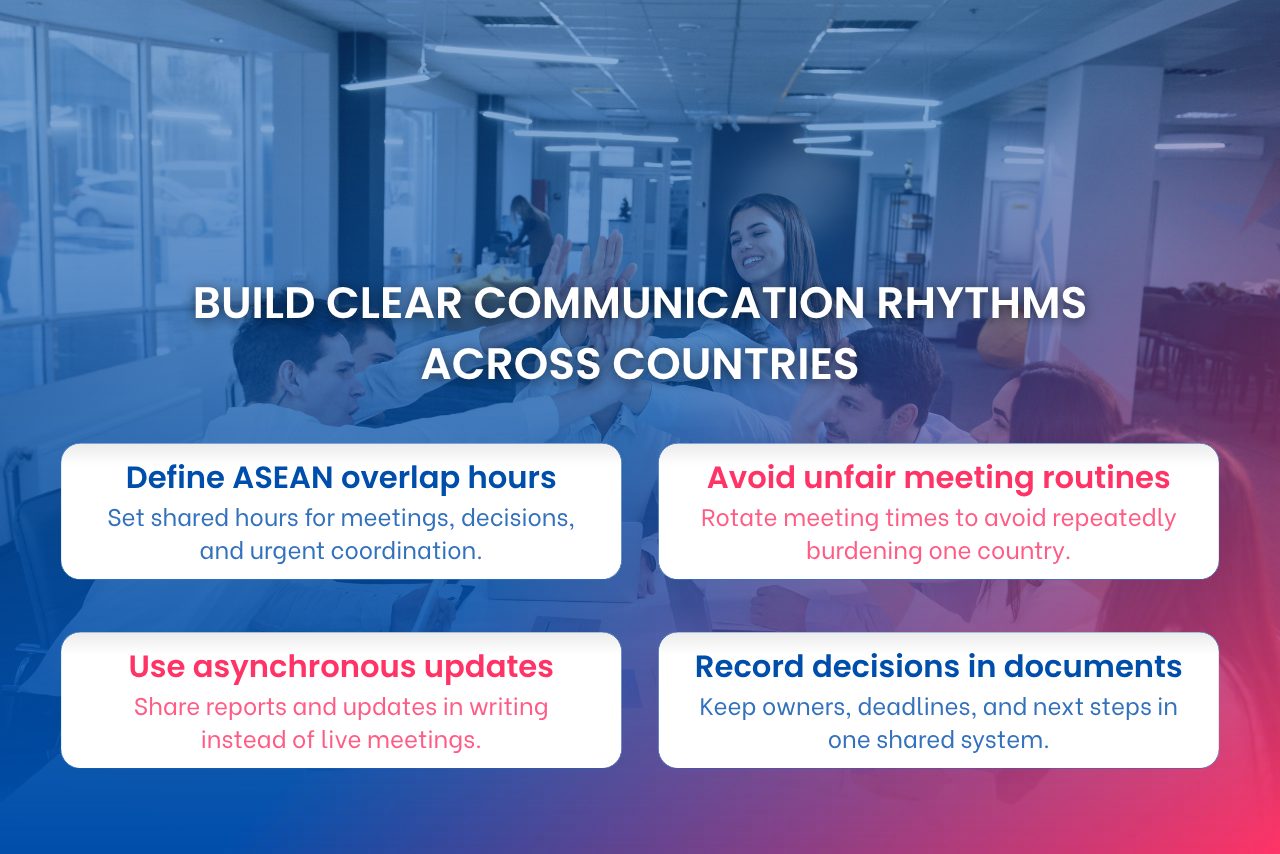
Structured communication rhythms help teams coordinate across countries, time zones, channels, and working styles.
Align KPIs, performance, and accountability
Performance management across ASEAN should create shared expectations without ignoring local conditions. The focus is not only on setting KPIs, but also on how teams measure progress and review results.
A practical approach includes:
- Set shared goals and KPIs: Define regional priorities first, then translate them into measurable indicators that each country team can track against its role and responsibilities.
- Adapt performance measures to local context: Keep core metrics consistent, but adjust targets to reflect market size, team maturity, and operating conditions.
- Establish consistent feedback and reviews: Use the same review cycle and evaluation standards, while allowing managers to consider relevant local factors when assessing results.
Strengthen cross-market collaboration as the team scales
Growing across ASEAN can make country teams increasingly focused on their own markets. As a result, knowledge may remain within individual locations, making it harder to share solutions and coordinate across countries.
To address this, regular cross-market activities can help teams share experience and solve problems together:
- Shared projects: Bring teams from different countries together to solve regional issues and share practical experience.
- Knowledge-sharing sessions: Share lessons, tools, and market knowledge that other country teams can apply.
- Cross-country working groups: Bring relevant teams together to address common functional or operational issues.
- Shared playbooks and documentation: Provide a common reference for processes that therefore require consistent execution across markets.
The management approach should also evolve with team size:
| Team stage | Management focus | Typical structure |
|---|---|---|
| Early multi-country team | Clear ownership | Direct regional oversight |
| Growing regional team | Cross-market coordination | Regional/function leads + local ownership |
| Larger ASEAN operation | Governance and autonomy | Regional governance + country accountability |
This shift reduces day-to-day management pressure and lets regional leaders focus more on coordination, governance, and regional priorities.
When should you review the ASEAN team management model?
You should review your ASEAN team management model when coordination issues start affecting execution. Warning signs include delayed decisions, duplicated work, unclear ownership, inconsistent reporting, or local managers depending too heavily on regional approval.
A review is especially useful when entering a new ASEAN market, hiring the first local employees, or scaling from a small remote team into a larger regional structure. At this stage, companies need to assess whether their operating model, HR setup, reporting rhythm, and local support are ready to scale.
Explore our insight on building a local team vs. hiring via EOR in ASEAN to compare which approach fits your first-year expansion needs.
Final Thoughts
Managing teams across ASEAN requires a clear operating framework that connects regional priorities with local execution. Defined decision rights, shared standards, structured communication, aligned KPIs, and cross-market collaboration help maintain consistency as the organization grows.
At Source of Asia, we support companies in building and managing local teams across Southeast Asia through recruitment, EOR/wage hosting, payroll, staffing, training and coaching, HR audits, and process management. Share your challenges with us, and SOA’s team will reach out to you for a detailed solution.
Frequently Asked Questions
Set clear responsibilities, shared KPIs, communication routines, and regional standards. At the same time, give local teams enough flexibility to adapt execution to their market conditions.
Common challenges include unclear responsibilities, different working practices, communication gaps, inconsistent performance management, and finding the right balance between regional consistency and local flexibility.
The structure should evolve with team size. Smaller teams may need direct regional oversight, while larger operations benefit from regional or functional leads, country accountability, and clearer governance.