
Introduction
ASEAN is increasingly managed as a multi-country operating region, but its markets do not operate in the same way. Regulations, customer behavior, talent availability, infrastructure, and business conditions can vary significantly from one country to another.
This creates a common operating challenge. Too much global control can slow local execution, while too much local autonomy can lead to fragmented operations. As the business grows, the real question is which decisions should stay global, which should be made locally, and which require both regional oversight and local input.
In this guide, Source of Asia explains how to build a balanced decision-making model for ASEAN operations, from defining decision rights and regional guardrails to reviewing the model as your business expands.
Key Insights
- ASEAN operations require both regional consistency and local responsiveness.
- Too much global control can slow execution, while too much local autonomy can create fragmented operations.
- A balanced decision-making model helps companies clarify what should stay global, what should be decided locally, and what requires both regional oversight and local input.
- Decision rights should reflect local context, business risk, regional impact, and execution accountability.
- Companies should review their ASEAN operating model as they add markets, teams, customers, or more complex functions.
 Add Source of Asia as a preferred source on Google
Why Do ASEAN Operations Need a Balanced Decision-Making Model?
ASEAN’s market differences make a single operating approach difficult to apply. Companies therefore need to balance local responsiveness with regional consistency as they expand.
Different market conditions across ASEAN
ASEAN markets differ in regulations, customer behavior, language, infrastructure, talent availability, and market maturity. These differences directly shape how businesses operate in each country, meaning a process that works efficiently in one market may need to be adapted in another.
As companies expand into more ASEAN markets, a single centralized decision-making model becomes harder to manage. What works at the regional level may not always align with local operating conditions, making it harder for HQ to maintain consistency without slowing local execution.
Explore more:
|
Balancing local responsiveness with regional consistency
Local teams need enough authority to respond to customers, partners, regulations, and operational issues without escalating every decision to HQ. Local decision-making is most effective when it supports faster responses to market-specific needs.
At the same time, local autonomy should operate within clear regional requirements. HQ should maintain oversight of areas that affect the wider ASEAN operation, including:
- Regional strategy and business priorities
- Financial governance and risk management
- Reporting and performance standards
- Brand and product requirements
- Core compliance and operating policies
The goal is to give local teams room to execute while maintaining regional consistency across the areas that matter most.
The Trade-Off Between Global Control and Local Decision-Making
Regional governance and local decision-making each serve a purpose. Both can create operational issues when taken too far. The challenge is knowing where central oversight should end, and local authority should begin.
Bottlenecks from excessive centralization
When most decisions move through HQ, regional teams may spend too much time reviewing operational matters instead of focusing on strategy, risk, and cross-market priorities. Local teams, meanwhile, may have market knowledge but limited authority to act.
Common effects include:
- Longer approval cycles for routine local issues
- Delays caused by decisions that require local context
- Less authority for country teams to resolve problems directly
- Greater workload for regional management
Excessive centralization can help companies maintain control, but it can also slow decisions that require local context. In ASEAN operations, this becomes more visible as companies manage several markets with different customers, partners, regulations, and execution conditions.
Fragmentation from excessive local autonomy
Local autonomy can help country teams respond faster to market needs. However, when autonomy is not supported by clear regional guardrails, each market may begin to operate in its own way. This can create different processes, systems, reporting practices, approval rules, or performance standards across countries.
The risk is uncontrolled variation. Without common standards, HQ may struggle to compare performance, coordinate resources, identify risks, or scale effective practices across ASEAN markets
The cost of getting the balance wrong
The impact of an unbalanced operating model goes beyond efficiency. Too much centralization can slow decisions, while excessive local autonomy can make operations harder to coordinate and control.
- Too much centralization: Slower decisions, HQ bottlenecks, weak local accountability, and missed market opportunities.
- Too much local decision-making: Fragmented processes, duplicated efforts, inconsistent reporting, weaker regional visibility.
These issues can affect accountability, customer experience, scalability, and management control. The right balance helps companies maintain regional oversight while giving local teams enough authority to respond to market needs.
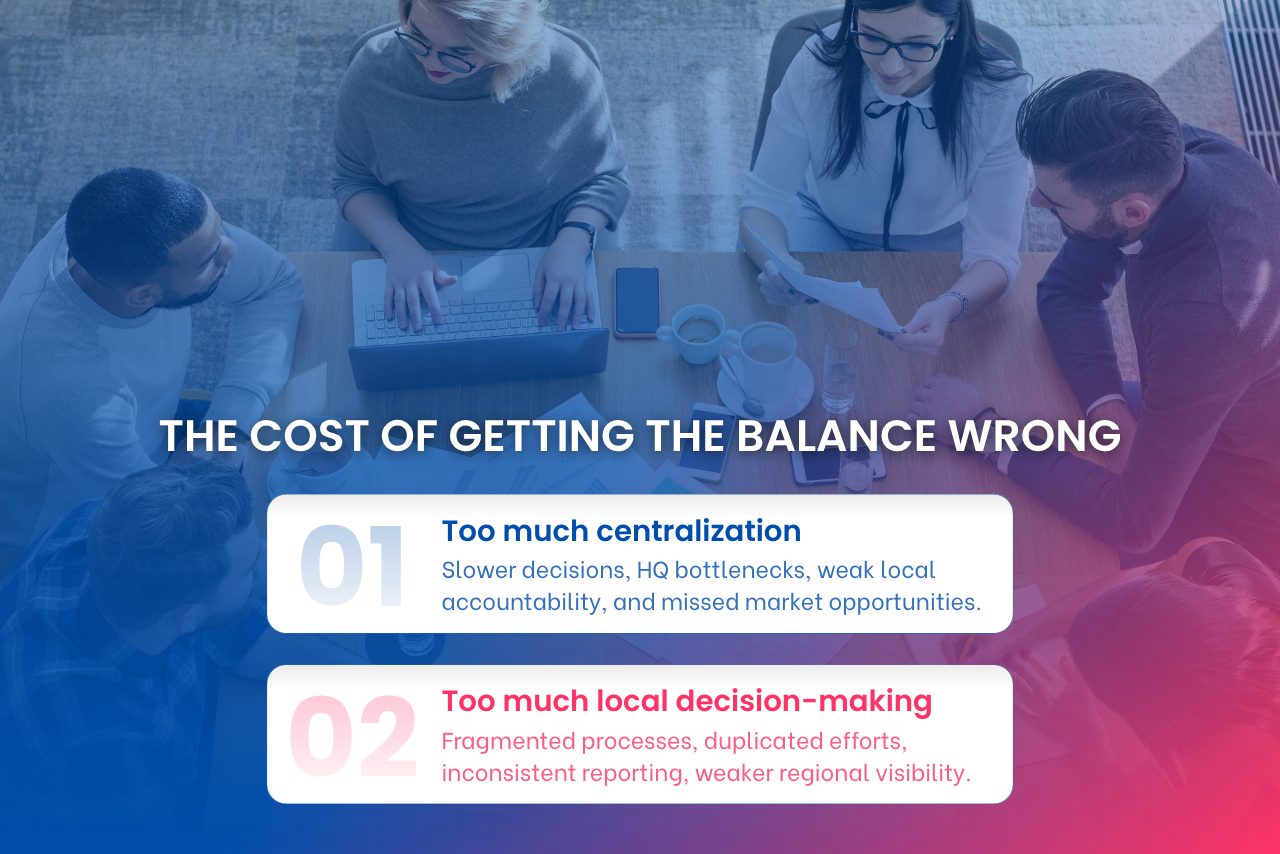
Excessive centralization slows decisions, while local autonomy can fragment ASEAN operations.
Signs Your ASEAN Operating Model Is Out of Balance
An operating model can become misaligned when decision rights no longer match how the business actually operates. These signs often appear in day-to-day execution before they become larger coordination problems.
Routine decisions are delayed by HQ approvals
When country teams regularly need HQ approval for pricing exceptions, customer issues, partner matters, or operational changes, local execution can slow down. This becomes more problematic when decisions depend on market-specific information that HQ may not have.
For example, a country manager may understand a customer’s expectations but still need regional approval before responding. If this happens repeatedly, HQ can become a bottleneck for routine matters, while local managers have responsibility without enough decision authority, weakening accountability and responsiveness.
Country teams use inconsistent processes or reporting
Different markets may develop their own workflows, KPI definitions, reporting formats, or approval processes to fit local needs. Some variation is reasonable, especially when regulations or operating conditions differ, but too much variation can weaken regional coordination.
When countries measure performance differently or follow separate reporting practices, HQ may struggle to compare results, identify emerging risks, or allocate shared resources effectively. Over time, this can create duplicated work and weak visibility. It can also make it harder to identify which practices should be standardized and which should remain adapted to local market needs.
Local teams lack authority to solve market-specific issues
Local teams may understand a customer, partner, regulatory, or operational issue but still lack the authority to resolve it. The gap between local knowledge and decision authority becomes particularly important when the issue depends on market-specific conditions.
Without sufficient authority, country managers may have to escalate problems that could otherwise be handled locally. This creates a mismatch between responsibility and control: teams remain accountable for market outcomes but cannot always make the decisions needed to address them.
Regional initiatives produce uneven results across markets
A regional strategy may be consistent, yet its results can vary significantly between countries. This does not always indicate a problem with the strategy. Different market conditions can require different approaches to execution, particularly across customer segments, regulations, and operating environments.
If decision rights do not clearly define what can be adapted locally, teams may either apply a regional initiative too rigidly or make their own adjustments without sufficient coordination. Both situations can lead to uneven execution and make regional initiatives harder to manage.
Business scale or market conditions have changed
Decision rights that worked for a smaller operation may no longer fit after entering new ASEAN markets, expanding local teams, managing more partners, or taking on more complex functions. Changes in the business can shift the right balance between HQ oversight and local authority.
Regulatory changes, larger country teams, or greater reliance on local partners can also change operating requirements. When these changes appear, companies should not wait for bottlenecks or fragmentation to become recurring problems. Reviewing the operating model early helps ensure decision rights still match the company’s size, market exposure, and execution needs.
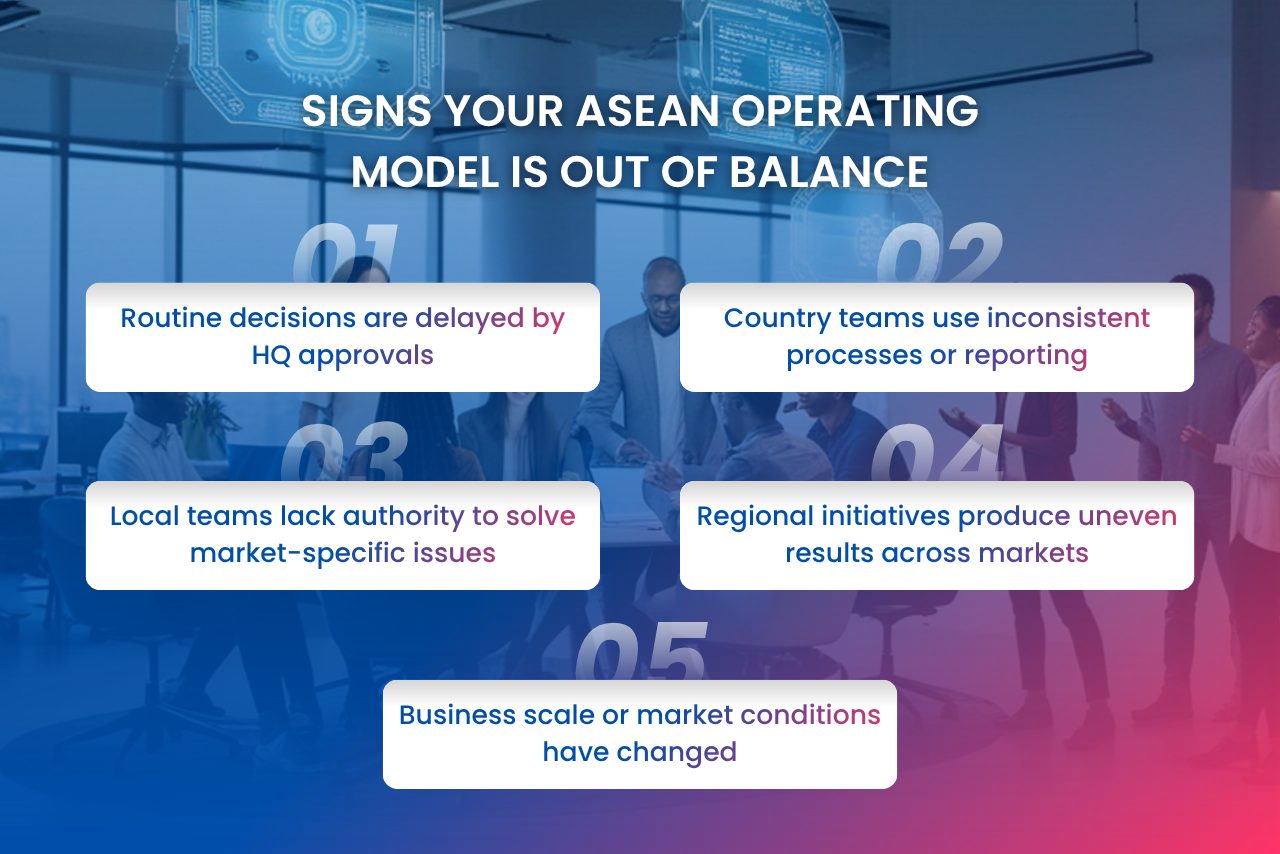
Approval delays and inconsistent processes can signal an unbalanced ASEAN operating model.
What Should Stay Global, Local, or Balanced?
A practical approach is to classify decisions as global, local, or balanced based on business risk, regional impact, and the level of local context required.
Decisions that should stay global
Some decisions are better kept at the regional or HQ level when they require cross-market alignment or when inconsistent approaches could create significant business risk. These areas define the common standards that apply across ASEAN.
Common examples include:
- Regional strategy and business priorities
- Brand and product standards
- Financial governance and risk management
- Data and reporting standards
- Core operating policies and compliance frameworks
Country teams can adapt how these requirements are implemented locally, but the underlying standards should remain consistent across markets.
Decisions that should stay local
Some decisions should remain with country teams when outcomes depend heavily on customer relationships, market knowledge, and day-to-day operating conditions. Local ownership allows teams to respond without unnecessary escalation to HQ.
These decisions often cover:
- Customer and partner management
- Local partnerships and commercial execution
- Market-specific sales activities
- Practical adaptations to local workflows
Local authority should still operate within clear regional guardrails, so market-specific decisions remain aligned with wider business requirements.
Decisions that require balanced decision-making
Some decisions require both regional oversight and local input because they have cross-market impact but depend on local feasibility. Neither HQ nor the country team has the full context to decide effectively alone.
Typical examples are:
- Pricing strategy
- Strategic partnerships
- Market-level KPIs
- Local regulatory implementation
- Major hiring plans
- Market expansion priorities
For these areas, HQ can set regional requirements and risk boundaries, while country teams contribute market-specific insights and execution input.
The table below shows where decision rights should sit across key areas of ASEAN operations, based on regional impact, local context, and business risk.
| Decision type | Best fit | Why |
|---|---|---|
| Regional strategy | Global | Requires cross-market direction and long-term alignment |
| Brand and product standards | Global | Protects consistency across markets |
| Financial governance | Global | Requires regional oversight and risk control |
| Core compliance framework | Global |
Defines the framework and sets common standards across markets |
| Local regulatory implementation | Balanced | Needs regional compliance oversight and local legal or market input |
| Pricing strategy | Balanced | Requires regional margin guardrails and local market adaptation |
| Strategic partnerships | Balanced | Needs local relationship insight and regional risk review |
| Market-level KPIs | Balanced | Needs comparable regional metrics and realistic local targets |
| Local hiring and team structure | Balanced | Depends on local talent needs, budget, and regional HR standards |
| Go-to-market execution | Local | Depends on customers, channels, and market behavior |
| Customer and partner relationships | Local | Requires local trust and direct market knowledge |
| Day-to-day operational issue resolution | Local | Requires speed and proximity to the market |
How to Build a Decision Rights Framework for ASEAN Operations
A clear decision rights framework helps you balance local flexibility with regional control. The process starts by defining authority, setting guardrails, standardizing what matters, and reviewing decision rights as business needs change.
Define who decides, approves, executes, and escalates
Start by mapping the decisions that have the greatest impact on your ASEAN operations, then assign clear responsibilities at each stage. This helps prevent routine decisions from moving unnecessarily to HQ while keeping higher-risk matters under the right level of oversight.
For each decision, clarify four roles:
- Decides: Who has final authority?
- Approves: Who provides formal approval?
- Executes: Who puts the decision into action?
- Escalates: When should the decision move to a higher level?
According to McKinsey & Company, unclear accountabilities can make delegation difficult in complex organizations, while clear decision rights help place decisions with the right people and reduce unnecessary escalation.
For example, a local sales manager may decide how to approach a customer within an approved strategy, while regional approval is required for exceptions that affect margins across markets.
Set regional guardrails for local autonomy
Local autonomy works best when country teams know which decisions they can make independently and where regional oversight applies. Clear guardrails give teams room to respond to local conditions without creating unnecessary variation across markets.
Regional guardrails can cover:
- Spending, pricing, and approval limits
- Brand, compliance, and operating standards
- Reporting, data, and system requirements
- Conditions that require regional escalation
The aim is not to standardize every action. Instead, standardize the requirements that protect the wider business, while giving local teams flexibility over how they execute within those boundaries.
Standardize reporting without forcing identical execution
Regional consistency does not require every country to follow the same operating process. The priority is to standardize what HQ needs to measure and compare, while leaving room for local teams to adapt execution to market conditions.
For example, countries can use common definitions for revenue, pipeline, headcount, and key operational KPIs while maintaining different sales routines or partner workflows. This gives HQ comparable data and regional visibility. It also allows local teams to use processes that fit their market.
Review decision rights as the business grows
Decision rights should evolve as your business structure and market responsibilities change. A model that works during early market entry may become inefficient as operations become more complex.
Review decision rights when:
- Enter new markets or add major functions
- Increase headcount or expand partner networks
- Introduce shared systems or face regulatory changes
- Move from market testing to long-term operations
Regular reviews keep decision authority aligned with business needs. They also prevent the original operating model from becoming outdated.
| Explore our insight on cultural misalignment in ASEAN to see where these cultural differences can create operational risks. |
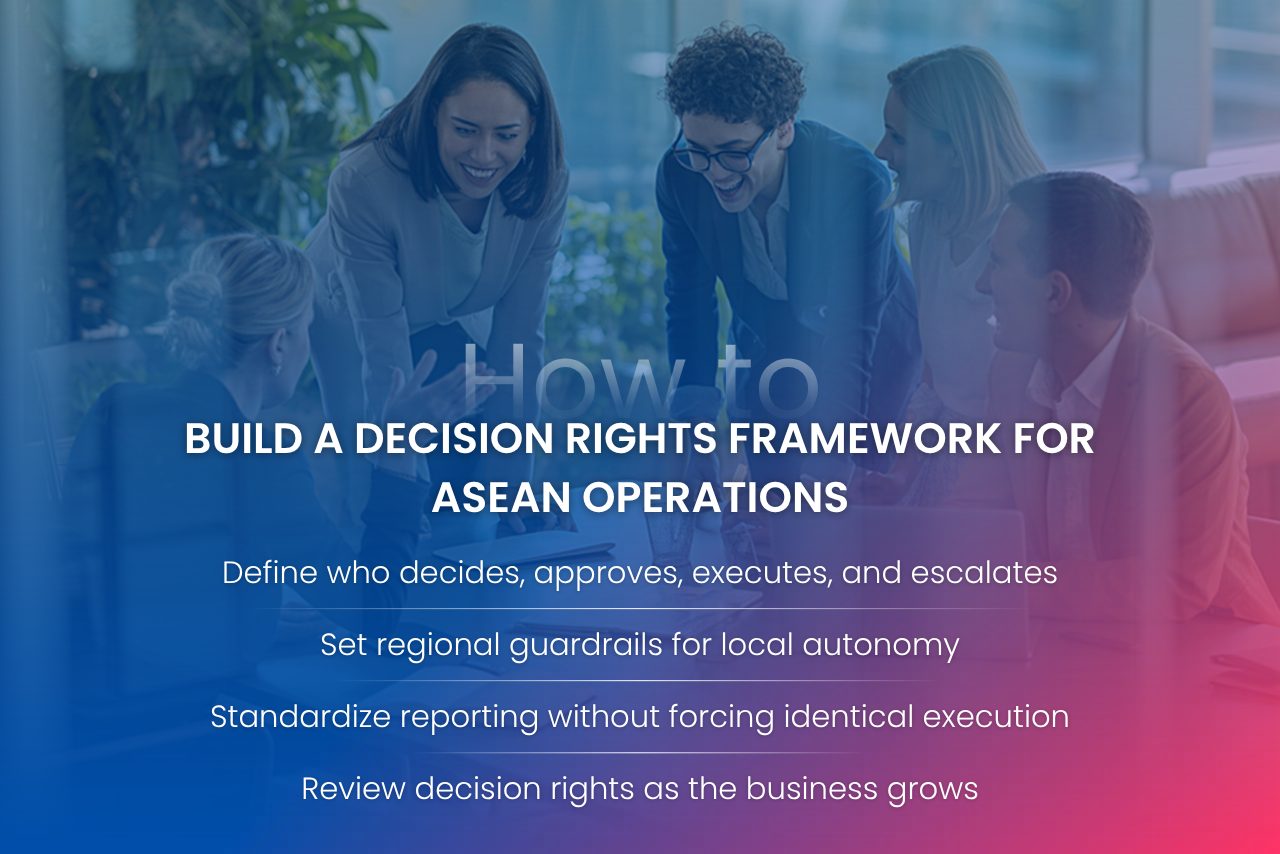
Clear decision rights help balance local autonomy with regional oversight across ASEAN.
Final Thoughts
There is no single ideal balance between global control and local decision-making across ASEAN. A stronger approach is to align decision rights with local context, regional impact, business risk, and coordination needs, while keeping core standards consistent and giving country teams sufficient authority to respond effectively to market realities.
For companies managing or expanding across ASEAN, the right operating model depends on both regional governance and local execution realities. Source of Asia supports international businesses with market entry, local coordination, partner identification, and on-the-ground execution across Southeast Asia.
| Contact Source of Asia experts to discuss your market structure and operational needs in Southeast Asia. |
Frequently Asked Questions
Local decision-making gives country teams authority to make decisions based on local customers, regulations, market conditions, and operating needs, while remaining within the broader governance and standards set by regional or global management.
Global control means keeping decisions such as regional strategy, financial governance, risk management, brand standards, and core policies at HQ or regional level to maintain consistency and manage cross-market risk.
Review your operating model when you enter new markets, add functions, increase headcount, expand partner networks, introduce shared systems, or face major regulatory changes that may affect how decisions should be allocated.
Keep strategy, risk, financial governance, and core standards global; keep customer management and local execution closer to markets. Decisions such as pricing, partnerships, and hiring often require both regional oversight and local input.