
Source of Asia helped a footwear materials innovator build a lean local presence in Vietnam without premature entity setup. By combining EOR/wage hosting, local operations support, recruitment, logistics, tax coordination, and IOR/EOR operations, SOA enabled the client to test, operate, and grow step by step with lower risk.
KEY RESULTS
Local team hosted and expanded progressively with business traction
Lean market entry in Vietnam without premature entity costs
Back-office, logistics, and tax operations handled locally
Flexible grow-as-you-go structure for Vietnam development
Phased, Low-Risk Market Entry in Vietnam Case Study
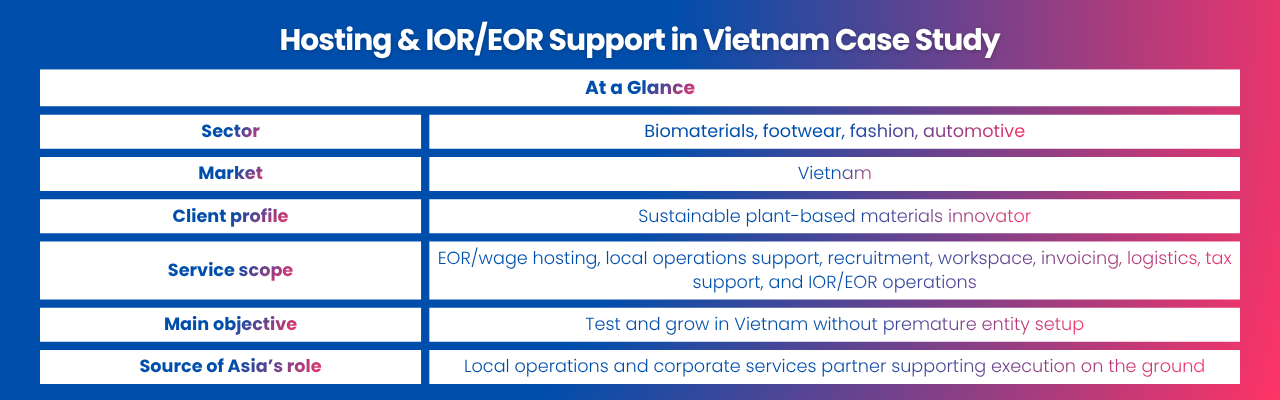
A concise case study summary highlighting the sector, market, service scope, main objective, and SOA’s role in supporting a low-risk market entry model in Vietnam.
The client wanted to test and grow in Vietnam with a lean structure. At the same time, the company needed to stay focused on orders, customer acquisition, sampling, and product development.
However, developing a local presence in Vietnam also required operational support on the ground. The company needed hosted local profiles, workspace, administrative coordination, logistics support, tax follow-up, and import & export operations.
Setting up a full legal entity too early would have added cost and complexity. Therefore, the challenge was to build enough local structure to operate well in Vietnam, without creating a heavy setup too soon.
SOA’s Role in Hosting, IOR and EOR Support
- Defined a lean Vietnam entry model
SOA first reviewed the client’s business priorities, operational needs, and Vietnam development stage. Based on this assessment, we built a phased entry model. This allowed the client to start small, operate locally, and scale as traction increased.
- Hosted the first local profiles
To help the client build an immediate presence in Vietnam, SOA provided wage hosting for initial Sales and Technical profiles. As a result, the company could support customers, manage local discussions, and follow new opportunities without setting up a full entity from the start.
- Set up the workspace and daily administration
SOA supported the local team with workspace access and operational administration in Vietnam. This gave the client a practical working base. It also reduced the workload linked to local coordination, documents, and daily tasks.
- Supported recruitment as traction increased
As the activity grew, SOA helped the client expand its Vietnam setup by providing recruitment support. This ensured that team growth followed real business needs rather than being based on premature assumptions or fixed entity-building plans.
- Coordinated invoicing, logistics, and tax support
SOA managed key back-office and operational processes in Vietnam. This included local invoicing support, logistics coordination, and tax-related follow-up. In addition, this helped reduce friction between sales activity, customer needs, and local requirements.
- Enabled IOR and EOR operations for scalable growth
To support import and export needs, SOA provided Importer of Record and Exporter of Record operations. This gave the client a more flexible way to manage product flows in Vietnam. It also kept the setup aligned with the client’s pace of growth.
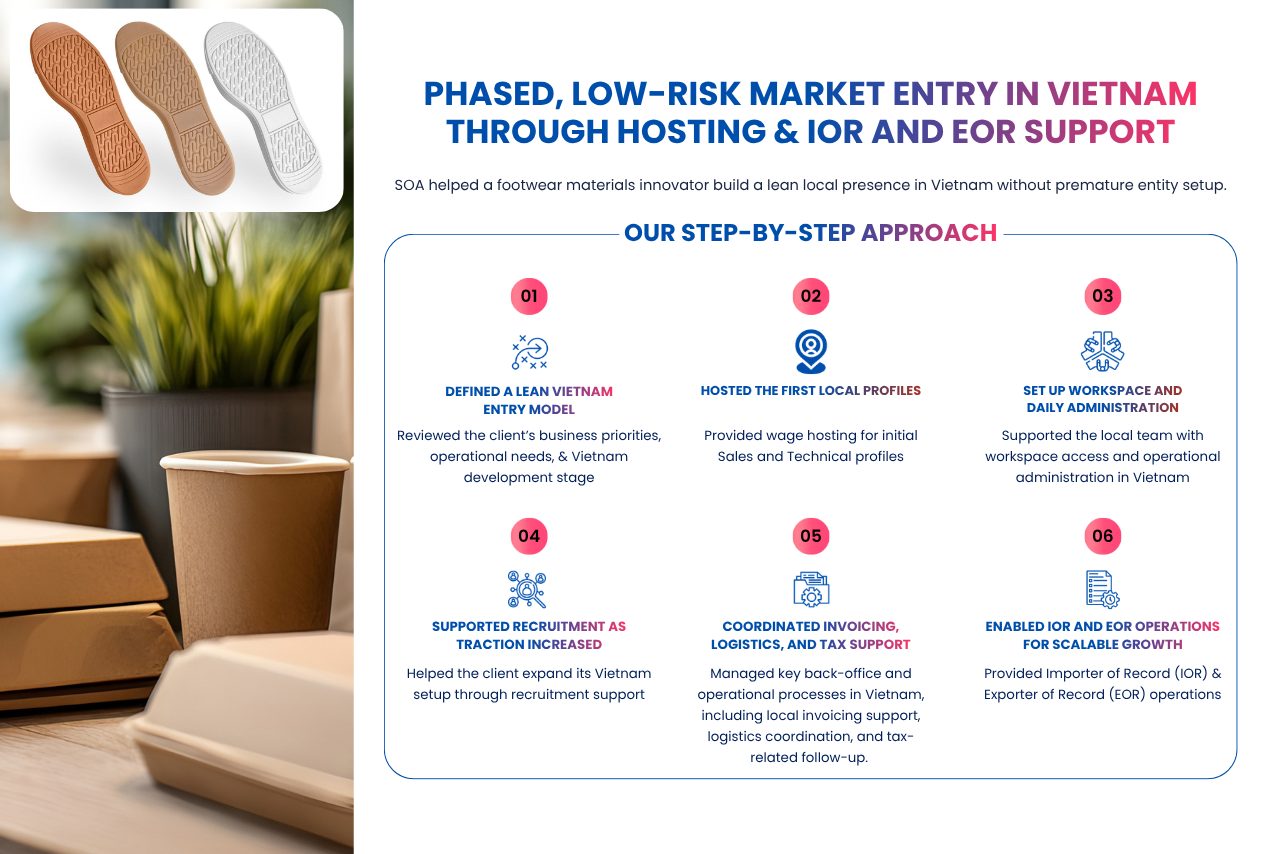
A six-step overview of how SOA supported the client in Vietnam, from defining a lean entry model and hosting local profiles to recruitment, operational coordination, and scalable IOR/EOR support.
Business Impact
With SOA’s support, the client was able to build a practical local presence in Vietnam without committing too early to a full entity setup. The company could remain focused on its core priorities, including orders, sampling, customer acquisition, and product development, while SOA handled the local operational layer.
The hosted team expanded progressively with business traction. Back-office, logistics, tax, and IOR and EOR operations were managed locally, helping the client reduce complexity and improve responsiveness in Vietnam.
Most importantly, the client gained a flexible Vietnam development model. Instead of choosing between “no local presence” and “full entity setup”, the company was able to grow step by step with a structure adapted to its real market progress
What Companies Can Take from This Case
For international companies entering Vietnam, a local setup does not always need to start with entity creation. In many cases, a phased model is more suitable.
This approach is useful when a company still needs to test demand, support customers, manage samples, or build first commercial traction. By combining wage hosting, recruitment, workspace, local admin, logistics, tax support, and IOR/EOR operations, companies can build a lean but functional presence in Vietnam.
As a result, they can reduce early risk, keep more flexibility, and grow based on real market signals.
Planning to Build a Lean Presence in Vietnam?
SOA’s Corporate Services & HR Solutions team helps international companies establish, manage, and grow their local presence in Vietnam. Our support covers EOR and wage hosting, recruitment, workspace, local admin, payroll, tax support, and IOR/EOR operations.
Whether you are testing the market or preparing to scale, we help you build a local structure that fits your current business stage.
Explore our services here!

FAQs
Phased market entry in Vietnam means starting with a lean local setup before creating a full legal entity. It allows companies to test demand, host local talent, manage local operations, and scale their structure gradually as business traction becomes clearer.
EOR or wage hosting allows companies to host local profiles through a trusted local partner. This helps them start operating in Vietnam without immediately managing their own entity, payroll, HR administration, and employment compliance.
IOR and EOR support helps companies manage import and export operations without building a heavy local structure from day one. It is useful for businesses that need to handle product flows, samples, logistics, and local operations while keeping flexibility during market validation.
A phased entry model is useful when a company wants to test Vietnam, build first local traction, or support customers without committing too early to a full entity. It gives the company more flexibility while still creating operational capacity on the ground.

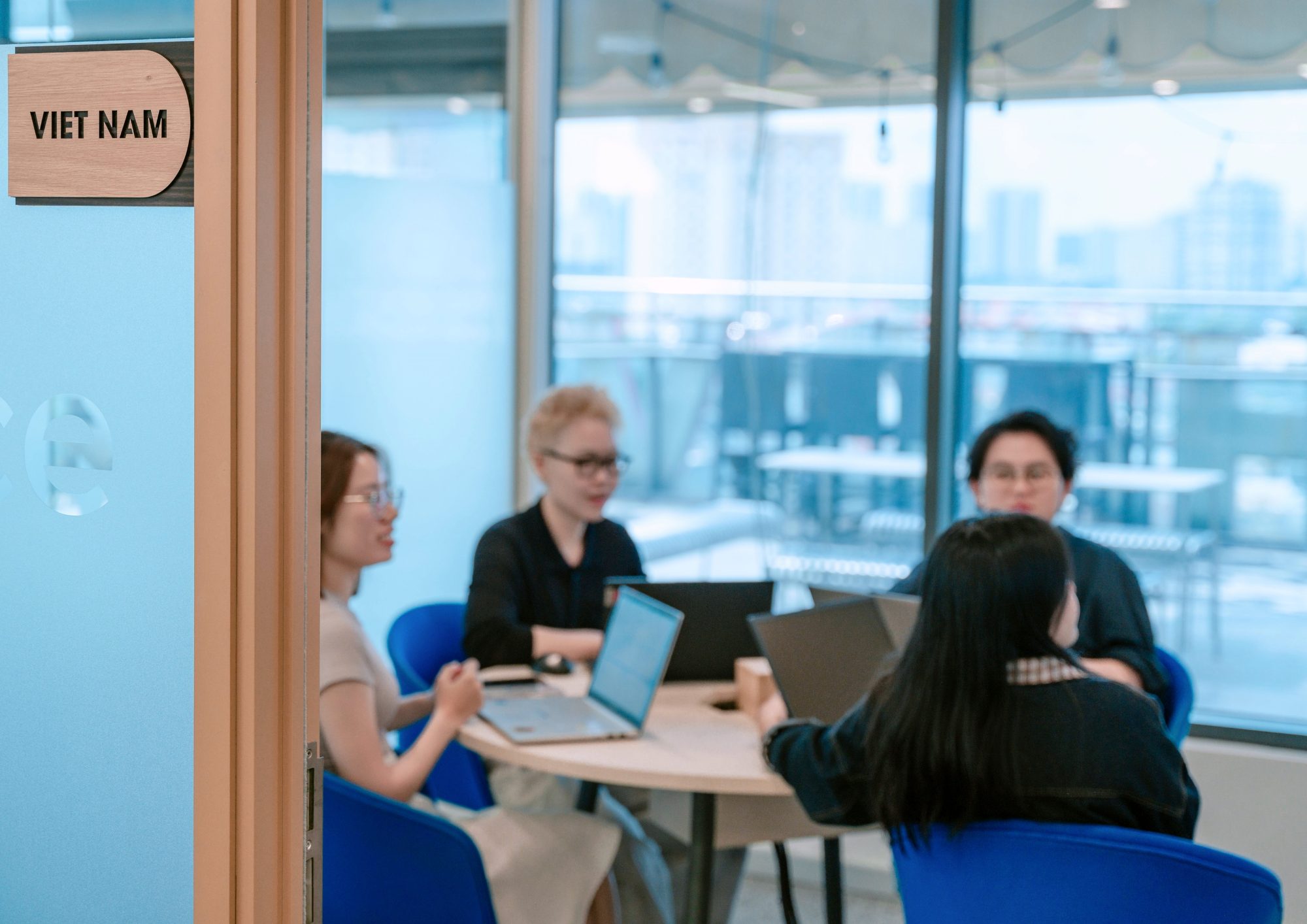



Our partnerships are built by people who understand how business works across Southeast Asia.

See how SOA helps companies solve complex business challenges across Southeast Asia.