Introduction
In 2026, South Korea remains a major cosmetic manufacturing market, known for strong R&D, advanced production systems, and fast innovation cycles. As K-beauty expands globally, many brands source from Korean suppliers to develop products faster and meet international market demands.
Yet, sourcing from cosmetic manufacturers in South Korea is not only about finding well-known factories. The real challenge is identifying a partner that can respond to your brief, meet your production needs, support sample development, and comply with target market requirements.
Understanding these challenges, in this article, we, Source of Asia, explain how to evaluate Korean cosmetic manufacturers, select the right manufacturing model, and build a more reliable sourcing approach for your brand.
Key Insights
- South Korea is a leading cosmetic manufacturing hub driven by innovation, R&D strength, and export-oriented production systems.
- OEM, ODM, and private label models serve different stages of brand development, from scaling production to full product creation.
- Manufacturer selection depends on capability fit, export experience, and production scale rather than reputation alone.
- Clear supplier communication requires structured briefs covering product, market, compliance, and commercial expectations.
- Early definition of product concept, budget, MOQ, and timeline helps improve supplier matching and development efficiency.
Why South Korea Is a Strategic Market for Cosmetic Sourcing
South Korea has a strong cosmetic manufacturing base driven by innovation, established infrastructure, and export-focused development. It offers international brands access to a mature and capable supplier ecosystem.
South Korea’s strength in beauty manufacturing
Cosmetics exports in South Korea reached USD 10.2 billion in 2024, up 20.6% from 2023, reflecting the continued global demand for K-beauty products. It is supported by continuous R&D investment, advanced production systems, and fast innovation cycles across skincare and beauty segments.
- The industry includes a broad base of MFDS-registered manufacturers. However, buyers should verify whether each supplier holds relevant quality certifications, such as Korean CGMP or ISO 22716, and whether the certification scope matches the product category.
- These standards are reinforced through structured quality control processes that support stable formulation performance and scalable manufacturing capacity for international brands.
- In addition, Korean manufacturers are widely recognized for agile formulation development, enabling faster product iteration and shorter time-to-market compared with many global suppliers.
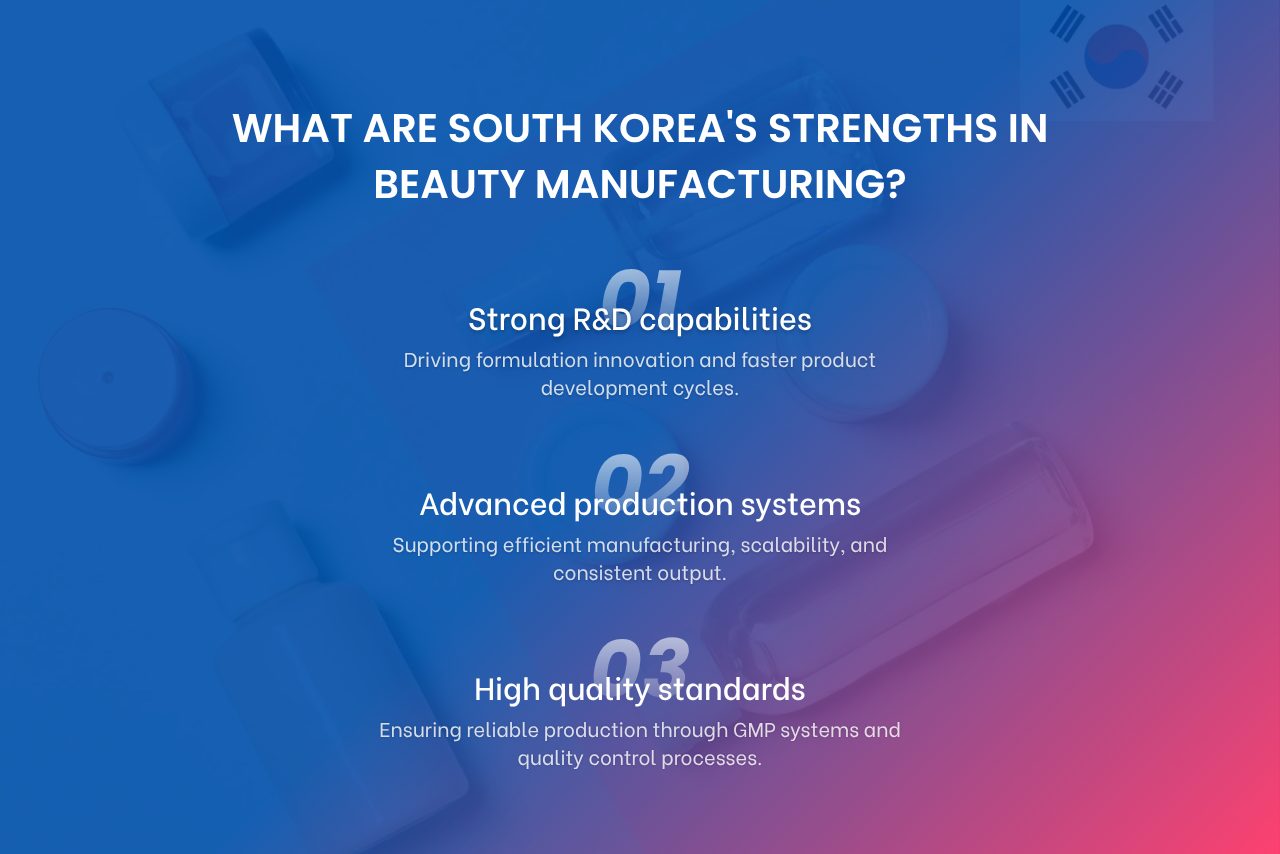
South Korea’s beauty manufacturing strength comes from R&D, advanced production systems, and quality standards.
Korean OEM and ODM manufacturers stand out
Korean OEM/ODM systems are highly integrated, which helps reduce fragmentation across formulation, production, and compliance stages. This structure supports faster development cycles and stable production quality, particularly for international cosmetic brands operating across multiple markets.
Most manufacturers provide end-to-end services from formulation development to packaging, regulatory documentation, and export preparation. In parallel, strong in-house R&D capabilities support advanced formulations in sun care, peptides, and functional skincare, helping brands align product development with global demand while maintaining manufacturing consistency.
“Made in Korea” credibility in cosmetics
The “Made in Korea” label is widely recognized in global beauty markets. It is associated with premium positioning, innovation capability, and consistent formulation quality. This perception has been reinforced by the global expansion of K-beauty across multiple skincare categories.
In many markets, the “Made in Korea” label can support product credibility, especially in skincare categories where K-beauty is associated with innovation, accessible quality, and fast-moving product trends. In sourcing practice, this recognition can also support smoother market entry, particularly in competitive retail environments.
However, while origin strengthens positioning, it does not replace the need for proper manufacturer selection, formulation alignment, and compliance verification, which remain critical factors in product success.
What Types of Cosmetic Manufacturers Can You Find in South Korea?
Different cosmetic manufacturing models serve different business objectives. Before contacting suppliers, brands should understand which type of manufacturer fits their product development stage.
Korean cosmetic OEM manufacturers
OEM (Original Equipment Manufacturer) refers to a model where the brand provides product specifications, formulation, or technical requirements, while the manufacturer is responsible for production, filling, and packaging execution. This structure is typically used when formulations are already finalized and ready for scale manufacturing.
Common requirements include:
- Formula specifications, including ingredient composition and performance targets
- Packaging requirements covering design, materials, and functional formats
- Production volume planning aligned with MOQ and manufacturing capacity constraints
- Quality standards, including testing and compliance expectations
Typically, OEM is most suitable for established cosmetic brands or companies with in-house formulation teams, focusing on scaling production with consistent quality and controlled execution.
Korean cosmetic ODM manufacturers
ODM (Original Design Manufacturer) allows the manufacturer to support product development from an earlier stage, where they handle formulation research, product development, manufacturing, and packaging execution based on brand requirements.
This model is typically suitable for:
- New beauty brands entering the market for the first time
- Companies expanding into skincare categories without prior experience
- Businesses without internal formulation or R&D teams
Many Korean ODM manufacturers maintain adjustable formula libraries for texture, ingredients, claims, and positioning, enabling faster market entry. However, brands still need to evaluate regulatory experience and product positioning to ensure proper market alignment.
Private label and contract manufacturers
Private label manufacturing refers to ready-made products that brands can customize through packaging, branding, and market positioning, without involving full product development. This model is commonly used when speed-to-market is the primary priority.
Common advantages include:
- Lower development costs due to pre-formulated products
- Faster production timelines, as formulation work is already completed
- Reduced technical requirements, making entry easier for new brands
- Simplified product testing, allowing quicker market validation before scaling
However, the main limitation is low differentiation, since identical or similar formulas may be supplied to multiple brands. Hence, companies need to assess whether the product can still support a clear and competitive market position.
Why It Is Hard To Contact Korean Cosmetic Manufacturers Directly
Finding a cosmetic supplier in South Korea is only the first step, but direct outreach does not always lead to quick responses or successful cooperation. Manufacturers receive many inquiries, so businesses must provide complete and structured information to be properly evaluated.
Korean manufacturers prioritize qualified B2B buyers
Most Korean cosmetic manufacturers operate within structured B2B systems and prioritize buyers who demonstrate clear product direction and realistic commercial potential. This is because they regularly handle a high volume of global inquiries across different markets.
Thus, vague requests such as “we want to make skincare products” are often insufficient for proper evaluation. Manufacturers typically require structured information to assess feasibility, including:
- Company background and business model
- Target market and sales channels
- Expected production volume
- Product category and positioning
- Launch timeline
Therefore, international brands need to ensure that initial communication is complete, specific, and commercially defined to improve response quality and cooperation outcomes.
Poorly prepared briefs lead to low response rates
A common issue when contacting cosmetic manufacturers in South Korea is sending generic inquiries without clear product direction or business expectations. Since manufacturers receive many requests, they usually prioritize projects with defined product concepts, target markets, and expected production volumes.
A structured brief helps suppliers evaluate technical feasibility and production requirements and provide more accurate quotations. For example, unclear formulation goals or missing market information can create additional clarification cycles. Hence, poor preparation can increase communication risks, delay sourcing progress, and reduce supplier matching quality.
MOQ and technical requirements filter potential partners
Minimum order quantity (MOQ) is one of the first factors Korean manufacturers consider when reviewing new projects. For custom OEM/ODM production, MOQs commonly range from around 3,000 to 10,000 units per SKU, depending on product type, packaging requirements, and production conditions.
However, MOQ is only one part of supplier evaluation. Manufacturers also review:
- Formula complexity and development requirements
- Testing requirements and quality standards
- Packaging customization level
- Compliance needs for target markets
- Production capacity and timeline expectations
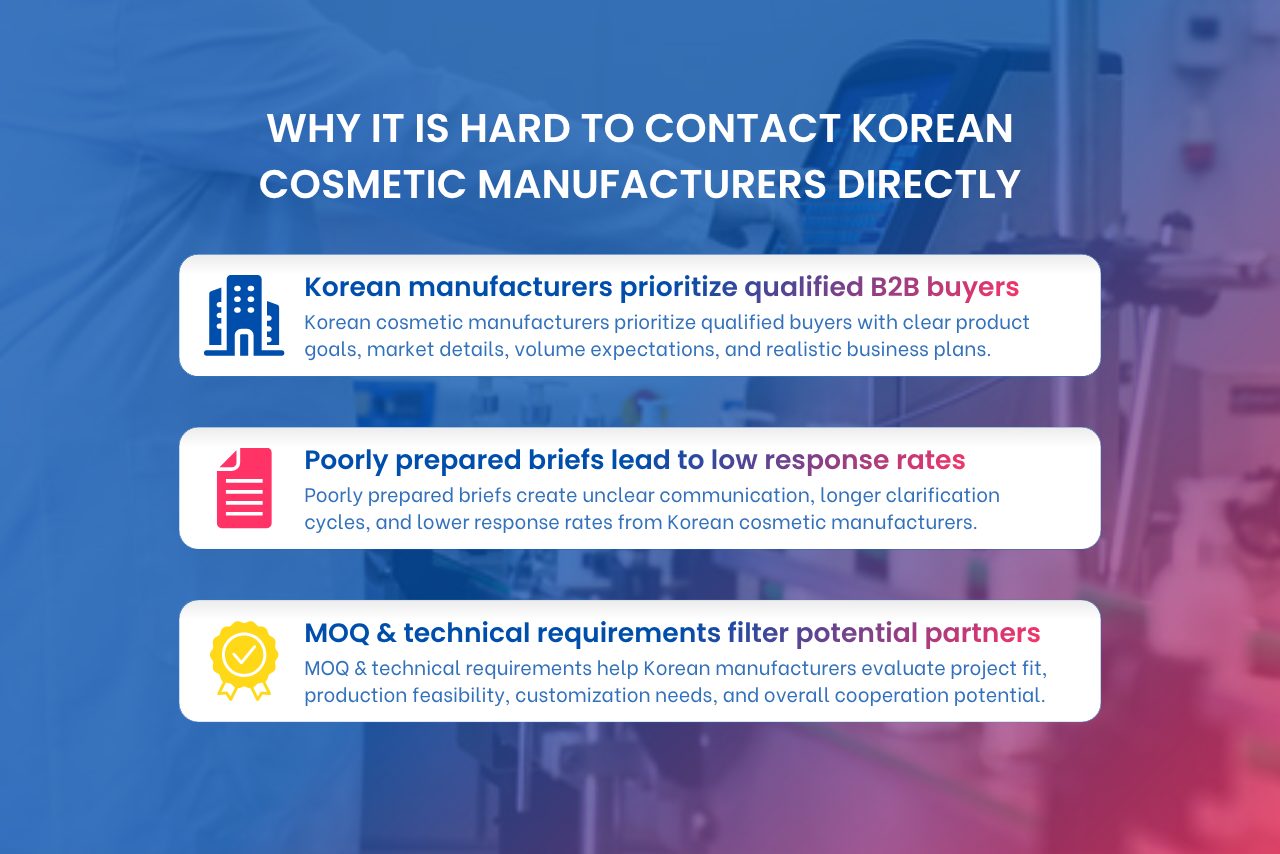
Contacting Korean cosmetic manufacturers directly can be challenging due to unclear briefs, MOQ, and supplier requirements.
Why manufacturer fit matters more than famous names
Choosing a well-known manufacturer does not always mean finding the right sourcing partner. Large cosmetic manufacturers often focus on high-volume production and established clients, which may not align with early-stage or mid-sized brands requiring smaller-scale support or more flexibility.
In contrast, specialized or mid-sized factories may provide closer collaboration, faster communication, and more adaptable production solutions. Successful sourcing depends on matching the manufacturer’s technical capability, production model, and cooperation style with the brand’s actual business needs.
How To Find Good and Trusted Cosmetic Manufacturers in South Korea
To effectively identify reliable cosmetic manufacturers in South Korea, brands need a structured approach that combines supplier discovery, capability assessment, compliance verification, and coordinated local support.
Use trade networks and industry channels
Finding reliable cosmetic manufacturers requires more than online searches. Brands often rely on industry channels and established trade networks to identify suppliers with export experience, production capability, and international market readiness.
Common channels include:
- Trade shows: The events such as Cosmobeauty Seoul and InterCHARM Korea provide direct access to export-active manufacturers, allowing brands to review product capabilities and discuss potential cooperation.
- KOTRA (Korea Trade Investment Promotion Agency): Provides manufacturer directories and structured introductions to Korean suppliers.
- Industry associations and B2B directories: Help identify mid-to-large manufacturers with proven production experience and export history.
| 👉 Explore upcoming beauty trade fairs in ASEAN for sourcing opportunities. |
Evaluate manufacturer capabilities and export experience
Not every cosmetic manufacturer has the same expertise across product categories. A supplier experienced in skincare development may have different capabilities from one specializing in color cosmetics, sun care, or functional beauty products.
When evaluating manufacturers, brands should consider:
- Product category experience and previous development projects
- Export markets served and regulatory familiarity
- Production capacity and manufacturing scale
- R&D capabilities for formulation support
- Quality management systems and production controls
Manufacturers with existing export experience in markets such as the EU, US, or ASEAN are often more familiar with international requirements. Early communication quality also provides insight into their coordination process during sampling, documentation, and production stages.
Verify quality standards and documentation readiness
Quality verification should be completed before any production agreement, as documentation determines both compliance and product approval feasibility. A qualified manufacturer must be able to demonstrate valid and clearly scoped quality certifications and explain how these standards are applied in production.
Key documents to review include:
- GMP (ISO 22716) or equivalent certifications, confirmed with scope and validity.
- Core technical documentation, including COA, MSDS, INCI lists, and product specification sheets.
- Prior compliance experience with target markets such as the FDA (US), EU CPNP, ASEAN, and GCC.
Work with a sourcing partner when local support is needed
Local sourcing partners help bridge language, technical, and negotiation gaps that commonly occur during early-stage sourcing with cosmetic manufacturers in South Korea. They ensure that product requirements are accurately translated into clear technical briefs, reducing misunderstandings in formulation and production discussions.
In addition, they support supplier qualification, brief alignment, sampling coordination, and compliance checks to ensure manufacturers match both product expectations and target market requirements. This role becomes especially valuable when supplier ecosystems are unfamiliar, communication is complex, or regulatory requirements for market entry demand higher precision and verification.
| When sourcing becomes complex, local support improves coordination and reduces risk.
👉 Learn more about sourcing agents in ASEAN and when you may need one. |
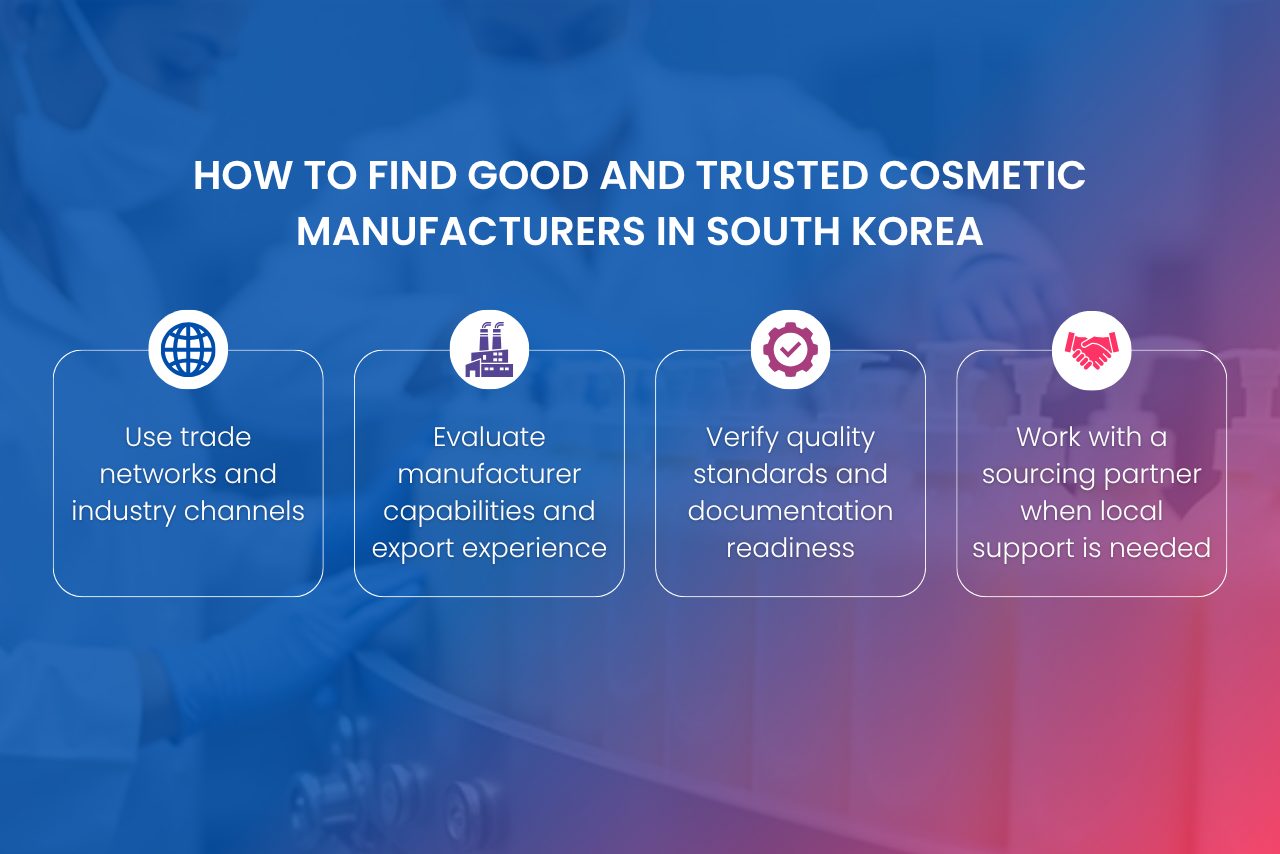
Finding trusted cosmetic manufacturers in South Korea requires supplier research, capability checks, and compliance verification.
What To Prepare Before Contacting Korean Cosmetic Manufacturers
To effectively engage Korean cosmetic manufacturers, brands need to prepare structured inputs covering product definition, compliance requirements, budget planning, and a clear commercial profile to ensure accurate evaluation and faster supplier qualification.
Define product concept and formulation requirements
A clear product concept is essential for manufacturers to evaluate development feasibility and technical alignment at an early stage. It helps reduce ambiguity and ensures suppliers can respond with accurate recommendations based on production capability and formulation scope.
To build a structured brief, brands should define product category, core function, active ingredients, and expected texture or finish. For example, specifying whether a serum targets hydration or anti-aging helps manufacturers select suitable formulation bases. In addition, reference products for texture or packaging can improve interpretation during sampling and reduce iteration cycles.
Depending on the model, OEM requires full formula specifications, while ODM starts from a structured concept brief. Clear inputs consistently improve supplier matching accuracy and shorten development timelines.
Prepare market, compliance, and documentation needs
Cosmetic regulations vary significantly across markets. Thus, identifying target countries early is essential to align formulation and documentation requirements. This step helps manufacturers prepare compliant product strategies from the beginning of development.
Depending on the destination market, requirements differ in scope and documentation.
- For the US market, brands should consider FDA-related requirements under MoCRA, including facility registration, product listing, safety substantiation, adverse event reporting, and labeling expectations. It is also important to remember that FDA generally does not “approve” cosmetic products before market entry.
- For the EU, brands need to prepare for requirements under Regulation (EC) No 1223/2009, including Responsible Person setup, Product Information File, Cosmetic Product Safety Report, labeling compliance, and CPNP notification before placing products on the market.
- ASEAN markets generally follow the ASEAN Cosmetic Directive framework, but notification, importer responsibility, labeling, language, and authority procedures still vary by country.
In addition, ingredient restrictions should be reviewed early, as certain components may require reformulation depending on regional rules. Without clear compliance planning, brands often face reformulation after sampling, delayed registrations, and additional testing costs.
Set realistic budget, MOQ, and timeline expectations
Production planning should consider more than unit price, as feasibility depends on overall project structure and scale. Before contacting suppliers, brands should define expected order volume, target budget, packaging scope, development costs, and logistics-related expenses.
In practice, pricing is closely linked to scale. A lower MOQ often leads to a higher unit cost, while larger volumes improve cost efficiency. For ODM projects, timelines also vary by complexity, with a typical development cycle of around 3 to 6 months, including formulation, testing, packaging, and revision stages.
Create a professional brand introduction
Manufacturers assess not only product ideas but also the commercial profile behind each inquiry. Therefore, providing a concise company overview helps improve qualification speed and response accuracy.
Key details include:
- Company stage and business model
- Target market focus and positioning
- Distribution channels and sales structure
- Target pricing range and margin expectation
- Expected launch timeline and scale readiness
This information allows manufacturers to evaluate feasibility beyond technical requirements and understand whether the project matches their production capacity. Thus, clear brand positioning improves response rate and supplier qualification quality, especially when dealing with export-oriented Korean cosmetic manufacturers.
Conclusion
South Korea is a leading cosmetic manufacturing hub with strong OEM/ODM systems, advanced R&D, and export-oriented production capabilities. Successful sourcing in this country depends on clear product definition, compliance planning, budget alignment, and structured supplier evaluation, rather than relying on manufacturer reputation or brand recognition alone.
At Source of Asia South Korea, we support companies in navigating cosmetic sourcing in Korea through structured sourcing and due diligence, including:
- Supplier identification aligned with product and market needs
- Manufacturer capability assessment across production and R&D
- Compliance and documentation verification for readiness
- Shortlisting and matching based on commercial objectives
| 👉 Ready to turn your beauty concept into a “Made in Korea” product? Contact our sourcing experts to find the right manufacturing partners. |
Frequently Asked Questions
Most Korean cosmetic manufacturers apply MOQs depending on packaging type, formulation complexity, and production setup. Some ODM or specialized suppliers may support smaller batches, but standard factories typically prioritize mid-scale production aligned with export efficiency and stable manufacturing planning.
Product development in Korea generally takes around 3–6 months. The timeline includes formulation development, stability and safety testing, packaging design, sampling revisions, and regulatory preparation, depending on product complexity and target market requirements.
ODM is often more suitable for new brands because manufacturers support formulation, development, and packaging from early stages. OEM requires complete technical specifications and is better suited for established brands with internal R&D and finalized product formulas.
Foreign companies can work directly with Korean manufacturers. However, suppliers expect structured briefs including product details, target markets, compliance needs, and volume expectations to properly evaluate feasibility and respond with accurate quotations and development proposals.