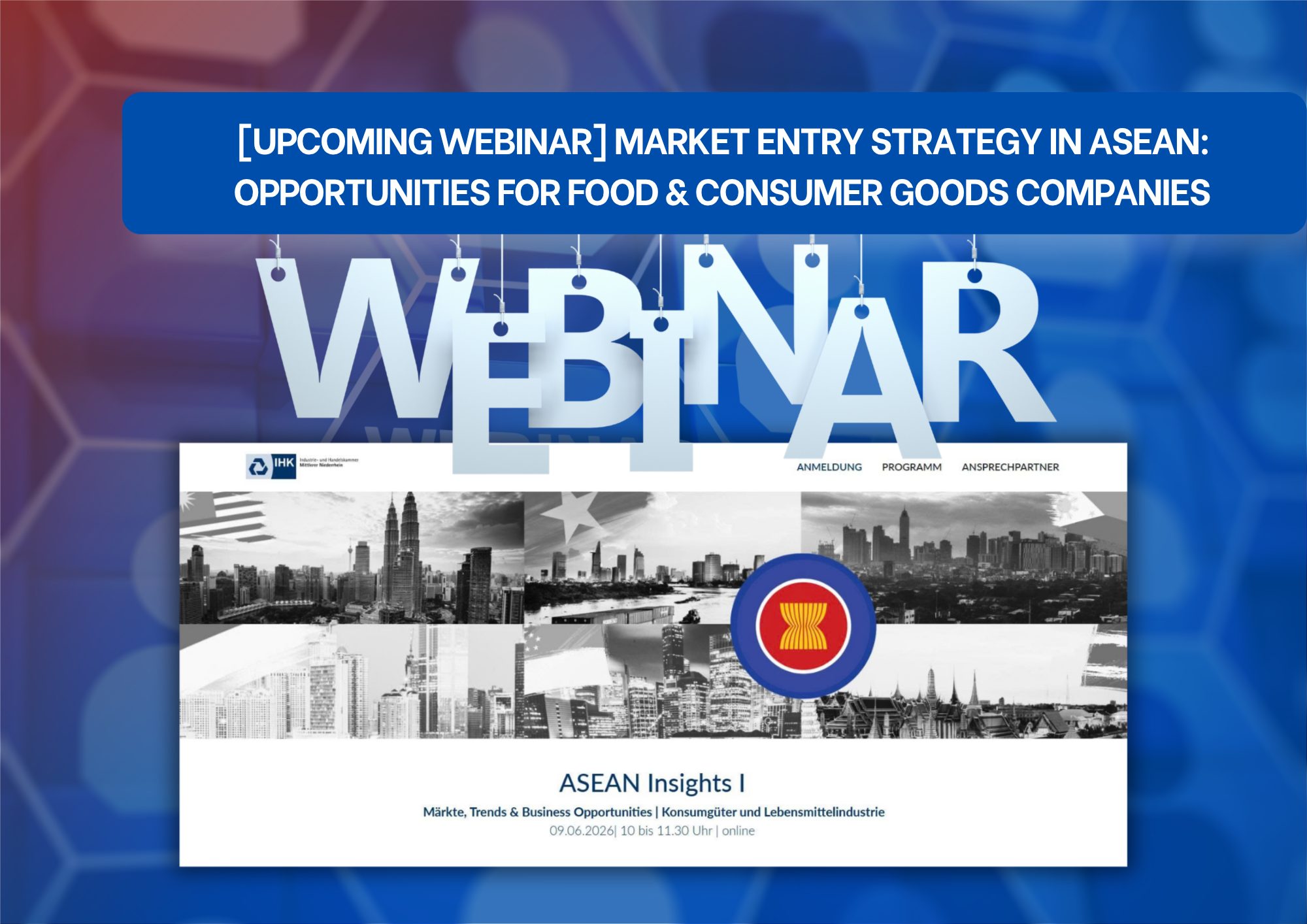
On June 9, 2026, Source of Asia joined an IHK Mittlerer Niederrhein webinar dedicated to the food and consumer goods sector in ASEAN. The session was led by Thierry Mermet, Founder of Source of Asia, and focused on one practical question: how can international companies build an effective ASEAN expansion strategy with a clearer, more realistic, and locally grounded approach?
During the webinar, we did not present ASEAN as one single market. Instead, we discussed how companies should read each country differently, compare opportunities carefully, and prepare their local execution before moving too fast.
Several questions came up during the session:
- Which market should we start with?
- How much budget and time should we prepare?
- Which trade fairs or business channels are worth exploring?
- How do we find reliable local partners?
- Do we need a local presence?
- What should we know about customs, regulations, or Halal requirements?
For those who could not attend the webinar, here are the key answers and takeaways we shared during the discussion, based on SOA’s experience supporting companies across Southeast Asia.
We’ve shared the full webinar for your reference. If you have time, kindly click the video below to watch it.
At a Glance: 5 Key Lessons for Your ASEAN Expansion Strategy
- ASEAN is not 1 market
This was one of the first points we emphasized. Consumer behavior, pricing expectations, regulations, and distribution channels can change significantly from one country to another.
- Market selection comes before expansion
Our answer was clear, which is not to choose a market only because it is large. The right starting point depends on product fit, competition, regulations, and commercial access.
- Reliable partners matter
Many companies ask us how to find distributors. We usually tell them that the harder question is how to qualify them properly.
- Regulations should be assessed early
For food and consumer goods companies, labeling, customs, import permits, product registration, and Halal requirements can all affect timing and budget.
- Local execution drives long-term success
A strategy only works if companies can follow up, adapt, and manage relationships locally.
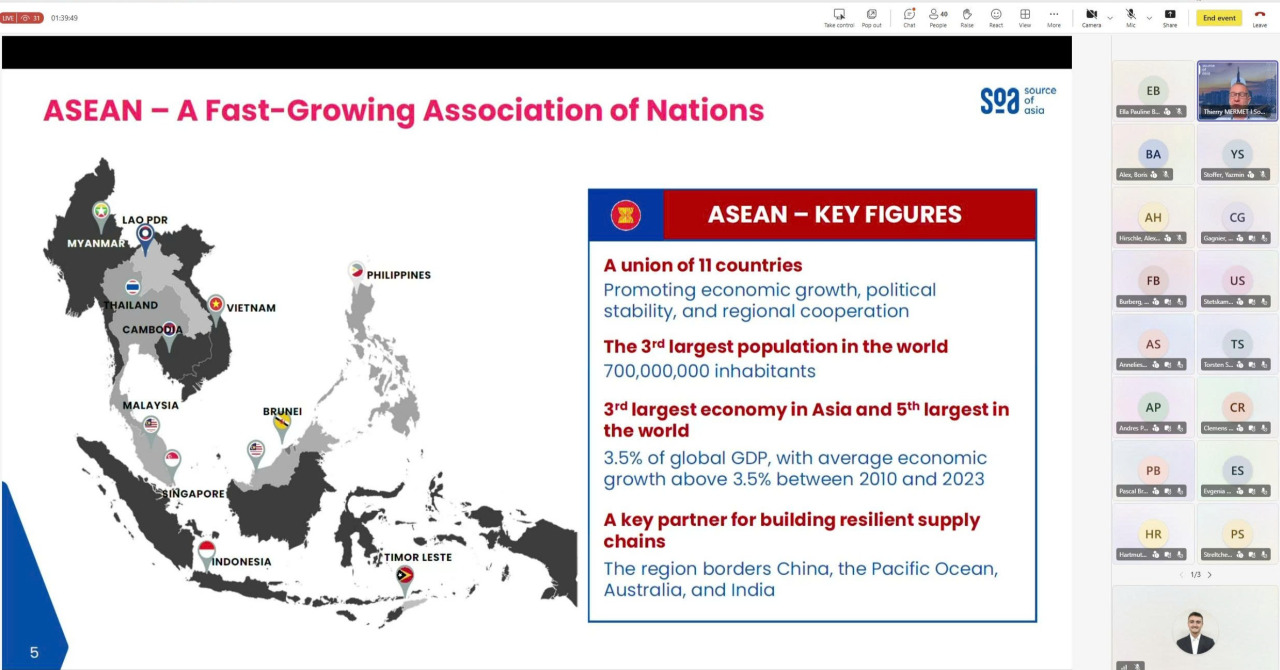
CEO Thierry Mermet shares key figures highlighting ASEAN’s economic scale, growth potential, and strategic role in global supply chains.
What Food and Consumer Goods Companies Should Consider Before Expanding into ASEAN
One question came up quickly during the webinar: which ASEAN market should we start with?
From our experience, this is rarely a question of size alone.
Vietnam, Indonesia, Thailand, and Malaysia all offer strong opportunities. They have growing consumer demand, active distribution networks, and expanding retail ecosystems. However, each country plays a different role. In the webinar, we explained:
- Singapore can work well as a regional hub for premium brands and innovation-led companies.
- Thailand may be relevant for manufacturing, food processing, and tourism-related sectors.
- Vietnam often stands out for market growth, production, and sourcing thanks to its fast-growing consumer base and competitive manufacturing ecosystem.
That is why we recommend starting with a country benchmark. Before spending budget on sales trips or distributors, companies should compare demand, competition, pricing, regulation, distribution, and product-market fit.
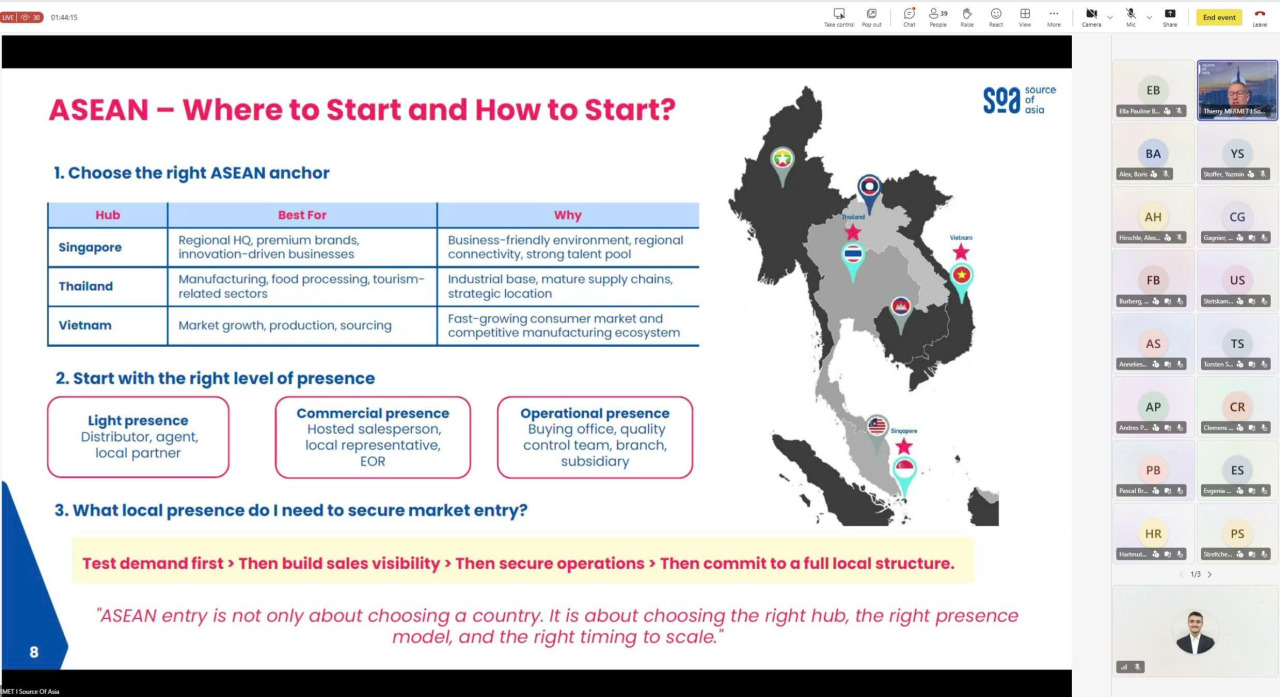
The webinar explored how businesses can gradually build their presence in ASEAN, from local partners to full operations.
The second question was about budget and timing.
We answered that companies should prepare for a phased journey. First, test demand. Then, build sales visibility. After that, secure operations. Only then should they commit to a heavier local structure.
In practice, this means that a company may start with market research and partner identification. Then it may organize B2B meetings, test product feedback, and work with selected distributors. If traction becomes stronger, local representation or a more operational presence may become relevant.
Companies can move from a light presence, such as a distributor, agent, or local partner, to a commercial presence, and later to an operational presence such as a buying office, quality control team, branch, or subsidiary.
This is why an ASEAN expansion strategy should not be built as one big jump. It should be designed as a step-by-step process.
Common Questions Discussed During the IHK Webinar
Another recurring question was: “How do we find reliable local partners?”
Many companies start with trade fairs, chamber events, online searches, or referrals. These channels are useful. However, they only create a first list of contacts.
What matters next is qualification. Based on our work in the region, we usually recommend checking:
| Market coverage | Financial stability |
| Product portfolio | References |
| Sales channels | Level of commitment |
| Import experience | Strategic fit |
A distributor who looks good on paper may not be the right partner in practice. For this reason, SOA often combines desk research with direct calls, local checks, and targeted B2B meetings before recommending a shortlist.
We also discussed customs, regulations, and Halal requirements.
This is especially important for food and beverage companies. In some markets, product registration, labeling, import permits, and customs procedures can create delays if they are not reviewed early.
For Malaysia and Indonesia, Halal can also become a major market-access topic. During the webinar, we highlighted Malaysia’s role as one of the most developed Halal ecosystems, with strong domestic demand and internationally recognized certification standards. The presentation also noted that more than 200 countries recognize Malaysia’s Halal certification system.
This does not mean every company needs Halal certification from day one. However, companies should understand early whether Halal affects their category, target consumers, distribution channels, or long-term positioning.
We also talked about trade fairs and business channels.
Our view is that trade fairs can be useful, but they should not be treated as the whole strategy. A trade fair helps companies observe the market, meet potential partners, and test reactions. Yet the real value comes after the event, when companies qualify leads, follow up, compare options, and turn conversations into commercial actions.
In other words, one event can open doors. It cannot replace market preparation.
Beyond Webinar: How SOA Supports Your ASEAN Expansion Strategy
Many of the challenges discussed during the webinar reflect the situations companies face every day when entering Southeast Asia.
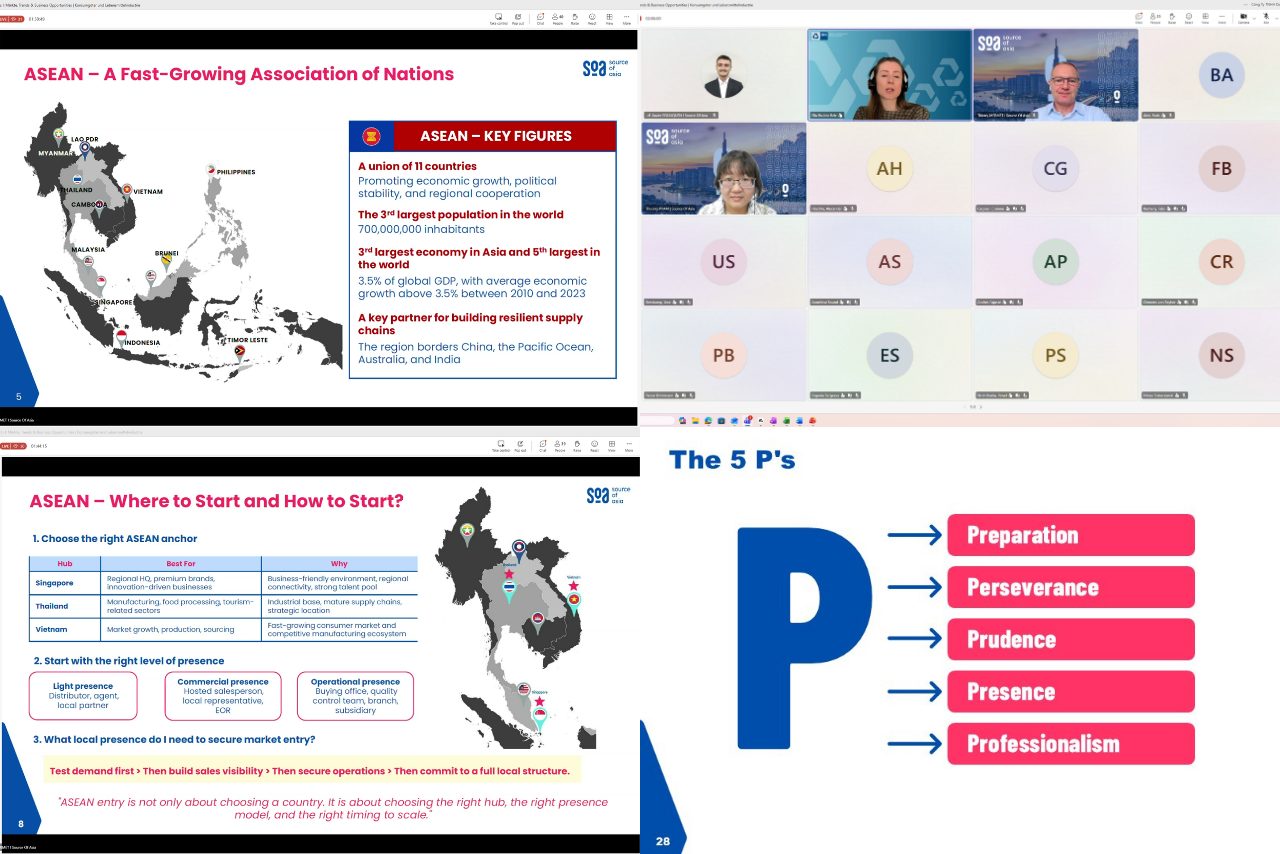
One of the key frameworks discussed during the session was the “5 P’s”, emphasizing preparation, perseverance, prudence, presence, and professionalism when entering ASEAN markets.
At Source of Asia, we help businesses move from market evaluation to practical execution through a structured expansion approach. Our support includes:
- Market intelligence and country benchmarking
- Go-to-market strategy development
- Distributor and partner identification
- B2B matchmaking and business meetings
- Sales representation and market activation
- Commercial development support
SOA’s Market Expansion framework is built to help companies move from market prioritization to partner search, sales activation, and trading support with local execution.
We also shared a practical example during the webinar. A Belgian company in processed cereals for baby food needed to compare Vietnam, Thailand, and Malaysia before entering Southeast Asia. Our experts conducted a country benchmark, selected Vietnam as the most promising market, prepared a go-to-market report, mapped distributors and importers, and facilitated five B2B meetings with qualified local partners.
This type of approach reflects what we often see in the field. Companies do not only need data. They need a clear route, relevant contacts, and local follow-up.
Conclusion
The IHK webinar gave us a good opportunity to address questions that many food and consumer goods companies ask before entering Southeast Asia.
From our perspective, ASEAN rewards preparation. Companies that take time to understand each market, assess regulations early, qualify partners properly, and build local execution capacity are usually better positioned for sustainable growth.
One point that stands out from the webinar is that companies should not approach ASEAN with a copy-paste plan. Each market requires its own reading, timing, and local execution. That is why a strong ASEAN expansion strategy should combine market intelligence with practical local execution.
Are you interested in developing your ASEAN expansion strategy? Let’s Source of Asia support your companies in Southeast Asia through market intelligence, partner search, market activation, and commercial development. Contact us now!