Introduction
Lifestyle sourcing continues to evolve as brands respond to changing designs, materials, colors, packaging requirements, and consumer preferences. These shifts create more opportunities for product innovation but also require suppliers to adapt quickly across development and production stages.
However, sourcing challenges often appear when businesses focus only on supplier selection and overlook long-term collaboration. Communication gaps, unclear expectations, and production inconsistencies can affect quality, timelines, and the ability to respond to market changes.
In this guide, Source of Asia explains how supplier relationship management supports stronger supplier partnerships across four stages, from supplier selection and qualification to communication and performance management.
Key Insights
- Supplier relationship management starts with choosing suppliers that can support long-term collaboration, not only one-time orders.
- Clear sourcing requirements help reduce misalignment during supplier search, sampling, and production.
- Supplier qualification validates production capacity, scalability, quality systems, and real execution capability.
- Strong supplier relationships depend on aligned expectations, regular communication, and consistent execution.
- Production control, supplier scorecards, and performance reviews help reduce risks across future sourcing cycles.
Step 1: Find Suppliers With Long-Term Collaboration Potential
The first stage of supplier relationship management is choosing partners that match your sourcing goals. A supplier should not only meet current requirements but also support future product development and business growth.
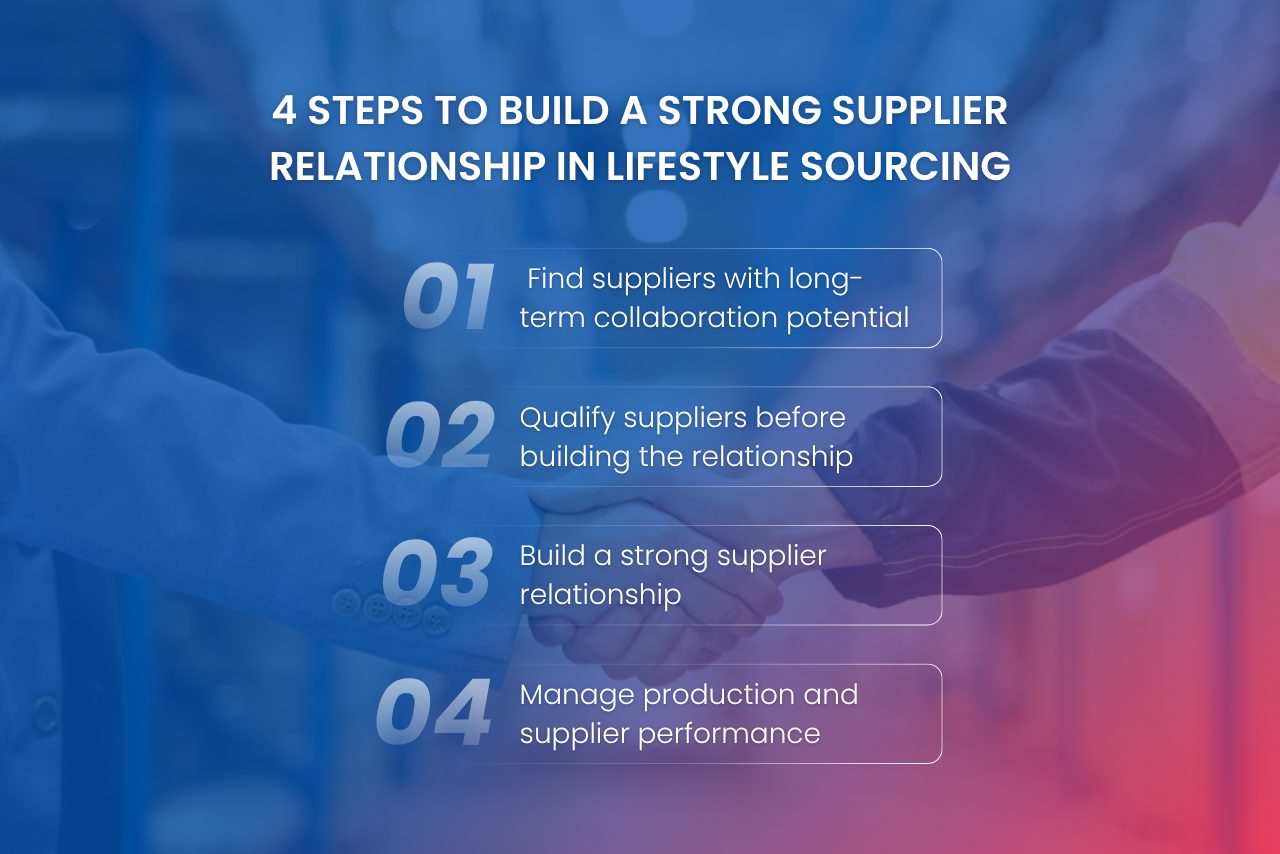
Four steps to build a strong supplier relationship for lifestyle sourcing in ASEAN
Defining sourcing requirements before supplier search
Before contacting suppliers, businesses should define clear sourcing requirements to avoid delays and misalignment during supplier evaluation. In lifestyle sourcing, product details can change frequently, so suppliers need accurate information about expectations from the beginning.
According to ASCM, regular communication and data-driven supplier selection help avoid misunderstandings and make informed decisions based on historical performance.
A structured sourcing brief should cover key areas such as:
- Product specifications and material requirements to ensure suppliers understand quality standards
- Customization needs and MOQ expectations based on production capability and order planning
- Seasonal and trend-driven considerations that may affect design updates or timelines
Therefore, clear requirements help suppliers provide more accurate quotations, production schedules, and capability assessments before cooperation begins.
Identifying supplier channels that match sourcing goals
Finding the right supplier starts with choosing channels that provide reliable market information. In lifestyle sourcing, supplier discovery is not only about finding manufacturers but also understanding their production experience, product focus, and ability to meet buyer requirements.
Businesses often explore different channels, including:
- Trade fairs and industry events help buyers observe product quality, discuss requirements, and identify experienced manufacturers.
- Local supplier networks provide market knowledge that may not be visible through public information.
- Regional sourcing ecosystems across Asia allow businesses to compare manufacturing strengths and find suitable production partners.
| Trade fairs often provide early signals of supplier capability and category fit in lifestyle sourcing. 👉 Explore how trade fairs shape supplier discovery in Southeast Asia. |
Screening suppliers for long-term collaboration potential
Supplier screening helps businesses identify whether a potential partner can support long-term sourcing objectives, not just complete an initial order. A supplier’s product experience, communication style, and adaptability often show early signs of future cooperation. For new suppliers, buyers can review available references, export experience, sample results, and early communication quality. For existing suppliers, historical performance data can also support better selection decisions. In practice, suppliers with experience in lifestyle categories usually understand changing materials, seasonal trends, and customization requirements better.
Therefore, businesses should evaluate key collaboration signals before moving forward, including responsiveness in discussions, knowledge of product categories, and the ability to adapt as requirements change. A supplier that communicates clearly and manages expectations from the start is more likely to become a reliable partner throughout the sourcing process.
Step 2: Qualify Suppliers Before Building the Relationship
Supplier qualification helps buyers make decisions based on verified capability. It prevents them from relying only on first impressions or product samples. At this stage, businesses assess whether suppliers can consistently meet production, quality, and communication requirements before entering long-term cooperation.
Evaluating operational and production readiness
A supplier’s production capability is a critical factor in long-term sourcing success. While product quality and pricing are important, operational readiness determines whether a supplier can maintain stable output as demand changes and requirements become more complex.
PwC’s report Supplier Relationship Management: How Key Suppliers Drive Your Company’s Competitive Advantage highlights that key suppliers can contribute to competitive advantage when companies manage them beyond transactional purchasing. In lifestyle sourcing, this reinforces the need to assess suppliers not only on price but also on production capacity, scalability, quality systems, and long-term collaboration potential.
Key areas businesses should evaluate include:
- Manufacturing capabilities and production capacity to confirm whether suppliers can support expected order volumes
- Scalability for future growth when product ranges expand, or market demand increases
- Quality management processes that help control consistency across production cycles
A supplier with strong production systems can reduce delivery risks, quality issues, and unexpected costs. Thus, qualification should focus not only on what suppliers offer today but also on their ability to support future business needs.
Validating performance through samples and pilot orders
Samples and pilot orders are important because supplier capability is often different from initial discussions. Real production trials show how well a supplier understands requirements and converts specifications into finished products. This is especially important in lifestyle sourcing, where small differences in materials, colors, or product details can affect the final result.
Before moving into larger orders, businesses should review sample quality, production consistency, and execution accuracy. Pilot production also reveals potential gaps in timelines, quality control, or communication processes. By testing supplier performance early, buyers can reduce sourcing risks and build stronger supplier relationships based on actual results rather than expectations.
Assessing transparency and communication practices
Supplier communication becomes especially important when sourcing involves multiple product requirements, production stages, and market expectations. Supplier transparency matters most when challenges appear. It shows whether a partner can manage cooperation beyond the first discussion.
Reliable suppliers usually demonstrate three important practices:
- Clear communication channels that allow buyers to receive timely updates and resolve questions efficiently.
- Production visibility through information about timelines, progress, and potential risks before they affect delivery.
- Structured problem-solving processes to define responsibilities and handle unexpected issues.
These practices help businesses make informed decisions faster and create a more stable foundation for long-term supplier collaboration.
| Supplier qualification in lifestyle sourcing often requires deeper validation beyond initial discussions and samples. 👉 Learn more about why qualification takes longer in real sourcing practice. |
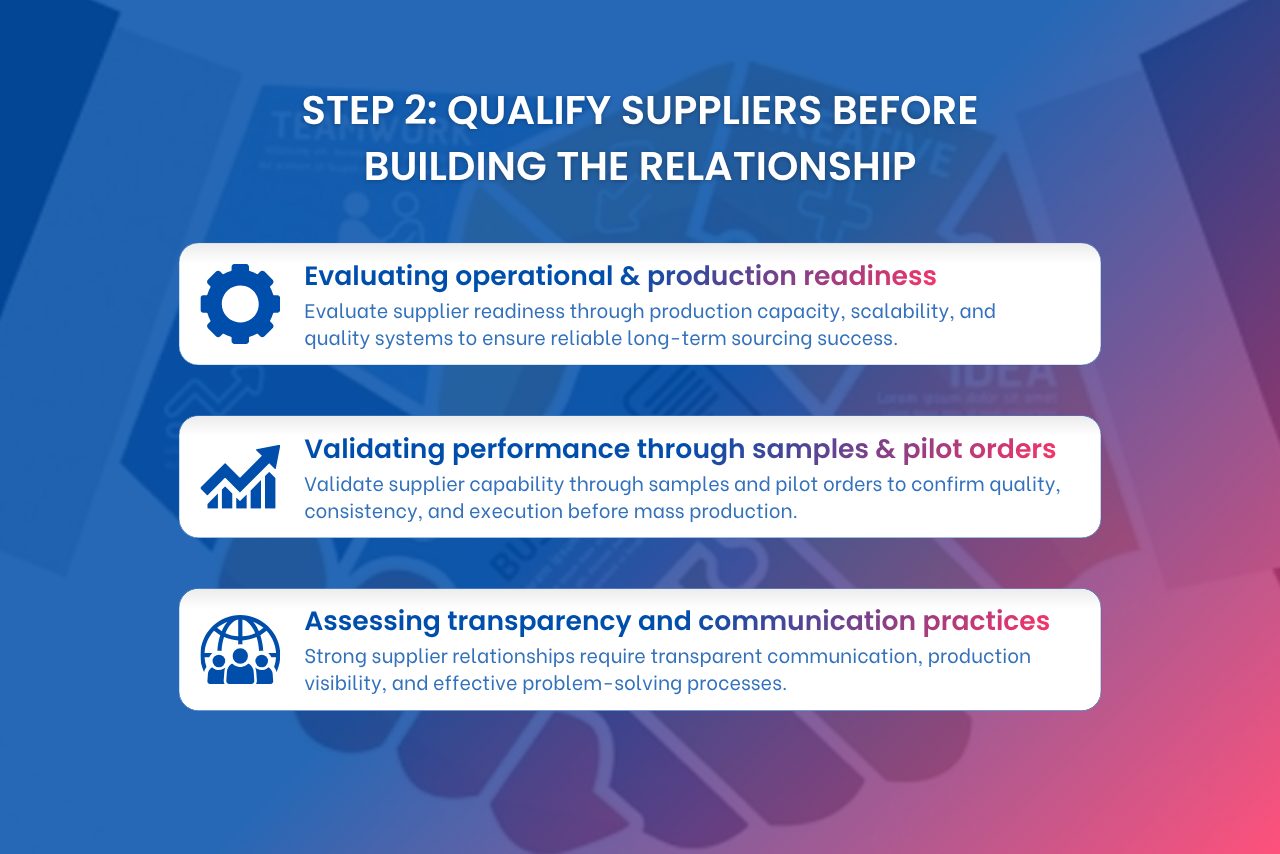
Companies validate suppliers through production readiness, samples, communication practices, and capability assessment
Step 3: Build A Strong Supplier Relationship
Once suppliers are qualified, the focus naturally shifts to how both sides work together in real operations. At this stage, strong relationships depend on alignment in expectations, communication discipline, and execution consistency across the entire production process.
Aligning expectations from the beginning
In supplier relationship management, most production issues occur when expectations are not clearly defined at the start. This is common in lifestyle sourcing, where frequent changes in materials, colors, and packaging often lead to deviations during mass production and create avoidable operational risks.
- Quality standards and acceptance criteria, including defect thresholds and inspection methods
- Lead times and production milestones are aligned with actual factory capacity and workload
- Packaging and product specifications, based on retail, logistics, or export requirements
For example, in home décor sourcing in Vietnam, unclear carton strength or labeling requirements often lead to shipment rework or export delays. Hence, early alignment improves execution accuracy and reduces supply chain risks.
Establishing clear communication and collaboration
In supplier relationship management, communication gaps often lead to delayed responses, production errors, and increased costs. This is especially relevant in lifestyle sourcing, where demand shifts quickly and suppliers must adjust materials, capacity, and schedules based on updated requirements.
Furthermore, strong supplier relationships also depend on buyer discipline. Suppliers can only perform well when buyers provide clear briefs, timely feedback, realistic forecasts, and controlled specification changes. In lifestyle sourcing, delayed approvals or unclear design revisions can create production pressure and quality risks. Therefore, supplier relationship management should also define what the buyer must provide to keep cooperation stable.
Key practices include regular production updates to track progress and detect risks early, forecast and demand sharing to support supplier planning, and clear feedback and decision-making processes to resolve issues efficiently.
For example, in ASEAN sourcing, regular demand forecasts help suppliers secure raw materials earlier, reducing delays and improving delivery stability across production cycles.
| Local execution and communication quality often depend on how supplier ecosystems operate in each market. 👉 See how local ecosystems influence sourcing success in ASEAN. |
Building trust through consistent execution
Trust usually becomes visible after production starts. At this stage, planned requirements meet real factory conditions. In lifestyle sourcing, this stage is often sensitive because design changes, material adjustments, and shifting delivery schedules can easily disrupt execution. When performance is not stable, even small deviations may impact product quality, lead times, and downstream logistics planning.
Key practices focus on three core areas:
- Delivering on commitments: Consistent execution of quality standards, lead times, and order volume
- Managing expectations realistically: Alignment with production capacity, seasonal demand, and material availability
- Aligning on shared business objectives: Long-term supply stability, cooperation consistency, and mutual growth goals
For example, in apparel sourcing across ASEAN, suppliers that consistently meet inspection standards and on-time delivery requirements are often prioritized during peak seasons. As a result, trust is built step by step through stable execution, making coordination more predictable and reducing the need for intensive supervision over time.
Step 4: Manage Production And Supplier Performance
After supplier relationships are established, the focus shifts to controlling execution quality during production. This stage ensures consistency, reduces operational risks, and supports continuous improvement across suppliers.
Manage changes throughout the production cycle
In lifestyle sourcing, production changes often occur when buyers adjust designs, materials, or packaging requirements based on market demand. Without a clear process, even small updates can create confusion between buyers and suppliers, leading to delays and inconsistent output. Consequently, businesses need a controlled approach to manage changes before they reach production.
A structured change process includes reviewing each adjustment for feasibility, confirming updated specifications on both sides, and tracking impacts on cost and timeline. For instance, in ASEAN sourcing, unclear approval of material changes often leads to rework or mismatched batches. With proper control, businesses maintain product consistency, reduce operational risks, and keep production aligned throughout the cycle.
Control the gap between samples and mass production
In lifestyle sourcing, a gap often appears between the approved sample and final mass production due to scaling, material variation, or inconsistent interpretation of specifications. Without control, this leads to quality deviation and rework.
To reduce this risk, businesses should focus on structured control points:
- Production scaling effects: When shifting from sample to bulk, changes in machine load and workflow can create variation in stitching, finishing, or assembly quality.
- Material variation: Small differences in raw materials, dye lots, or substitutions may affect color, texture, and durability.
- Specification misinterpretation: Unclear instructions lead to assumptions on the factory floor, causing inconsistent output and quality gaps.
Address quality issues and corrective actions collaboratively
Quality issues can appear at any stage of production, even when suppliers are experienced. These problems often come from material variation, process gaps, or unclear execution standards. Instead of treating them as isolated incidents, businesses should focus on identifying the root cause and improving the overall process to prevent repetition.
Effective corrective actions include reviewing the source of the issue to understand whether it comes from materials, production steps, or communication gaps. Next, both sides should agree on clear improvement steps and assign responsibility. Finally, businesses need to monitor future production results to ensure corrections are applied consistently and quality stability is maintained across batches.
Use supplier scorecards and performance reviews
Supplier issues often appear only when they impact production output, delivery timing, or communication flow. Without a structured system, evaluation depends on informal feedback, making supplier comparison and early risk detection difficult. A supplier scorecard turns daily operations into measurable indicators for clearer assessment, for example:
- Quality performance: Defect rates, consistency, and specification compliance
- Delivery reliability: On-time shipment and lead time accuracy
- Communication effectiveness: Responsiveness and coordination clarity
- Improvement progress: Ability to resolve issues and enhance processes
Regular reviews based on these metrics help businesses identify strong suppliers early, correct weaknesses, and maintain stable sourcing performance across future production cycles.
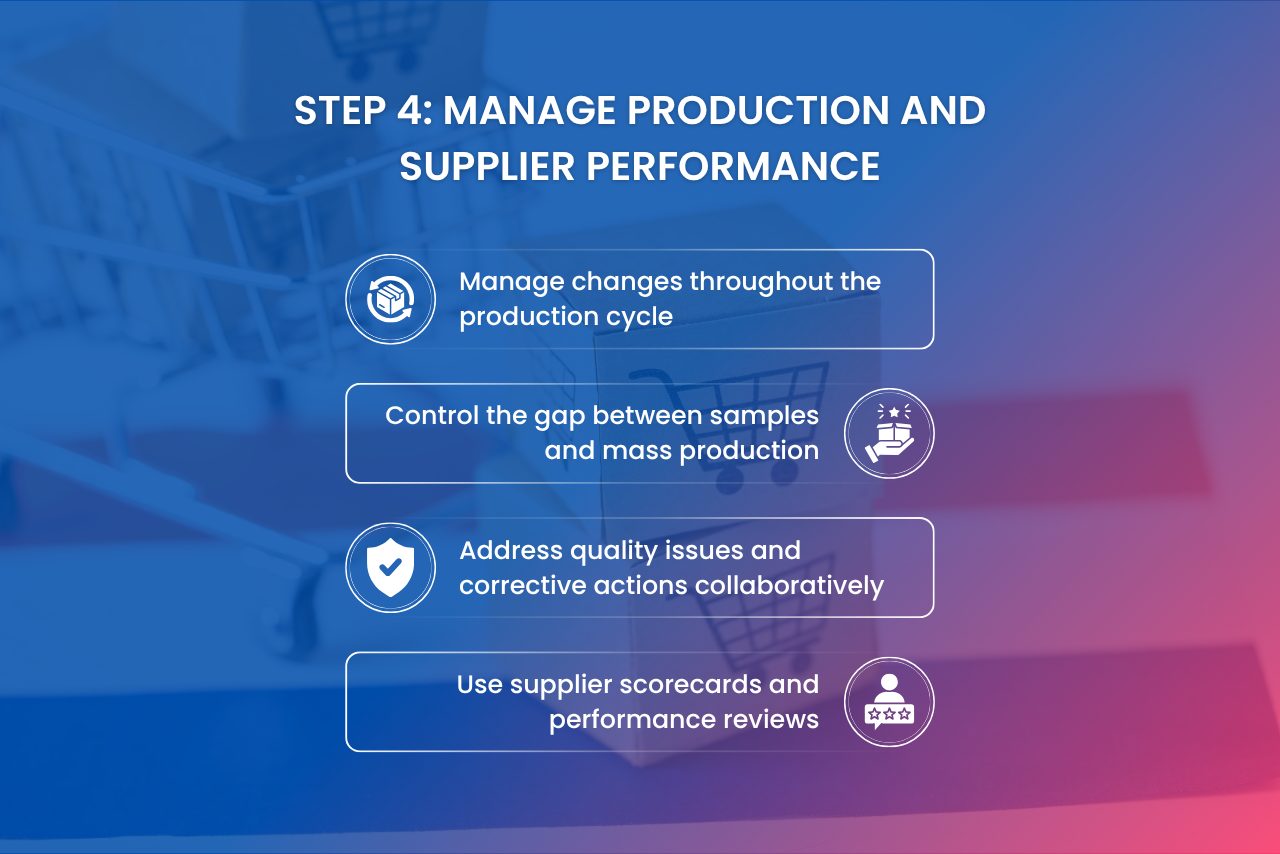
Business manages production changes, quality issues, and supplier performance to maintain stable sourcing outcomes
Final Thoughts
Supplier relationship management is built through a structured process that connects supplier selection with execution control in real operations. Across lifestyle sourcing, businesses need consistency from qualification to production management, especially when product requirements shift frequently. A clear framework helps reduce risks, improve coordination, and maintain stable output across markets.
Knowing that, Source of Asia supports companies in identifying qualified suppliers and strengthening sourcing decisions across ASEAN. Our approach also supports coordination during evaluation and production stages, helping businesses improve control and responsiveness in multi-market supply chains. This enables more stable execution and better alignment between requirements and supplier capability.
| 👉 Need support managing supplier relationships in ASEAN? Contact Source of Asia to strengthen supplier qualification, production follow-up, and local coordination. |
Frequently Asked Questions
Supplier relationship management is the structured approach to managing suppliers across selection, qualification, communication, and performance control. It focuses on ensuring quality consistency, delivery reliability, and long-term collaboration while reducing sourcing risks in complex supply chains.
Businesses need clear change control processes, updated specifications, and fast alignment with suppliers. Regular communication and structured approvals help avoid misinterpretation and keep production stable during design or material changes.
Local support is not always mandatory, but it can significantly improve coordination speed, supplier visibility, and issue resolution. In ASEAN, where regulations and supplier capabilities vary, on-ground support helps ensure smoother execution and faster response to production challenges.
We support end-to-end sourcing through supplier identification and qualification, sample follow-up and RFQ coordination, production monitoring with quality control, and local execution across ASEAN to ensure stable, compliant, and efficient supply chain operations.