Introduction
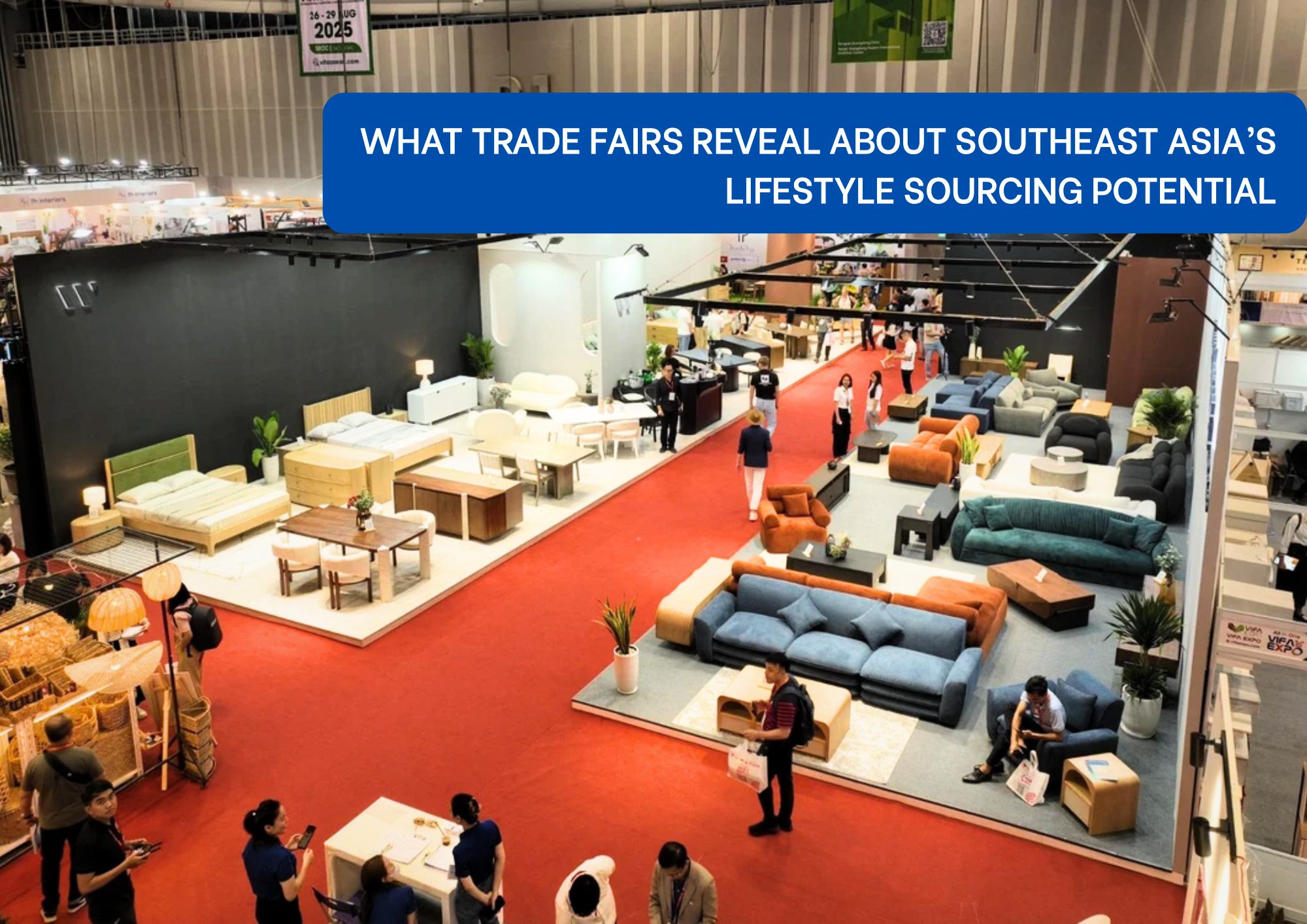
Trade fairs are showing that Southeast Asia is gaining increasing visibility in lifestyle sourcing. Across regional exhibitions, buyers can discover suppliers offering furniture, homeware, home décor, giftware, kitchenware, fashion accessories, outdoor lifestyle products, and packaged consumer goods. This growing presence reflects the continued development of ASEAN manufacturing and export ecosystems.
However, discovering suppliers is only the first step. Trade fairs can help buyers compare products and identify potential partners, but they cannot fully verify production capability, compliance readiness, quality consistency, or sourcing reliability. These factors usually become clear only after structured supplier evaluation, sample checks, and factory follow-up.
In this guide, we, Source of Asia, explain what trade fairs reveal about ASEAN’s lifestyle sourcing potential and how buyers assess suppliers before making sourcing decisions.
Key Insights
- Trade fairs accelerate supplier discovery but require deeper validation for capability and compliance accuracy.
- Online sourcing tools lack visibility into real production quality, customization ability, and operational depth.
- Supplier capability differences become visible only through samples, audits, and structured RFQ processes.
- Local coordination is essential to reduce communication gaps and ensure execution consistency after trade fairs.
- Parallel supplier evaluation improves sourcing decisions by comparing capacity, compliance, and ecosystem strength.
Why Lifestyle Sourcing Buyers Still Rely On Trade Fairs
Trade fairs continue to play a central role in supplier discovery despite the growth of digital sourcing platforms. For many buyers, a sourcing trade fair remains the most efficient way to evaluate multiple suppliers within a short timeframe.
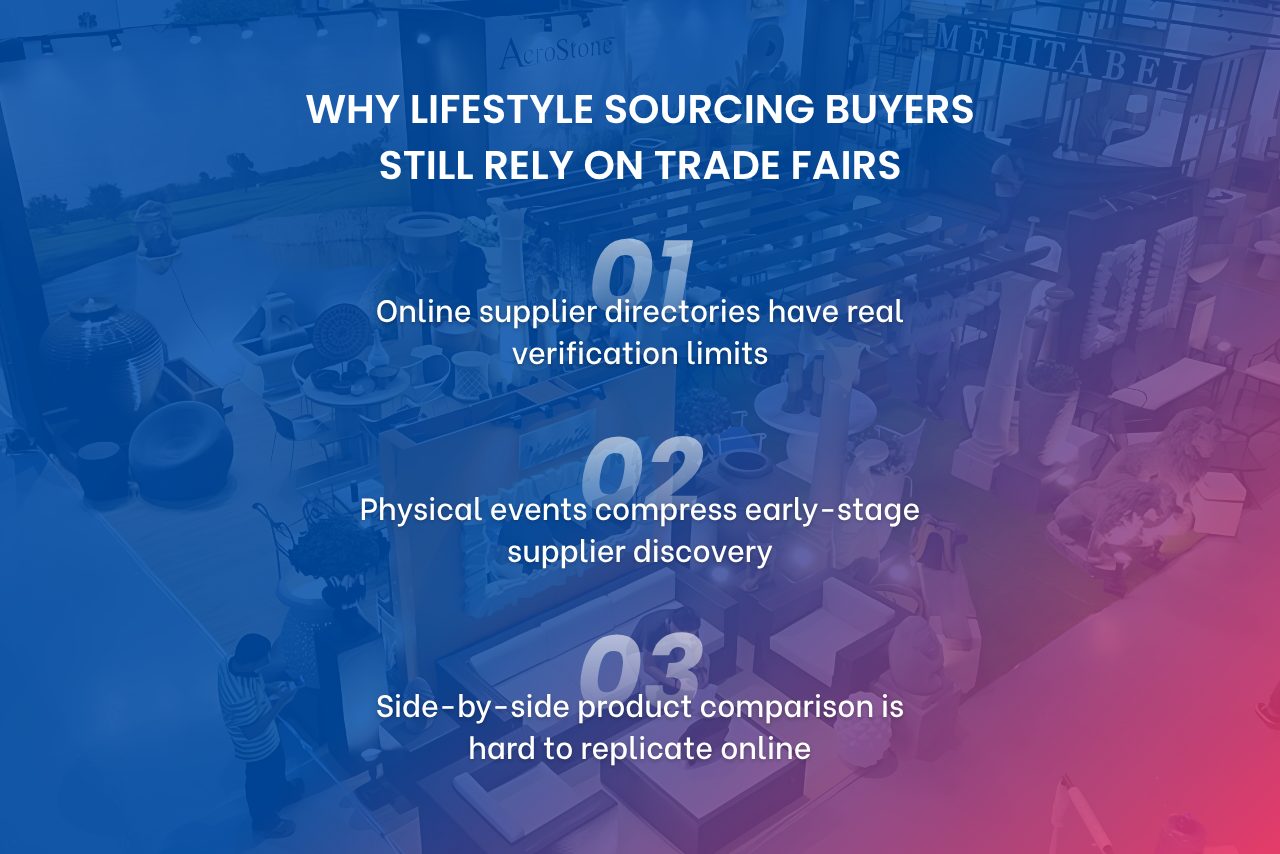
Trade fairs help buyers validate products, compare suppliers directly, and accelerate early-stage supplier discovery.
Online supplier directories have real verification limits
Online supplier directories have made supplier discovery faster and more accessible. Buyers can search thousands of suppliers, compare product categories, and build an initial shortlist without significant time or travel costs.
However, successful supplier discovery involves more than identifying companies. Buyers also need to understand whether a supplier’s products, capabilities, and positioning align with their sourcing requirements. Online profiles often provide limited visibility into:
- Product quality and finishing standards
- Design and customization capabilities
- Material selection and sourcing expertise
- Category specialization and market focus
As a result, suppliers that look similar online may perform very differently in practice. Therefore, many buyers still rely on trade fairs to compare products firsthand and identify the most relevant suppliers more efficiently.
Physical events compress early-stage supplier discovery
Trade fairs bring a large number of suppliers together in one location, making supplier discovery more efficient. Instead of spending weeks reviewing online listings and scheduling separate meetings, buyers can compare suppliers across multiple lifestyle categories within a few days and build a stronger initial shortlist.
More importantly, face-to-face interactions provide insights that are difficult to obtain online. Buyers can assess product development capabilities, customization flexibility, communication quality, responsiveness, and export experience through direct discussions. Hence, trade fairs help buyers identify the most suitable suppliers faster and move into the qualification stage with greater confidence.
Side-by-side product comparison is hard to replicate online
Many lifestyle products require physical evaluation before buyers can make informed sourcing decisions. Although online catalogs provide images and specifications, they often cannot fully convey important product characteristics, including material quality, surface finish, color consistency, craftsmanship, and design details.
This is particularly relevant for categories such as furniture, home décor, home textiles, giftware, fashion accessories, and outdoor lifestyle products. At trade fairs, buyers can compare products from multiple suppliers side by side, allowing them to assess quality differences, manufacturing strengths, and supplier specialization more efficiently. Consequently, buyers gain a clearer understanding of available options than they would through online research alone.
| 👉 Looking for relevant trade fairs in ASEAN? Explore upcoming industry-specific trade events and sourcing opportunities across the region. |
What Trade Fairs Reveal About Southeast Asia’s Lifestyle Sourcing Potential
Supplier participation shows how Southeast Asia’s lifestyle sourcing landscape is evolving. It also helps buyers identify category strengths, supplier capabilities, and early signs of export readiness.
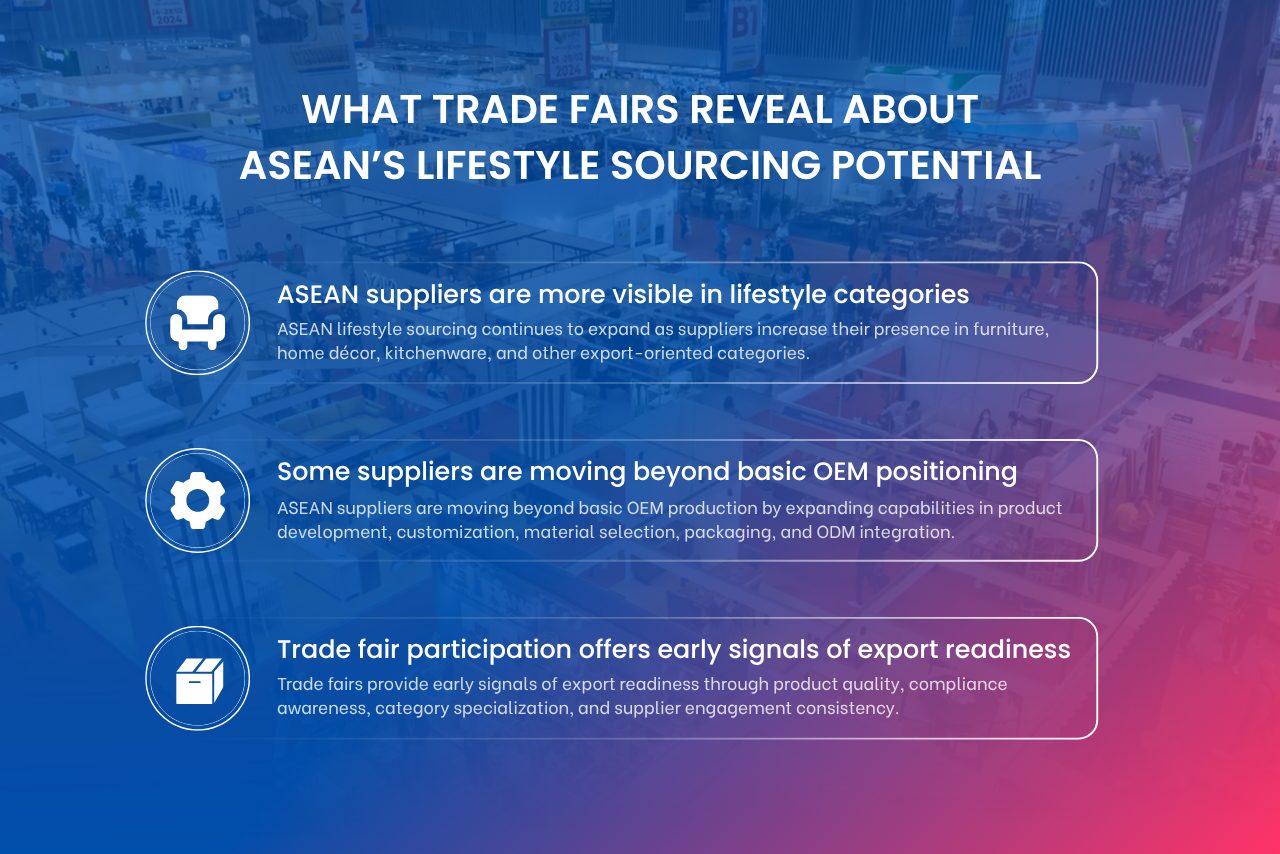
Supplier participation can reveal category specialization, capability development, and early indicators of export readiness across ASEAN lifestyle sourcing markets.
ASEAN suppliers are more visible in lifestyle categories
ASEAN suppliers are becoming more visible across lifestyle sourcing segments, reflecting stronger participation in export-oriented networks. Vietnam, Thailand, and Indonesia appear more consistently in home décor, furniture, kitchenware, giftware, and fashion accessories. This shift reflects clearer category specialization and stronger export-facing visibility.
For example:
- Vietnam is often considered relevant for furniture, homeware, and export manufacturing categories.
- Thailand can be relevant for design-led lifestyle goods, décor, and selected consumer products.
- Indonesia is often associated with craft-based products, natural materials, and home décor categories.
Consequently, dedicated lifestyle zones in trade fairs and sourcing platforms indicate where ASEAN manufacturing ecosystems are structurally expanding and becoming more export-visible.
| Each ASEAN market plays a different role in lifestyle manufacturing. 👉 Explore our Country Profiles for deeper market insights. |
Some suppliers are moving beyond basic OEM positioning
ASEAN manufacturing is gradually shifting from OEM – focused production to more capability-driven models, as buyers increasingly require upstream support in product development. This change is visible across Vietnam, Thailand, and Indonesia, where suppliers are expanding beyond execution-only roles.
In practice, suppliers are now building capabilities in:
- Product design input aligned with functional needs
- Material selection and development for performance improvement
- Customization across components and specifications
- Packaging development for export readiness
- ODM integration covering design and production
This reflects a move toward value-added manufacturing in ASEAN supply chains, with stronger alignment between production systems and product development requirements.
Trade fair participation offers early signals of export readiness
Trade fair participation provides early indicators of supplier export readiness, particularly in ASEAN lifestyle sourcing. In sourcing practice, supplier presence is not only about visibility but also about how consistently they meet international buyer expectations.
Key signals include:
- Product presentation quality, reflecting production stability and design control
- Compliance readiness, indicating the ability to meet export and regulatory requirements
- Category specialization, showing depth in specific lifestyle segments
- Consistency in buyer engagement, reflecting operational maturity
Together, these factors help buyers assess which supplier ecosystems may be better prepared for international buyer requirements. Trade fairs, therefore, function as a screening layer, helping identify manufacturing clusters that can support structured international sourcing requirements.
What Trade Fairs Cannot Confirm About Supplier Capability?
Trade fairs provide visibility into suppliers’ presence and positioning, but they do not fully verify production capacity, commercial accuracy, or compliance integrity, which require deeper due diligence through audits and structured validation.
Booth presence does not confirm real production capacity
Booth presence at trade fairs reflects marketing investment and presentation capability, not verified manufacturing strength. In sourcing practice, this distinction is critical when assessing supplier reliability in ASEAN lifestyle sectors.
A professional booth does not confirm:
- Factory scale or actual production capacity
- Workforce capability and skill depth
- Equipment availability and utilization rates
- Subcontracting or outsourcing practices
In many cases, the true operating environment only becomes clear during factory audits and production verification. This gap often leads to sourcing risks, as initial exhibition impressions may not align with actual manufacturing conditions, particularly in fragmented supplier ecosystems across the region.
On-site pricing is rarely the final commercial position
At trade fairs, pricing is generally indicative rather than final, as suppliers present initial quotations to support early-stage discussions. In ASEAN lifestyle sourcing, these figures often reflect simplified assumptions rather than confirmed production parameters.
However, final pricing is established only after RFQ validation, where MOQ requirements, material specifications, packaging structures, testing standards, payment terms, and delivery conditions are fully defined. Without this alignment, on-site comparisons can misrepresent the actual cost structure and sourcing feasibility.
In addition, sample outputs do not ensure mass production consistency, as controlled prototypes differ from scaled manufacturing conditions. This gap is typically clarified during factory audits and production execution reviews.
Compliance claims require independent verification
Compliance is a critical risk factor in international sourcing, especially in ASEAN lifestyle sourcing, where regulatory requirements vary across destination markets. At trade fairs, suppliers may present certifications; however, these documents do not always confirm full or current compliance status.
Before supplier qualification, claims must be independently verified. For example, products sold in the European Union may need to meet REACH requirements for restricted substances. Toy-related products may require EN71 testing, while electrical or electronic lifestyle products may fall under RoHS.
Requirements for the United States, Australia, and other destination markets also vary by product category, material, labeling, and consumer safety rules. Therefore, third-party audits and testing remain essential to ensure regulatory alignment before final supplier approval.
| 👉 Compliance verification is only one part of supplier qualification. Explore why the process often takes longer than buyers initially expect. |
What Buyers Need To Do After The Fair
Post-fair sourcing requires a structured follow-up process to validate supplier capability, standardize evaluation, and reduce risk before moving into final qualification and production decisions.
Shortlist suppliers on capability, not first impression
First, supplier shortlisting should move beyond exhibition impressions and focus on structured capability evaluation. This helps reduce the risk of selecting partners based on presentation quality rather than operational strength. A practical assessment framework typically includes:
| Evaluation Area | Key Focus |
| Capacity | Production capability and scalability |
| Compliance | Certifications and regulatory readiness |
| Export History | Experience serving international buyers |
| Quality Systems | Process control and consistency |
| Communication | Responsiveness and technical understanding |
In practice, maintaining three to five suppliers per category creates a balanced evaluation pool. This range supports meaningful comparison while avoiding excessive complexity in sourcing decisions, especially in fragmented ASEAN supplier ecosystems.
Request samples and quotations through a clear process
Second, supplier follow-up should be based on a structured and standardized request workflow, as uncoordinated communication after trade fairs often leads to inconsistent outputs and unclear comparisons. Sample requests should clearly define:
- Material specifications
- Dimensions and design requirements
- Color and finish standards
- Packaging requirements aligned with end-market use
All suppliers must receive a standard RFQ template, ensuring alignment in how information is collected and evaluated. This allows consistent comparison of pricing, lead time, and service capability under the same sourcing conditions.
Without this discipline, supplier engagement tends to lose momentum after the exhibition stage, making downstream sourcing decisions less structured and harder to validate.
Evaluate multiple suppliers in parallel before committing
Third, supplier evaluation should go beyond selecting a single strong factory, as sourcing outcomes are influenced by the broader supplier ecosystem rather than isolated performance. A parallel assessment helps buyers compare key capabilities across multiple suppliers in a structured way.
In practice, this includes evaluating compliance readiness, product specialization, production scalability, supply chain support, and category expertise. Moreover, ecosystem strength directly affects lead-time stability and sourcing resilience, especially when managing multi-country sourcing across ASEAN. Therefore, parallel evaluation improves decision quality and reduces dependency risks before final supplier commitment.
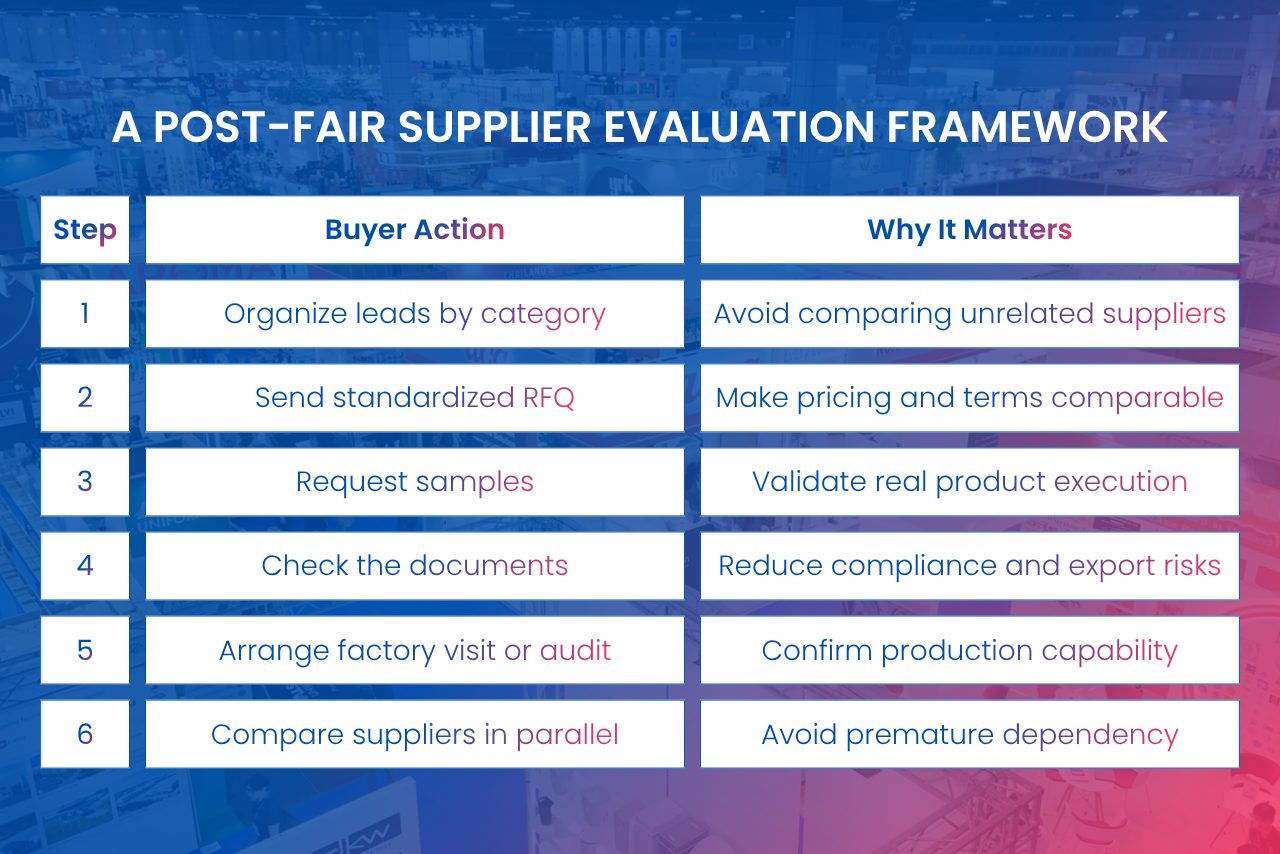
After trade fairs, buyers need structured supplier evaluation, standardized RFQs, and parallel comparison to support more reliable sourcing decisions.
Why Local Coordination Matters After Trade Fairs
Post-fair sourcing often depends on local coordination. Distance-based communication can create gaps in alignment, execution speed, and supplier consistency.
Remote management creates compounding delays
Post-trade fair sourcing requires strong local coordination, as remote management often creates communication gaps that slow supplier alignment and reduce execution accuracy. Without consistent follow-up, small discrepancies in requirements can escalate into operational delays.
- Time zone differences impacting communication speed
- Language gaps reducing technical clarity in specifications
- Delayed supplier responses are affecting decision cycles
- Misinterpretation of materials, packaging, or product details
- Slow resolution of sampling and production issues
A single misunderstanding in materials, packaging, or product details can lead to weeks of delay in production planning and execution. These risks are often not visible at early stages but typically emerge once sourcing moves into scheduling and manufacturing phases.
Technical alignment needs consistent local presence
Lifestyle products require precise technical alignment, as small deviations in materials, finishing, or packaging can directly affect product quality and compliance outcomes. Without consistent coordination, key specifications may be misunderstood during cross-border communication.
To ensure consistency across suppliers, key technical elements must be clearly defined from the outset:
- Material specifications and composition details
- Surface treatment and finishing requirements
- Packaging structure and labeling standards
- Quality expectations across production batches
Hence, local coordination plays a critical role in ensuring accurate information transfer, faster clarification cycles, better supplier alignment, and reduced rework. This becomes even more important when managing multiple suppliers simultaneously across fragmented ASEAN sourcing networks.
On-ground coordination turns leads into long-term partners
Factory visits, sample inspections, and production monitoring require physical presence on the ground to validate supplier capability in real operating conditions. Without this step, trade fair interactions often remain at the level of initial interest rather than structured sourcing execution.
In addition, local teams manage follow-up coordination, quality checks, and issue escalation throughout sampling and production phases. This ensures consistent communication between buyers and suppliers, while also reducing gaps between expectations and actual output. Thus, operational continuity becomes a key factor in distinguishing suppliers who remain leads from those who develop into reliable long-term sourcing partners in ASEAN manufacturing networks.
This is where Source of Asia helps buyers turn trade fair leads into qualified suppliers and reliable sourcing partnerships. We support buyers across the full post-fair cycle:
- Supplier screening and qualification
- Sampling and quotation coordination
- Factory audit support
- Supplier comparison and evaluation
- Local execution for sourcing alignment
👉 Share your challenges with our experts!
Conclusion
Trade fairs act as an important entry point into ASEAN’s lifestyle sourcing ecosystem, providing early visibility into supplier presence, category specialization, and capability signals. However, they do not present a complete assessment of production capacity, commercial accuracy, or compliance readiness, which require deeper validation through structured sourcing processes.
An actual sourcing outcome is determined after the event through supplier evaluation, sampling, audits, and local coordination. Without this execution layer, initial impressions from exhibitions may lead to incomplete or misaligned decisions. Businesses that treat trade fairs only as a discovery channel, without a disciplined follow-through process, risk delays in supplier qualification and long-term sourcing stability.
| 👉 Need support turning trade fair leads into lifestyle sourcing partnerships? Contact us to discuss your requirements. |
Frequently Asked Questions
Lifestyle sourcing is the procurement of consumer products such as home décor, furniture, kitchenware, giftware, and accessories, where buyers evaluate not only price but also design capability, material consistency, compliance readiness, and production scalability across supplier networks.
Trade fairs provide early signals of sourcing potential by showing supplier visibility, product category focus, and initial capability indicators. However, these signals require validation through sampling, audits, and structured RFQ processes to confirm actual production and compliance capability.
Southeast Asia commonly supplies home décor, furniture, kitchenware, giftware, textiles, and fashion accessories. These categories are supported by manufacturing clusters in Vietnam, Thailand, and Indonesia, where production covers both standard and design-driven lifestyle products.