Introduction
International business expansion is a priority for many European companies looking for growth beyond mature home markets. Recently, Vietnam has moved from an emerging option to a more established destination for international business expansion.
With strong trade links to the EU, steady reforms, and a strong manufacturing base, Vietnam offers several viable pathways for business expansion, depending on strategy and execution. In this guide, Source of Asia shares practical insights to help you plan market entry with lower risk and a long-term view.
Key Insights
- EU–Vietnam trade continues to grow despite global pressure, supported by EVFTA market access.
- Vietnam serves as a practical base for ASEAN expansion, allowing regional reach from one location.
- Competitive labor and rising domestic demand support both export production and local sales.
- EVFTA lowers entry costs and early risks, helping EU firms test and scale with more control.
- EU investment now focuses on long-term presence, including R&D centers and regional offices.
- Most challenges come from execution, especially licensing, coordination, and cultural alignment.
Overview of Vietnam-EU Trade and Investment Today
Trade between Vietnam and the EU has kept a steady upward trend in recent years. According to Vietnam Customs data, bilateral trade with the EU reached nearly US$68.4 billion in 2024, and exports to the bloc continued rising in the first eight months of 2025 with US$36.9 billion, up about 8.4% year-on-year.
Vietnam is now a stable trading partner for the EU. The EU remains one of Vietnam’s main export markets, with strong flows of electronics, textiles, furniture, and food products. EVFTA data show that trade continued to grow even during global slowdowns, pointing to deeper and more reliable market access.
EU investment also continues to rise. European companies are expanding in manufacturing, services, and technology, strengthening Vietnam’s role in international business expansion. As a result, Vietnam is now seen as a strategic entry point for long-term growth in Asia, not just a sourcing base.
Why Vietnam Stands Out in International Business Expansion for European Companies
Vietnam offers a balanced mix of cost control, market growth, and policy support. This balance can make business expansion in Vietnam more predictable to plan and manage compared with some other emerging markets. For European companies, this means fewer surprises as you move from entry to scale.
Strategic Location and ASEAN Access
Vietnam sits at the heart of Southeast Asia, offering direct access to ASEAN markets. From this location, you can reach major regional economies within short shipping times. Many European firms use Vietnam as a regional hub to expand your business beyond one country.
This setup helps you:
- Serve ASEAN customers faster
- Centralize production and coordination
- Reduce logistics complexity as you scale
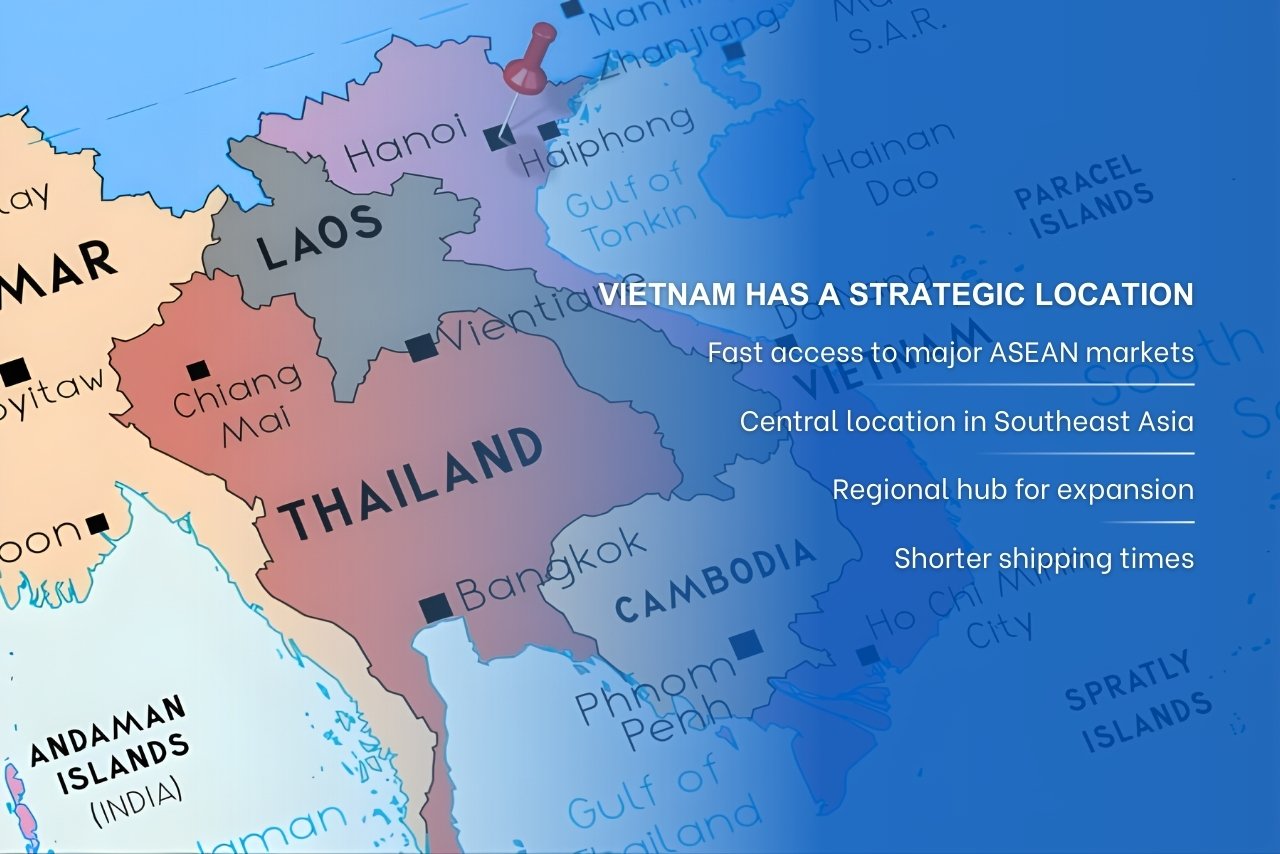
Vietnam’s location makes it a practical hub for reaching ASEAN markets
Competitive Labor and Growing Market
Vietnam combines competitive labor costs with steadily improving skills. Manufacturing experience, technical training, and management quality continue to advance year by year.
At the same time, the country’s fast-growing middle class supports new demand. This allows EU firms to balance export-focused operations with local market entry, based on your international business expansion strategy.
Supportive Policies and Reforms
Vietnam continues to upgrade investment rules through policy reforms and digital processes. Licensing, tax administration, and customs systems show gradual but clear improvement.
While challenges remain, the direction is stable. This policy consistency helps European companies plan long-term expansion with more confidence and fewer regulatory shocks.
How EVFTA Creates Real Business Opportunities
EVFTA creates real business opportunities by lowering entry costs and reducing early-stage risk. This helps EU company enter Vietnam faster and plan with more control.
First, tariff cuts matter. Under EVFTA, over 99% of tariffs will be removed over time, which lets EU goods enter Vietnam at better prices. This makes market testing and scaling easier. According to EuroCham, EU–Vietnam trade reached nearly USD 300 billion between 2020 and mid-2025, showing strong real use of the agreement.
Next, the rules are clearer. EVFTA improves customs steps, product rules, and origin checks. This reduces delays and surprise costs that often slow new markets.
Finally, protection is stronger. As noted by Vietnam Briefing, better IP rules give you more confidence to bring branded and higher-value products.
Taken together, EVFTA lowers certain entry barriers and improves operating clarity. Also, it makes Vietnam more accessible for EU companies considering long-term expansion.

EVFTA helps European companies enter Vietnam with lower tariffs and clearer trade rules
Current Trends in EU Investment in Vietnam
EU investment in Vietnam is moving from short projects to long-term market building. This matters for European companies thinking about where to invest next and how to position their expansion strategy.
Leading countries and key sectors
The European capital keeps growing. According to Vietnam’s General Statistics Office, total registered FDI reached about US$28–30 billion in 2025, with the EU among the largest contributors. Countries such as Germany, France, the Netherlands, Italy, and Denmark remain active investors.
Investment focuses on areas where Vietnam is pushing hard:
- Manufacturing and high-tech production
- Renewable and green energy
- Logistics, healthcare, and consumer goods
Standout projects and companies
EU firms are not just building factories. Many open R&D centers, service hubs, and regional offices in major cities and industrial zones. European clean-energy and high-tech investments are particularly active in Ho Chi Minh City, Hanoi, and northern industrial clusters.
This shift toward deeper local integration means Vietnam rewards companies ready to invest early and build capacity, not just test the market. As you plan your move, the trend toward strategic, high-value investment highlights the importance of both sector choice and execution approach for long-term success.
Common Challenges in International Business Expansion into Vietnam
International business expansion always has pros and cons. Vietnam offers strong upside, but success depends on how early you manage common execution risks.
Regulatory and Administrative Hurdles
Vietnam continues to improve laws for foreign investors, especially after major trade agreements. However, local interpretation still varies. The same rule may be applied differently across provinces, sectors, or authorities. This can affect licensing, tax setup, and customs processes.
Many delays come from small gaps, not major barriers. Companies that study procedures early and follow local practice tend to move faster. Those who rely only on written rules often face rework and longer approval cycles.
Licensing, approvals, and timeline uncertainty
In practice, companies entering Vietnam often fall into two clear groups. The difference is not size or budget, but how early they prepare for local procedures.
On one side, prepared and locally guided companies take time to learn approval steps, document order, and informal expectations. They work closely with local advisors and stay flexible on timelines. Because of this approach, licensing moves more smoothly; risks are spotted early, and delays are easier to absorb.
On the other side, underprepared companies rely on overseas experience or fixed schedules. As a result, they submit incomplete files or misunderstand local requirements. This leads to revisions, unclear feedback, and longer waits. In most cases, delays come from preparation trade-offs, not from Vietnam’s laws themselves.
Cultural gaps
Vietnamese business culture values relationships, respect for hierarchy, and indirect communication. Decisions often build through trust, not confrontation. European managers may expect fast answers or direct feedback, which can cause tension.
When styles clash, deals slow down and teams lose alignment. Companies that invest time in relationship-building often gain smoother negotiations, better cooperation, and stronger long-term results.
Operational coordination gaps
Head office plans often assume stable timelines and clear reporting. Local reality can differ. Suppliers, partners, and teams may work at a different pace or manage risks differently.
Problems arise when expectations stay unclear. Regular updates, simple reporting lines, and local decision authority help bridge the gap. Early alignment prevents small delays from turning into larger operational issues.
Talent availability and management expectations
Vietnam offers a skilled and motivated workforce, but competition for talent is rising. Employees value clear roles, learning paths, and stable leadership. High turnover often links to management style, not salary alone.
European companies may need to adjust how they lead, train, and retain teams. When management adapts early, teams stay longer and perform better.
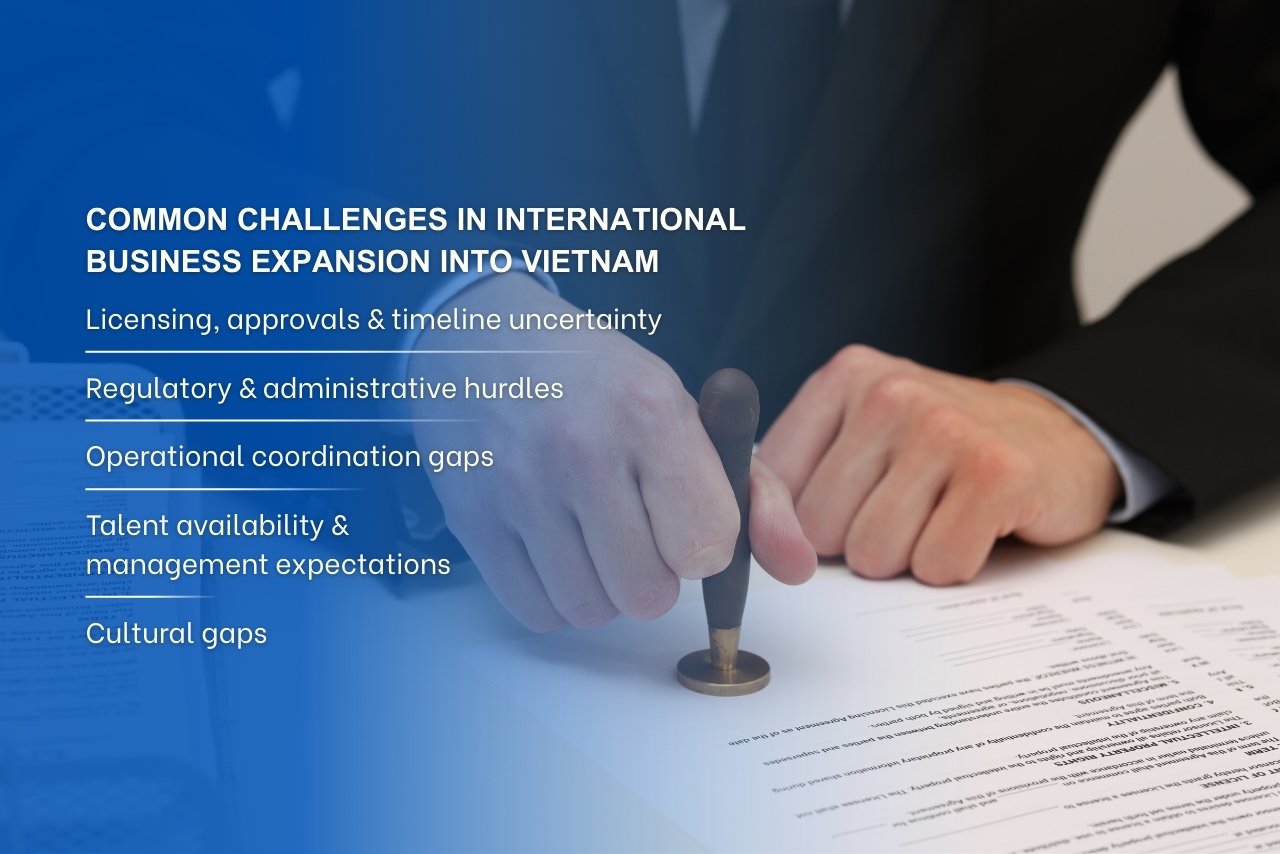
Common challenges often shape the success of business expansion into Vietnam
Final thoughts
International business expansion into Vietnam works best when strategy is aligned with local operating realities. Market size, trade access, and policy support create real opportunity, but execution decides results. The companies that succeed are those that prepare early, understand local patterns, and adapt step by step.
At Source of Asia, we believe that sustainable expansion starts with a clear understanding. If you are considering working with a local partner to expand your business in Vietnam and beyond ASEAN, you can explore some useful insights from our expert:
- Do you need to have a local partner when doing business in Vietnam?
- Doing Business in Vietnam 2024: Comprehensive guidelines for investors.
- Set up your business in ASEAN: A Market Entry Checklist 2025.
Frequently asked questions
For many European companies, the answer is yes. Vietnam offers stable growth, strong trade access, and a large supplier base. Costs stay competitive, while skills continue to improve. That said, success depends on preparation. If you plan entry carefully and understand local rules early, Vietnam can support long-term expansion, not just short-term gains.
The main risk is not cost, but execution. Many companies struggle with licensing steps, unclear timelines, or partner selection. These issues often appear after entry. To reduce risk, you should map procedures early and test assumptions before committing fully. This approach helps you avoid slowdowns later.
Not always, but a local partner often helps. Partners support approvals, supplier access, and daily operations. If you are still researching entry options, the next step is to assess whether local support fits your expansion goals and internal capacity.