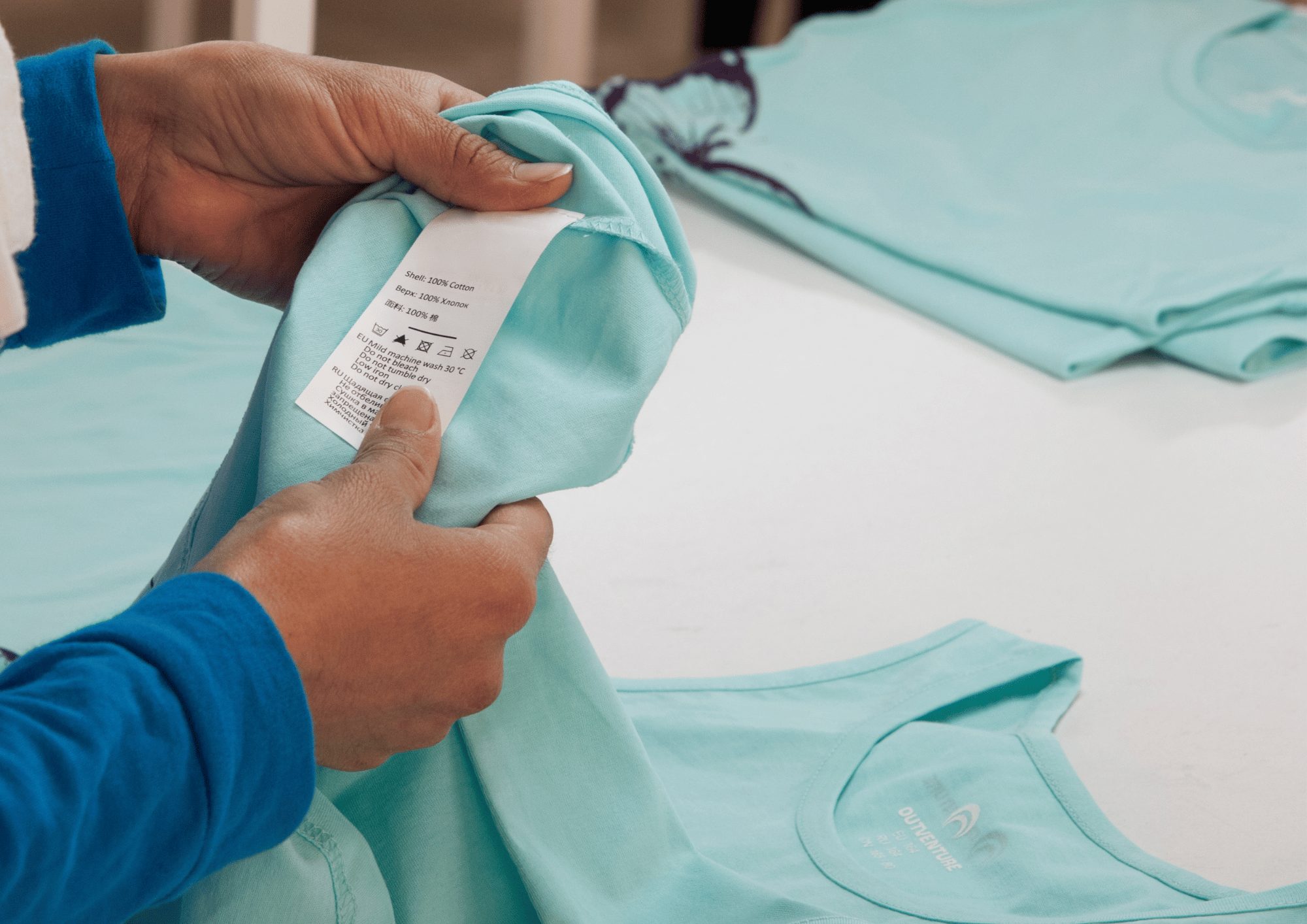
This supply chain audit case study shows how SOA helped a European textile and garments brand assess whether its Vietnam-based supply chain could benefit from EVFTA preferential treatment. The project reviewed rules of origin, transformation criteria, HS codes, and EUR.1 certificate requirements. As a result, the client gained clearer supply chain scenarios and practical recommendations for future compliance and tariff optimization.
KEY RESULTS
EUR.1 eligibility assessed across 7 HS codes
30-page final audit report delivered
Clear supply chain scenarios for EVFTA benefits
Practical recommendations for future compliance and tariff optimization
Building a Clearer View of EVFTA Eligibility
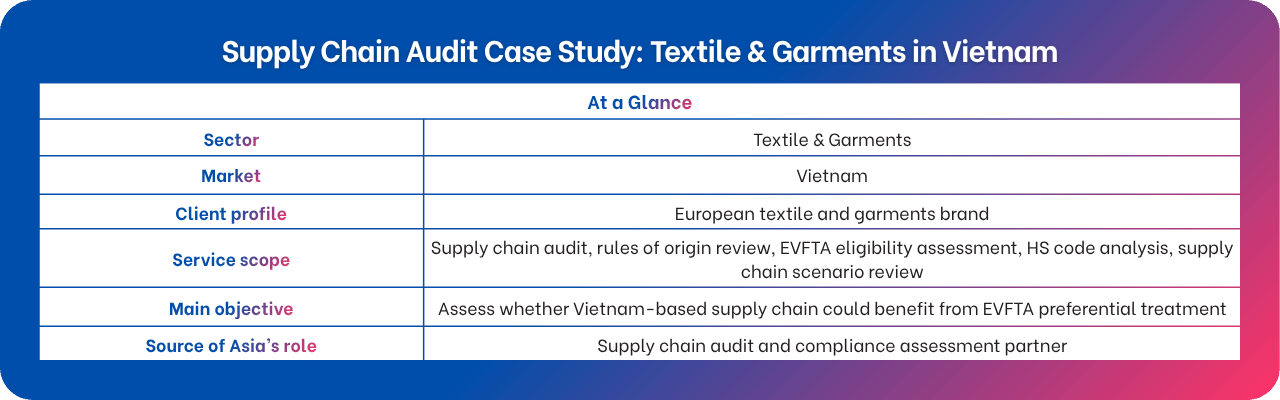
The client already had a Vietnam-based supply chain. However, the business question went beyond supplier performance or product quality. The company needed to know whether its current sourcing and production structure could support EVFTA preferential treatment.
For textile and garments companies, tariff benefits depend on more than the final place of production. Material origin, transformation steps, product classification, and export documents can all affect eligibility. Therefore, the client needed a structured review before making future sourcing or production decisions.
Several questions had to be answered:
- Which HS codes could support EUR.1 eligibility?
- Did the current supply chain meet the required rules of origin?
- Which transformation criteria apply to the client’s products?
- What supply chain scenarios could improve EVFTA benefits?
- What changes should be considered for future compliance?
In this case, a general factory audit would not have been enough. The client needed a supply chain audit focused on origin rules, documentation, and practical trade agreement use.
SOA’s Supply Chain Audit Approach
We designed the audit around the client’s product categories, sourcing flows, and Vietnam-based production structure.
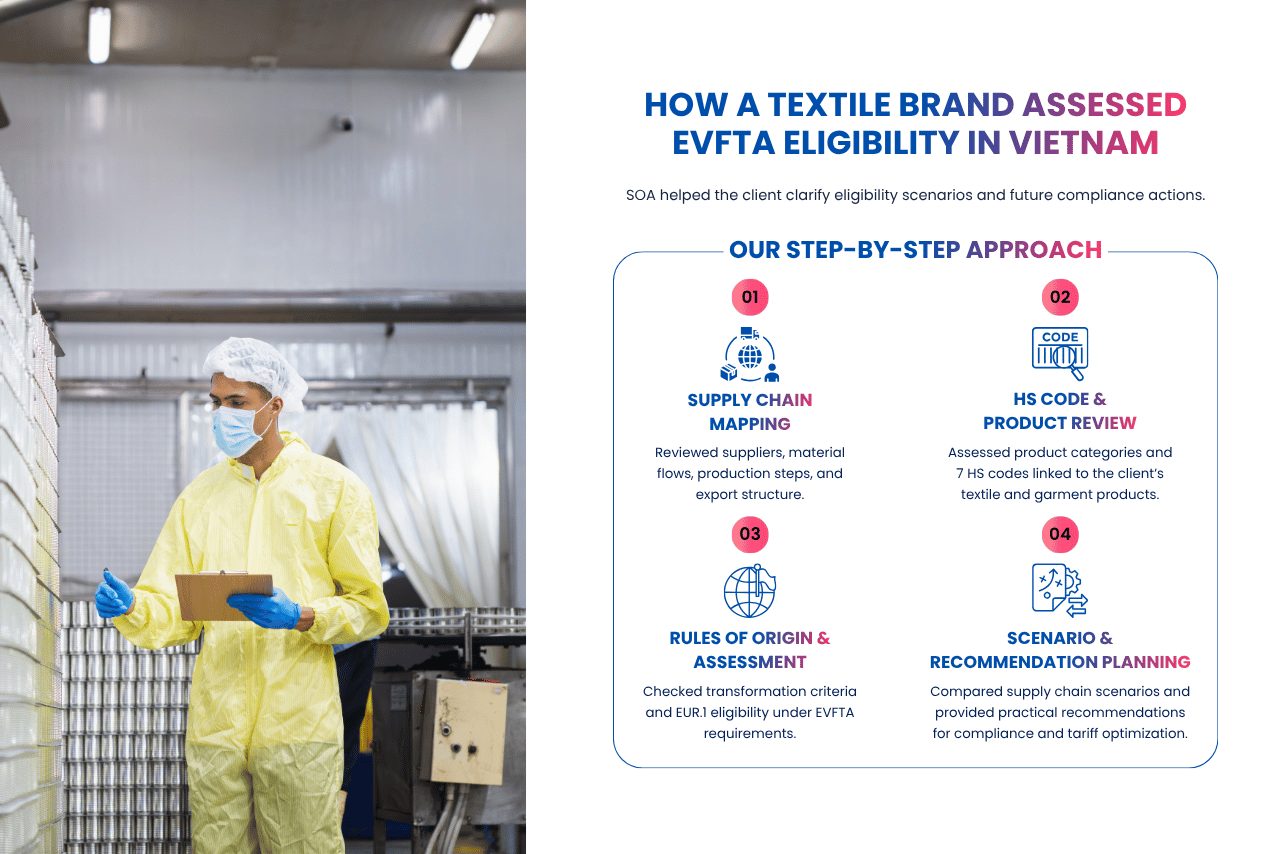
SOA’s step-by-step supply chain audit approach helped the client review HS codes, rules of origin, EUR.1 eligibility, and future compliance actions.
The first step was supply chain mapping. SOA reviewed how materials, production steps, and export flows were organized. This helped identify which parts of the supply chain were relevant for EVFTA analysis and where possible limitations could appear.
The second step focused on HS code and product review. The team assessed 7 HS codes linked to the client’s textile and garments products. This was important because rules of origin can vary depending on product classification. A small difference in product category can change the way eligibility is assessed.
The third step reviewed rules of origin and transformation criteria. SOA checked whether the existing production process could meet the required origin conditions. This part of the audit helped the client understand whether current operations were aligned with EVFTA expectations, and where the supply chain may need adjustment.
The fourth step compared supply chain scenarios. Instead of giving a simple yes-or-no answer, SOA analyzed various routes and provided practical recommendations. This gave the client a clearer view of what could work now, what could be improved, and which options to consider for future tariff optimization.
The final output was a 30-page audit report. It gave the client a structured view of EUR.1 eligibility, origin-related risks, and possible next steps.
Business Impact
The supply chain audit gave the client a clearer understanding of how its Vietnam-based operations aligned with EVFTA preferential treatment.
By reviewing 7 HS codes, Source of Asia helped the client see which product categories had stronger eligibility potential and which areas needed closer attention. This reduced uncertainty before future sourcing and production decisions.
The scenario analysis also added practical value. The client could compare different supply chain options and understand how sourcing choices, transformation steps, and documentation could affect access to EVFTA benefits.
As a result, the company received more than a compliance check. It gained a decision-making tool for future planning. The audit report supported clearer internal discussions around supply chain structure, export documentation, tariff optimization, and long-term compliance.
What Textile and Garments Companies Can Take from This Case
For textile and garments companies sourcing from Vietnam, supply chain performance is only one part of the equation. Trade agreement benefits can also depend on rules of origin, material source, product classification, and the documents used to prove eligibility.
This is why a supply chain audit can be useful before changing suppliers, expanding production, or planning exports. It helps companies avoid assumptions and gives them a clearer view of where risks or opportunities exist.
A factory audit can show whether a supplier is reliable on the ground. However, an origin-focused supply chain audit goes further. It reviews how the full sourcing and production structure supports trade agreement use.
| Interested in responsible sourcing and traceability?
Read more about SOA’s FSC certification renewal and how it reflects our continued commitment to more responsible supply chain practices. |
Planning to Assess Your Supply Chain in Vietnam?
SOA helps international companies review supplier performance, production structure, rules of origin, and trade agreement eligibility in Vietnam and Southeast Asia. From factory audit and supplier review to EVFTA eligibility assessment and supply chain recommendations, our team helps you reduce uncertainty and move forward with clearer operational decisions.
For companies facing similar questions, SOA can support several key steps:
- Quality Control & Supply Chain Audit
- Factory Audit & Supplier Assessment
- Rules of Origin Review
- EVFTA Eligibility Assessment
Together, these solutions help international companies review supplier performance, assess compliance risks, improve supply chain visibility, and make better sourcing decisions in Vietnam and Southeast Asia.

Written by:
Reviewed by:

Quyen NGUYEN
Marketing & Communications Director

Nhi NGUYEN
Head of Sourcing & Supply Chain Operations
With over 8 years of experience in sourcing and supply chain management, Nhi Nguyen currently serves as the Head of Sourcing & Supply Chain Operations at Source of Asia. She is responsible for overseeing the entire sourcing process, from product development to order management and logistics, while leading a dedicated team. Nhi specializes in categories such as furniture, home decor, lighting, pottery, and kids’ items, focusing on key markets including the US, Canada, and Scandinavian countries.
Her expertise spans procurement, cost-benefit analysis, and supply chain optimization across multiple Asian markets, including Vietnam, Indonesia, and China.
FAQs
A supply chain audit reviews how suppliers, materials, production steps, documents, and logistics are organized. It helps identify risks, compliance gaps, and improvement opportunities across the supply chain.
An EUR.1 certificate is a movement certificate used to support preferential tariff treatment when goods meet the required origin rules under relevant trade agreements. It helps prove that exported products qualify for reduced or preferential duties.
Rules of origin determine whether a product can qualify for preferential tariff treatment under a trade agreement. For textiles and garments, eligibility often depends on material origin, transformation steps, HS codes, and export documents.
A factory audit reviews supplier facilities, production capacity, quality systems, and on-site practices.
A supply chain audit looks more broadly at suppliers, sourcing flows, production steps, documents, compliance risks, and trade agreement eligibility.
To audit a supply chain for B Corp readiness, companies should review supplier practices, sourcing flows, labor standards, environmental policies, traceability, and available documentation. A supply chain audit helps identify gaps, improve transparency, and prepare clearer evidence before a formal assessment.
To audit a full supply chain for environmental risks, start by mapping suppliers, materials, production steps, logistics flows, and high-risk activities. Then review energy use, waste, emissions, chemical use, water impact, and compliance documents. This helps prioritize where corrective actions are most needed.
Choose a vendor with local market knowledge, audit experience, sector expertise, and a clear method for checking suppliers, documents, production flows, and traceability gaps. The right vendor should provide practical findings, not only a checklist, so your team can act on the results.
Source of Asia supports supply chain audits through supplier review, factory assessment, rules of origin analysis, HS code review, EVFTA eligibility assessment, and practical recommendations for sourcing and export planning.




Our partnerships are built by people who understand how business works across Southeast Asia.

See how SOA helps companies solve complex business challenges across Southeast Asia.