The Philippines witnessed significant economic growth in 2023, with a robust GDP growth of 5.6% last year, driven by strong domestic consumption and government policies, the country looks set to continue its upward trajectory in 2024. The International Monetary Fund (IMF) and the World Bank both forecast sustained growth, with predictions ranging from 5.8% to 6.3%. As the country eyes its long-term goal of becoming an upper middle-income economy, factors like foreign direct investments (FDI), employment trends, and international relations play a pivotal role. Let’s explore the key factors driving the Philippines’ economic success and its 2024 outlook.
The Philippines’ GDP 2024, building from 2023
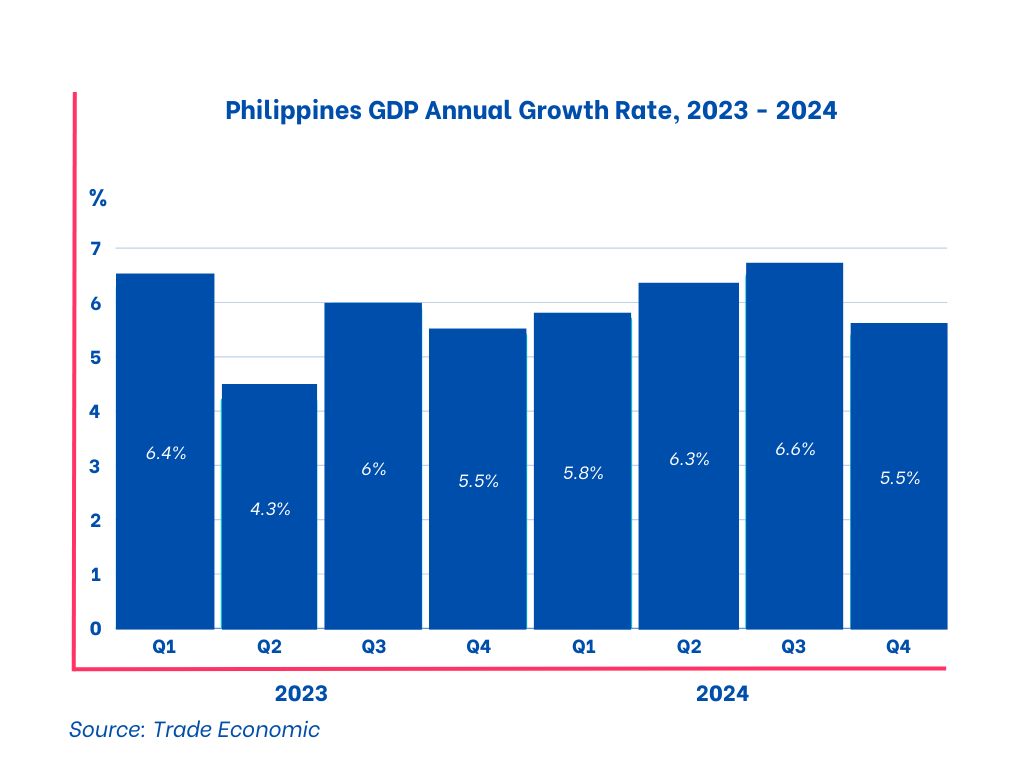
Philippines GDP Annual Growth Rate, 2023 – 2024 | Source: Trade Economics
In 2023, the Philippines’ GDP growth rate exceeded expectations with a 5.6%, surpassing earlier forecasts ranging between 5% and 6.3%. According to the World Bank, the last quarter of 2023 alone saw a 5.8% expansion, highlighting the country’s strong recovery post-pandemic. This economic performance was accompanied by a significant reduction in inflation, which fell to 3.9% by December 2023, down from 8.7% at the year’s start. Key drivers of growth included robust private consumption, increased public investment, and steady demand for Philippine exports. The country’s inflation rate is expected to remain stable within the target range of 2-4% for 2024, offering a conducive environment for further economic expansion. Discover more about the Philippines through our comprehensive country profile.
The Philippines’ economic outlook for 2024
The outlook for 2024 remains optimistic, with various institutions projecting further economic growth. The World Bank has revised its forecast for the Philippines, estimating a 5.8% growth in 2024. Meanwhile, the ASEAN+3 Macroeconomic Research Office (AMRO) expects a 6.3% expansion, positioning the Philippines as the fastest-growing economy in Southeast Asia.
The Philippine government has set an ambitious 6-7% growth target for 2024, driven by several factors:
- Increased Public Investment: The government plans to accelerate infrastructure projects and public investments.
- Improved External Demand: Philippine exports are expected to benefit from the easing of global supply chain bottlenecks.
- Favorable Economic Policies: Structural reforms and the country’s investment-grade credit ratings continue to attract foreign investments.
Despite this positive outlook, challenges remain. Global uncertainties, including geopolitical tensions, the West Philippine Sea dispute with China, and the impact of climate change, could potentially slow growth. Additionally, the El Niño phenomenon could impact agriculture, a crucial sector for the Philippines.
obal geopolitical developments, including US-China trade tensions, continue to shape Malaysia’s economic outlook. However, Malaysia’s balanced diplomatic approach has helped it navigate these challenges.
Employment growth in the Philippines
2023 was a remarkable year for the Philippine labor market. The employment rate rose to 96.4% in November, with the unemployment rate dropping to 3.6%, a significant improvement from the previous year. The Philippines saw a 10% increase in hiring activity, particularly in sectors such as retail (60%), education (49%), business process outsourcing (11%), and healthcare (11%).
The upward trend in employment is expected to continue in 2024, with the country boasting one of the highest employment growth intentions globally. According to AHK, 63% of Philippine businesses plan to increase hiring in the next 12 months, driven by a growing economy and favorable business conditions.
Foreign direct investment (FDI)
Foreign direct investment (FDI) plays a vital role in the Philippines’ economic strategy. In 2023, the country made significant strides, surpassing Malaysia and Thailand in net FDI inflows from January to September. Total foreign investments approved in the third quarter of 2023 reached PHP 27.30 billion, a staggering 109.3% increase compared to the same period in 2022.
The Philippines aims to become the second-highest recipient of FDI in Southeast Asia by 2028. For 2024, the country is targeting approved investments between PHP 1.3 trillion and PHP 1.5 trillion. Key sectors attracting foreign investments include services (47%) and sales and marketing (50%).
The Philippines on the international stage
The Philippines’ growing economic importance is attracting international attention. In 2023, European Commission President Ursula von der Leyen visited Manila, and in early 2024, German Federal Foreign Minister Annalena Baerbock followed suit. These high-level visits underscore the Philippines’ strategic role as a trade and investment partner in the ASEAN region.
President Ferdinand Marcos Jr.’s administration is focused on enhancing the Philippines’ global visibility, positioning it as a key player in Southeast Asia. His government’s goal of achieving upper middle-income status will rely heavily on strengthening international relations and securing foreign investments.
Final Thoughts
The Philippines is poised for continued economic growth in 2024, building on the success of 2023. With forecasts predicting GDP growth between 5.8% and 6.3%, a stable inflation rate, and robust employment trends, the country is on track to achieve its ambitious economic goals. Foreign direct investments, increased public spending, and improved export demand are expected to drive growth, despite potential global risks.
As the Philippines moves closer to its goal of becoming an upper middle-income economy, it will need to navigate challenges such as climate change, geopolitical tensions, and constitutional debates. However, with sound macroeconomic policies and a commitment to reform, the Philippines remains one of Southeast Asia’s most promising economies in 2024.
Source of Asia: helping you navigate opportunities in ASEAN
As part of our commitment to providing valuable insights, we’re excited to introduce our new booklet, “DOING BUSINESS IN ASEAN 2024-2025.” This comprehensive guide offers expert analysis on the economic trends, market opportunities, and regulatory frameworks that businesses need to understand when expanding into ASEAN markets. Whether you’re a multinational corporation or a startup, our booklet will equip you with the knowledge to thrive in the region.

Doing Business in ASEAN 2024 – 2025