
Introduction
When entering Vietnam, many businesses face a common challenge: how much should I pay my employees? Salary data is often fragmented, outdated, or too general to support real hiring decisions. As a result, companies risk offering uncompetitive packages or underestimating the true cost of hiring an employee.
In this guide, we – Source of Asia, clarify how employers should approach salary decisions in Vietnam. This includes market benchmarks, total employee costs, and practical ways to estimate hiring budgets so that companies can make informed decisions with greater cost control and predictability.
Key Insights
- Employers must account for base salary, statutory contributions, and benefits to calculate the full cost of hiring an employee in Vietnam.
- Use market benchmarks by role, seniority, industry, and city to set competitive salaries that attract and retain top talent.
- Mandatory contributions and benefits can raise total payroll costs to over 1.3 times base salary, impacting hiring budgets and decisions.
- Adjust compensation by location and industry, as Ho Chi Minh City, Hanoi, and IT roles demand higher pay due to talent scarcity.
- Strategically balance base salary, bonuses, and benefits to remain competitive, improve retention, and control overall hiring costs.
Average Salary Levels in Vietnam by Role and Industry
Understanding salary benchmarks is essential to position your offer correctly and avoid misalignment with the market. In Vietnam, salary levels vary significantly based on experience, role scope, and industry demand.
Salary ranges by role and seniority
Salary progression in Vietnam generally follows experience, but the gap between levels can be wide depending on the function and market demand:
- Junior level (0–2 years): Focused on execution tasks. Salary levels are relatively stable and cost-efficient for employers to build entry-level teams.
- Mid-level (3–5 years): This is the most competitive segment. Employees at this level combine execution with independent responsibility, leading to higher demand and upward pressure on salaries.
- Senior level (5+ years): Salary ranges vary widely depending on expertise, leadership responsibility, and industry. Roles with decision-making authority or team management typically command significantly higher compensation.
In practice, salary trends in Vietnam vary by function, reflecting differences in demand, talent availability, and the level of expertise required for each role.
- Administrative roles remain relatively stable across levels
- Functions such as finance, marketing, and supply chain show clearer progression at mid-level
- Senior roles are less standardized and require closer market benchmarking
Accurate benchmarking at each level helps you define a salary range that remains competitive while staying within budget.
Differences by industry and major cities
Location and industry directly affect how much should I pay my employees in Vietnam and how quickly you can hire.
- Ho Chi Minh City: As the main business hub, salaries are typically 10–20% higher than the national average due to strong demand and higher living costs
- Hanoi: Offers a stable talent pool for corporate roles, with salary levels generally slightly lower than Ho Chi Minh City but still competitive for administrative and professional positions
- Emerging provinces (e.g., Da Nang, Binh Duong): Salaries can be 10–30% lower, but talent availability is more limited, especially for mid- to senior-level roles
Industry differences also create clear gaps:
- Information Technology: Mid-level developers typically range from USD 1,000–2,000/month, while senior roles can exceed USD 3,000, reflecting ongoing talent shortages. Companies in this field often leverage tax incentives for software services to balance these high talent costs
- Manufacturing: Engineers and supervisors often range from USD 800–1,800/month, with higher levels in FDI-driven industrial zones
- Sales & Marketing: Mid-level roles range from USD 700–1,500/month, with total income increasing through performance-based incentives
- Administration: Salaries remain more stable, typically between USD 400–900/month for most roles, depending on experience
To get the full answer on how much should I pay my employees, you can view the Vietnam Salary Guide 2026 to align your compensation strategy with market data.
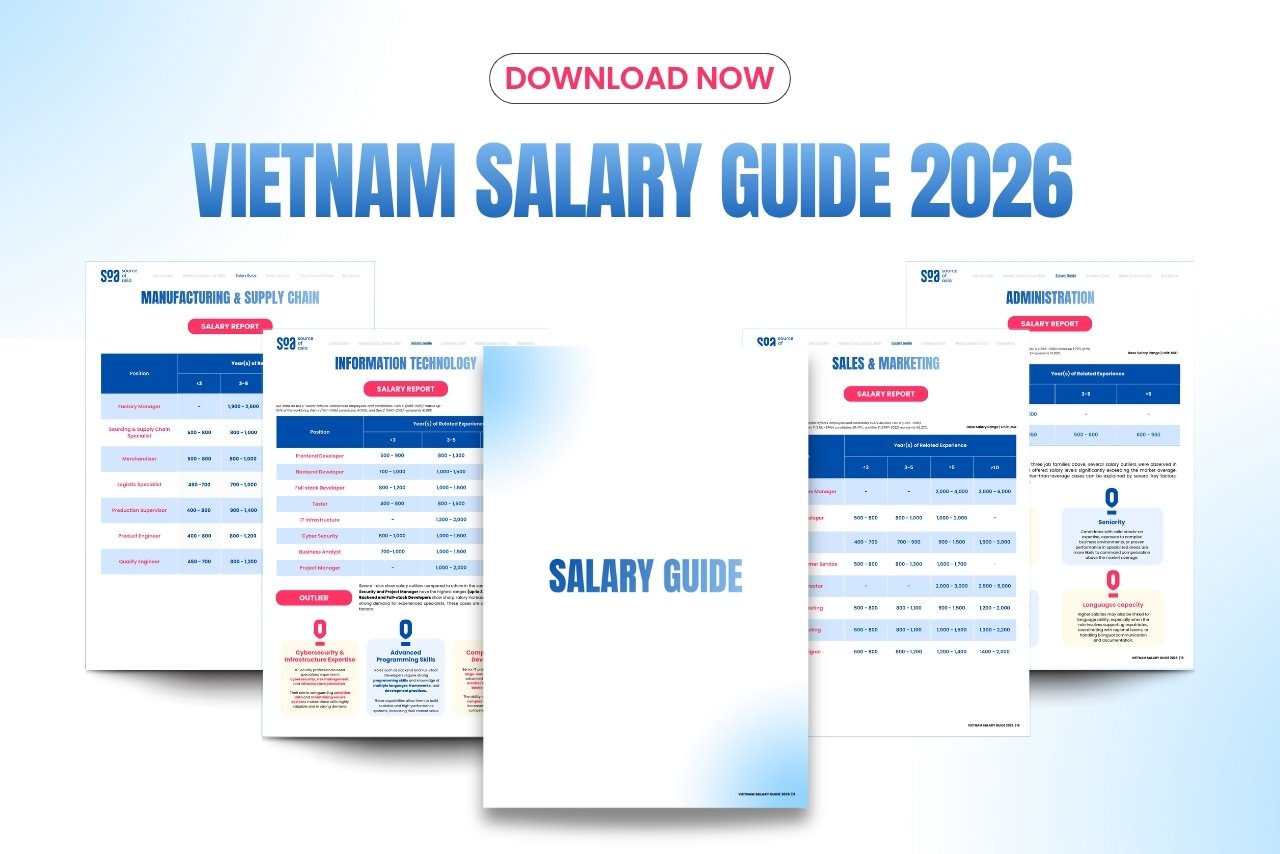
Download Vietnam Salary Guide 2026 to know more salary differences across Vietnam vary by city and industry
What Is the Real Cost of an Employee in Vietnam?
Many businesses underestimate the cost of hiring an employee by focusing only on base salary. In Vietnam, the actual cost is broader and directly affects budgeting, pricing, and hiring decisions.
Mandatory contributions and statutory costs
Employers doing business in Vietnam must account for mandatory contributions as part of total employee cost. These are calculated on the employee’s salary (subject to caps) and apply consistently across all formal employment contracts:
| Components | Employer’s Contribution | Employee’s Contribution | Note |
| Social Insurance | 17.5% of monthly salary | 8% of monthly salary | Capped salary for contribution: 46,800,000 VND |
| Unemployment Insurance | 1% of monthly salary | 1% of monthly salary | Capped salary for contribution: 106,200,000 VND |
| Health Insurance | 3% of monthly salary | 1.5% of monthly salary | Capped salary for contribution: 46,800,000 VND |
In total, employer contributions reach around 21.5% of the salary base, excluding other obligations such as trade union fees (~2%). As a result, the actual monthly employer cost is always higher than the agreed salary, even before adding bonuses or benefits.
Common benefits and additional compensation
Beyond statutory contributions, most companies in Vietnam include standard benefits to stay competitive in hiring. These are not legally required but are widely expected by employees:
- 13th-month salary: Common across industries, equivalent to one additional month of salary
- Performance bonuses: Vary by company, often linked to individual or business results
- Allowances: Typically include meals, transport, or, in some cases, housing support
In practice, these benefits can add a noticeable share to the total payroll. For example, a 13th-month bonus alone increases annual salary cost by ~8.3%. Consequently, employers need to factor these into the total employee cost, especially in competitive sectors where benefits directly impact hiring success and retention.
Fully loaded cost of employee
To know how much should I pay my employees, employers need to look beyond base salary and consider the fully loaded cost of employees. This includes salary, statutory contributions, and all additional benefits such as bonuses.
To illustrate how these costs accumulate in practice, the example below outlines a typical cost structure for an employee with a monthly salary of USD 1,500:
| # | Items | Normal Month | Month with Bonus | Annual Cost |
| 1 | Monthly Gross salary | $1,500 | $1,500 | $18,000 |
| 2 | 13th month Salary Bonus | $1,500 | $1,500 | |
| Estimated Monthly Net taking home for Employee | $1,287 | $2,528 | $16,686 | |
| 3 | Monthly Employer’s Social Contributions | $323 | $323 | $3,870 |
| 4 | Monthly Labor Trade Union | $30 | $30 | $360 |
| 5 | Total Employer Cost | $1,853 | $3,353 | $23,730 |
As shown, the total employer cost reaches around 1.3 times the base salary, even before factoring in indirect costs such as recruitment or onboarding. Thus, businesses should use the fully loaded cost, rather than base salary, as the reference point for budgeting and workforce planning.
However, employee cost structures vary significantly across ASEAN countries. If you are planning to expand in ASEAN, you can refer to our Vietnam Salary Guide 2026 for a detailed breakdown of employer costs, including contribution rates, benefits, and country-specific differences.
Access the Vietnam Salary Guide 2026
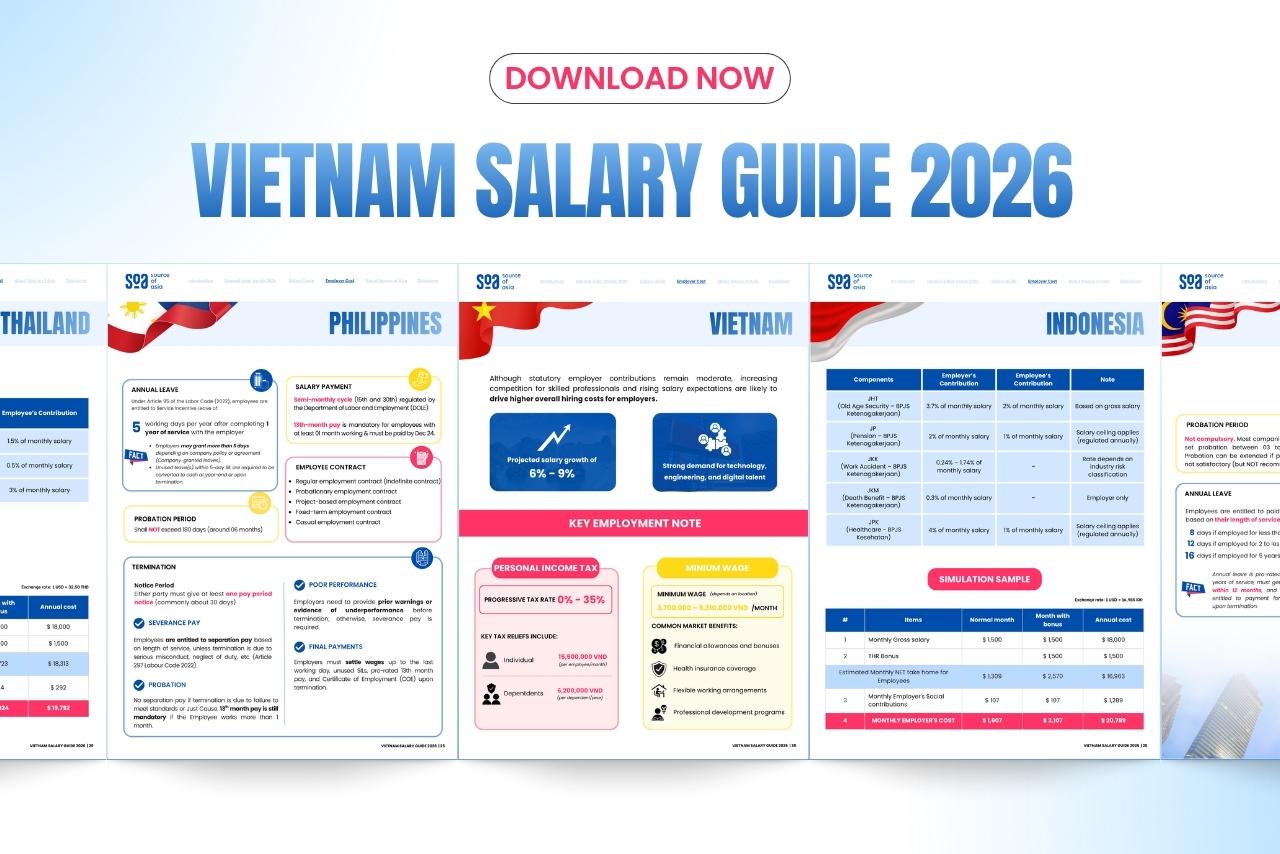
Employee cost structures, benefits, and contribution rates across ASEAN countries
How to Calculate How Much You Should Pay Your Employees
After identifying the main cost components, the next step is to apply them in a way that supports both hiring decisions and budget control. In Vietnam, many employers underestimate total cost by focusing only on salary, which often leads to gaps during execution.
- Base salary –the agreed monthly compensation
- Statutory contributions – typically around 21.5% of salary
- Benefits and bonuses – including 13th-month salary and common allowances
To answer the question “How much should I pay my employees?”, you need a formula that covers more than just the monthly check. A practical formula for Vietnam is:
| Total Employee Cost = Base Salary + Contributions + Benefits + Bonuses |
In practice, this approach gives a clearer view of how much an employee actually costs, helping you set a salary range that is both competitive and aligned with your hiring budget.
How To Set a Competitive Salary Range Based on Employee Cost
To define a salary range that is both strong and viable in Vietnam, employers must look beyond base pay and consider the full cost of staff, including legal costs and common benefits.
Key steps for setting the range:
- Analyze market benchmarks: Review salary data by role, rank, industry, and location to ensure offers align with current market conditions.
- Factor in statutory contributions: Employer duties such as social, health, and jobless insurance, and trade union fees typically add 20–25% to the base pay.
- Include benefits and bonuses: Incorporate 13th-month salary, performance bonuses, and allowances, which directly affect the total compensation package.
- Align with budget and hiring strategy: Define the minimum and maximum salary levels based on business cost structure, talent scarcity, and retention priorities.
- Adjust dynamically: Re-check ranges regularly to reflect changes in market demand, rising costs, and talent supply, mainly for key roles or in strong cities like Ho Chi Minh City and Hanoi.
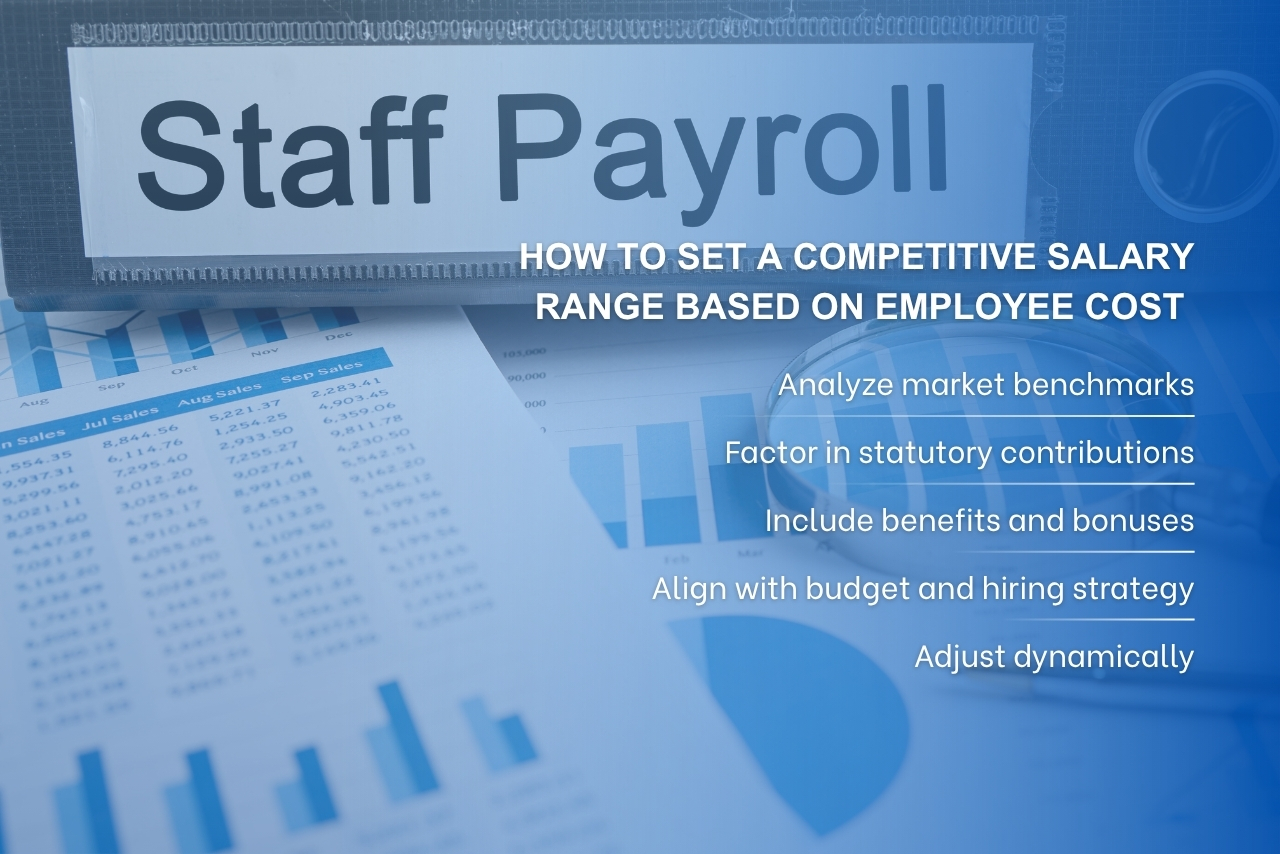
Set competitive salary ranges in Vietnam by factoring total employee cost, including contributions, benefits, and market benchmarks.
Final Thoughts
Understanding how much should I pay my employees is critical in a market where salaries, benefits, and statutory costs are constantly evolving. The Vietnam Salary Guide 2026 by Source of Asia provides comprehensive benchmarks, fully loaded employee costs, and sector-specific insights to support strategic hiring and budgeting decisions.
By combining data-driven analysis with practical guidance, the guide helps employers and HR teams make informed decisions on compensation, workforce planning, and retention. Download the Vietnam Salary Guide 2026 to align your salary strategy with accurate, market-based insights.
Download full Vietnam Salary Guide 2026
Frequently Asked Questions
Mandatory contributions include social insurance (17.5%), health insurance (3%), unemployment insurance (1%), trade union fees (~2%), and increased employer costs by ~23–24%, making total payroll higher than base salary. Accurate planning must account for these legal costs.
Gross salary is the agreed pay before deductions. Net salary is what employees receive after social insurance, health insurance, unemployment insurance, and personal income tax are subtracted. Clear understanding ensures clear offers and avoids doubt.
Yes. Ho Chi Minh City and Hanoi offer 10–20% higher pay than other areas. IT, finance, and specialized roles in command premiums, while administrative positions remain stable. Benchmarking location and sector is essential for competitive hiring.