Introduction
Trade and investment ties between the U.S. and ASEAN play a central role in how companies structure supply chains and expansion strategies in Asia. As businesses look to enter Southeast Asia, the challenge is not only selecting markets but also understanding how trade flows, investment patterns, and regulatory environments differ across countries.
In this guide, we – Source of Asia, outline how these dynamics work in practice, including key sectors, policy considerations, and execution risks. The objective is to help you assess where opportunities exist and how to approach market entry with a clear perspective.
Key Insights
- U.S.–ASEAN trade operates as a two-way system: ASEAN supplying large-scale manufacturing while the U.S. provides high-value goods, services, and capital.
- Growth is increasingly concentrated in four priority sectors, such as biofuels, CCS, medical devices, and solar PV.
- Tariffs and policy changes are directly impacting business decisions, requiring companies to reassess cost structures and market entry strategies.
- Supply chains are shifting toward regional integration, with companies building multi-country operations across ASEAN for greater resilience.
- Execution differs by market, meaning similar opportunities can produce different results depending on local conditions and regulatory environments.
Overview of U.S. – ASEAN Trade and Investment Flows
The trade and investment ties between the U.S. and ASEAN reflect a strong and expanding two-way relationship, driven by both trade demand and long-term investment. According to the United States Trade Representative, U.S.–ASEAN trade continues to grow, with goods trade reaching around USD 580.1 billion in 2025, while combined goods and services trade exceeded USD 571.7 billion in 2024.
In practice, this relationship operates in both directions. On one side, ASEAN serves as a key manufacturing and export base, with U.S. imports reaching USD 453.7 billion in 2025, up nearly 29% year-on-year. This growth is led by electronics, machinery, and consumer goods, supported by production hubs such as Vietnam and Malaysia.
On the other side, the U.S. exports both goods and services into ASEAN markets. U.S. goods exports reached USD 126.4 billion in 2025, alongside USD 61.0 billion in services exports in 2024, particularly in technology, finance, and business services.
This creates a structure where ASEAN supplies large-scale manufacturing, while the U.S. provides high-value products, services, and capital. For businesses, this confirms ASEAN’s role not only as a sourcing base, but as a strategic market within integrated global supply chains.
Key Sectors Driving Bilateral Engagement
The trade and investment ties between the U.S. and ASEAN are increasingly concentrated in a smaller group of high-priority sectors, where policy direction, capital flows, and technology needs are closely aligned. These sectors not only drive trade volume but also define how businesses position themselves in the region.
- Biofuels and alternative energy: ASEAN is expanding biofuel use in transport and power generation to reduce fossil fuel dependence. This creates opportunities for U.S. firms in energy technology, supply chain development, and project investment, while supporting regional energy security goals.
- Carbon Capture and Storage (CCS): CCS is becoming a key solution for decarbonizing heavy industries. ASEAN is actively developing policy frameworks and regional cooperation mechanisms, opening space for U.S. expertise in engineering, technology transfer, and infrastructure development.
- Medical devices: Stable healthcare demand and rising income levels, ASEAN is moving toward higher-value manufacturing in medical technology. The sector is increasingly recognized as a strategic investment area, supported by regional integration and industrial upgrading efforts.
- Solar photovoltaic (PV) equipment: Solar energy remains one of the most scalable renewable sources in ASEAN. Governments are strengthening regulatory frameworks and incentives, attracting investment in solar manufacturing, equipment supply, and project deployment.
These four sectors reflect where growth is becoming more structured and policy-driven across the ASEAN–U.S. corridor. However, execution still varies by market, making sector selection and entry strategy more complex.
The ASEAN–U.S. Business Outlook 2026–2030 booklet builds on this by analyzing each priority sector in detail, including signals by country, key trends and shifts, as well as challenges and opportunities. This helps you move from general insights to a clearer, market-specific strategy.
Get the booklet to explore four key sectors
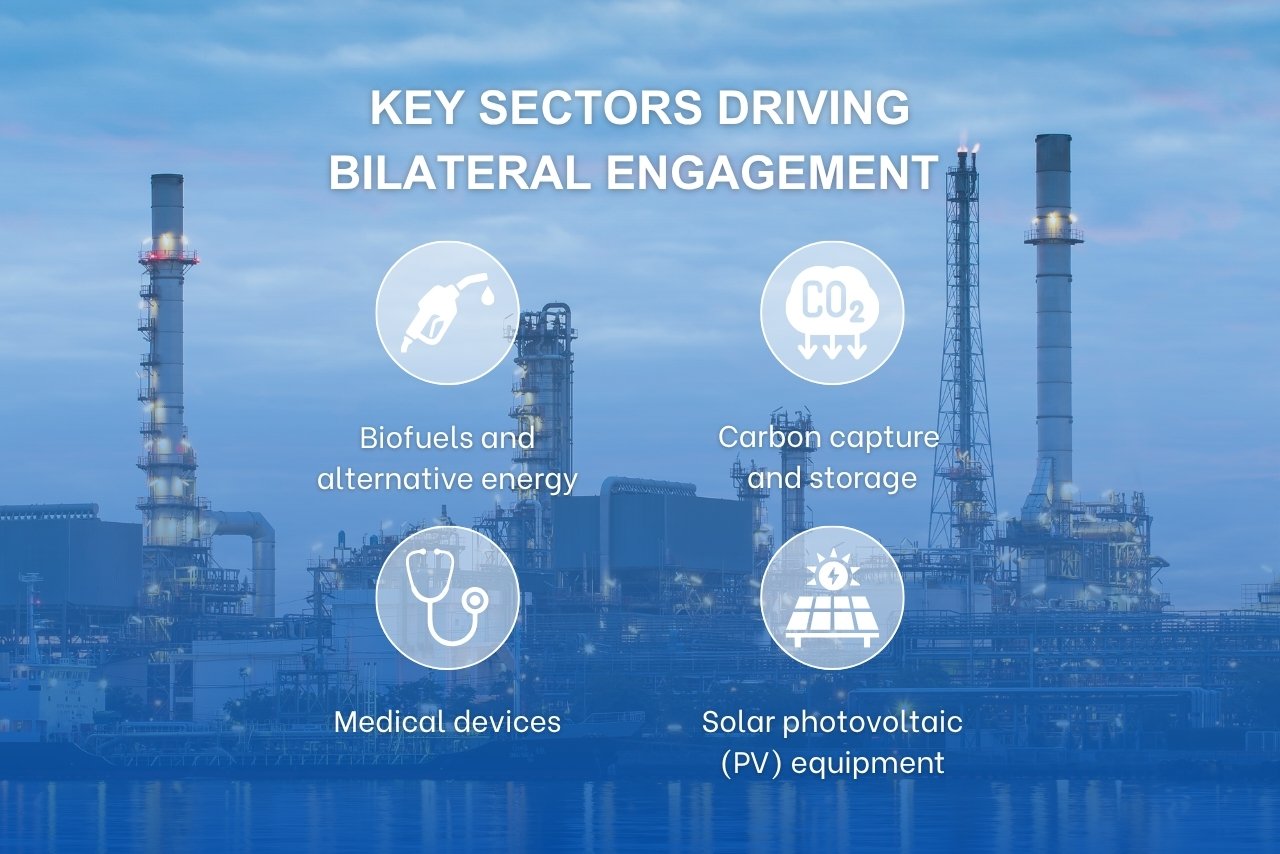
High-priority sectors like energy, healthcare, and technology shape structured U.S.–ASEAN trade and investment.
Policy And Tariff Considerations in 2026
Policy and tariff changes in 2026 are directly shaping how businesses approach the trade and investment ties between the U.S. and ASEAN, especially in terms of cost planning and supply chain strategy. Key considerations include:
- Rising U.S. tariff pressure across ASEAN: The U.S. has applied “reciprocal” tariffs on several ASEAN countries. Rates reaching up to 40% in markets such as Laos and Myanmar, 36% in Cambodia and Thailand, and around 20% in Vietnam, while Singapore remains lower at approximately 10%.
- Continued supply chain shifts despite tariffs: Companies are still expanding into ASEAN under the “China plus one” strategy. They balance lower production costs with moderate tariff exposure compared to China.
- Bilateral negotiations and targeted carve-outs: Some ASEAN countries are actively negotiating product-specific exemptions and non-tariff adjustments. These measures help maintain access to the U.S. market in key industries.
- Investment growth with higher risk exposure: Manufacturing relocation continues to drive FDI into Vietnam, Indonesia, and Malaysia. However, policy volatility is increasing uncertainty for export-driven models.
- ASEAN’s strategic response and diversification: ASEAN economies are strengthening regional integration. In addition, they are also diversifying trade partnerships to reduce dependency on a single market.
| For a deeper breakdown of how these tariff changes affect ASEAN markets and how businesses are responding in practice, you can refer to our article: US Tariffs 2025: Impacting ASEAN Businesses and Strategic Responses |
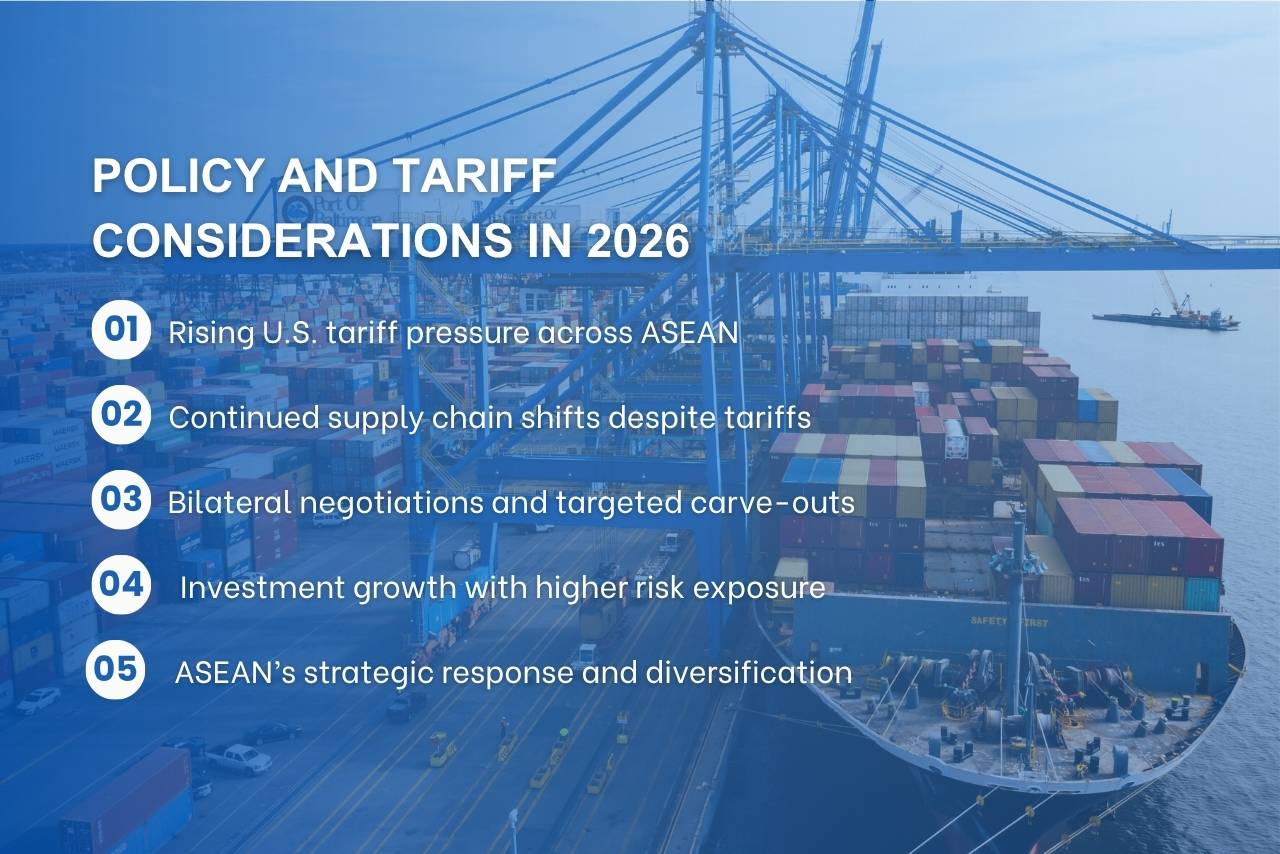
Tariff changes in 2026 influence supply chain strategy and investment decisions across ASEAN markets.
Investment Trends And Supply-Chain Integration
In 2026, investment trends show a clear shift in how companies engage with U.S.–ASEAN trade and investment ties. The focus is now stronger on resilience, value creation, and regional integration.
1. Diversification under the “China+1” strategy
U.S. firms continue to relocate or expand production into ASEAN to reduce tariff exposure and geopolitical risk. This has reinforced ASEAN’s role as a strategic alternative manufacturing base, not just a cost-driven option.
2. Shift toward higher-value manufacturing
Investment is moving beyond low-cost production into electronics, semiconductors, and specialized manufacturing, especially in Vietnam and Malaysia, where supply chain capabilities are maturing.
3. Growth in digital and green sectors
Capital flows are increasing in fintech, AI, and digital infrastructure, alongside renewable energy and sustainable supply chains, as companies align with ESG and long-term compliance requirements.
4. Concentration in key ASEAN markets
Vietnam continues to attract manufacturing investment, while Singapore acts as a regional hub for finance and digital services. Indonesia and Malaysia also see strong inflows due to market size and industrial capacity.
5. Regional supply-chain integration
Companies are building multi-country supply chains across ASEAN, supported by improving logistics and regional frameworks that enhance connectivity and standardization. This allows businesses to optimize sourcing, production, and distribution across markets.
These trends show that investment decisions in ASEAN are no longer driven by cost alone. Companies now consider how each market fits into a broader regional supply chain strategy. In practice, differences in policy, sector focus, and execution conditions can significantly affect outcomes.
To support a more structured evaluation, the ASEAN–U.S. Business Outlook 2026–2030 booklet consolidates these dynamics into one reference, helping you compare markets and align your strategy with real operating conditions.
Download the booklet to access full comparison
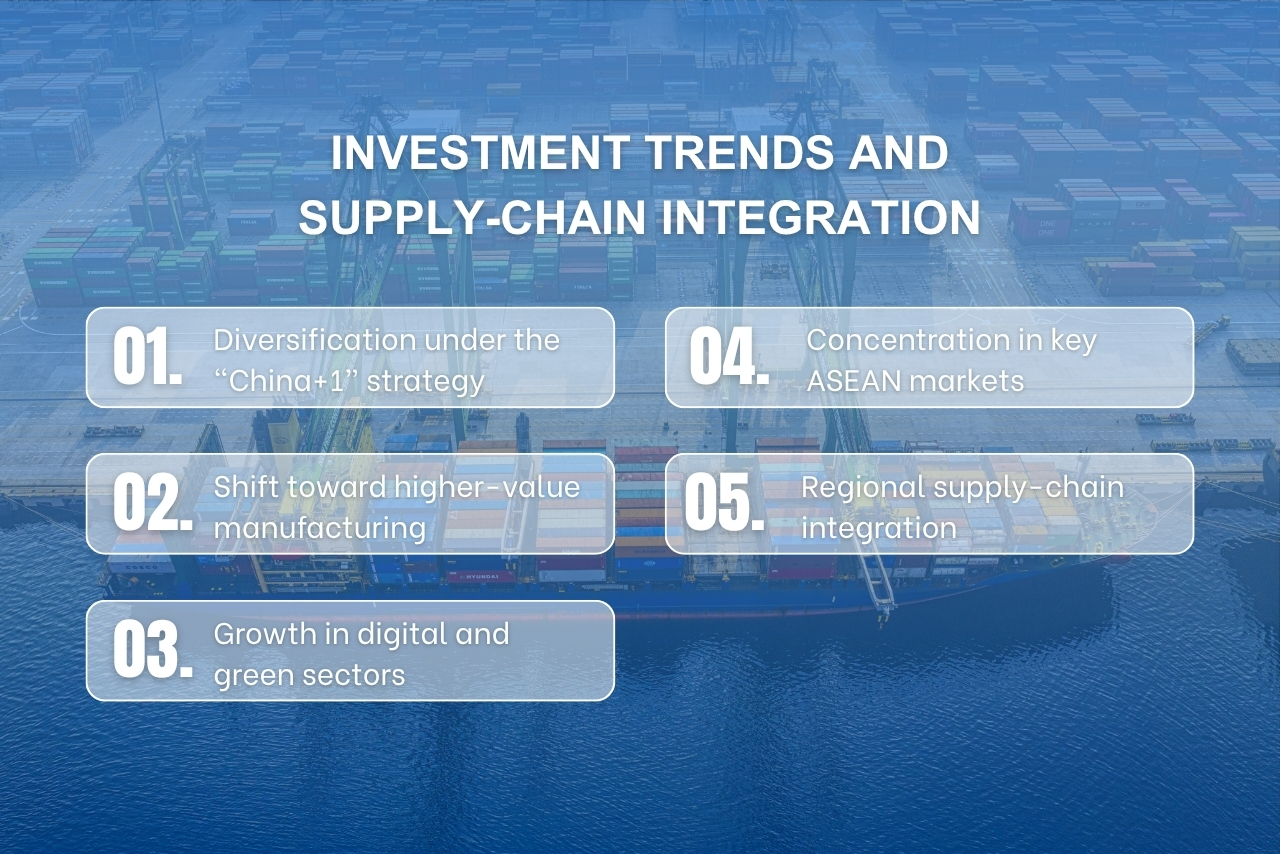
Investment is shifting to higher-value manufacturing, regional integration, and sustainable supply chains across ASEAN.
Final Thoughts
ASEAN-US trade and investment ties are increasingly shaped by interconnected trade, sector priorities, and regional supply chains. For businesses, the real challenge is deciding where to enter, which sectors to prioritize, and how to manage differences in policy, cost, and execution across countries.
The ASEAN–U.S. Business Outlook 2026–2030 booklet addresses this by bringing together insights on trade flows, sector focus, tariff dynamics, and supply chain shifts, supported by signals by country, key trends, and practical challenges to help you assess each market more clearly.
👉 Download the full booklet to support a more structured ASEAN market entry strategy.
Frequently Asked Questions
U.S. companies are increasing investment in ASEAN to diversify supply chains, reduce reliance on China, and access fast-growing markets. The region offers competitive manufacturing costs, improving infrastructure, and strong demand across sectors such as technology, energy, and healthcare.
U.S. tariffs increase cost pressure on exports, but they also accelerate supply chain shifts into ASEAN as companies look for alternatives to China. However, businesses must still evaluate tariff exposure, regulatory risks, and local execution conditions before making investment decisions.
You should go beyond headline data and evaluate each market based on sector alignment, regulatory environment, cost structure, and execution feasibility. For example, some countries are stronger in manufacturing, while others offer better conditions for services or regional coordination. A structured comparison helps you avoid selecting a market based only on cost or incentives.