Introduction
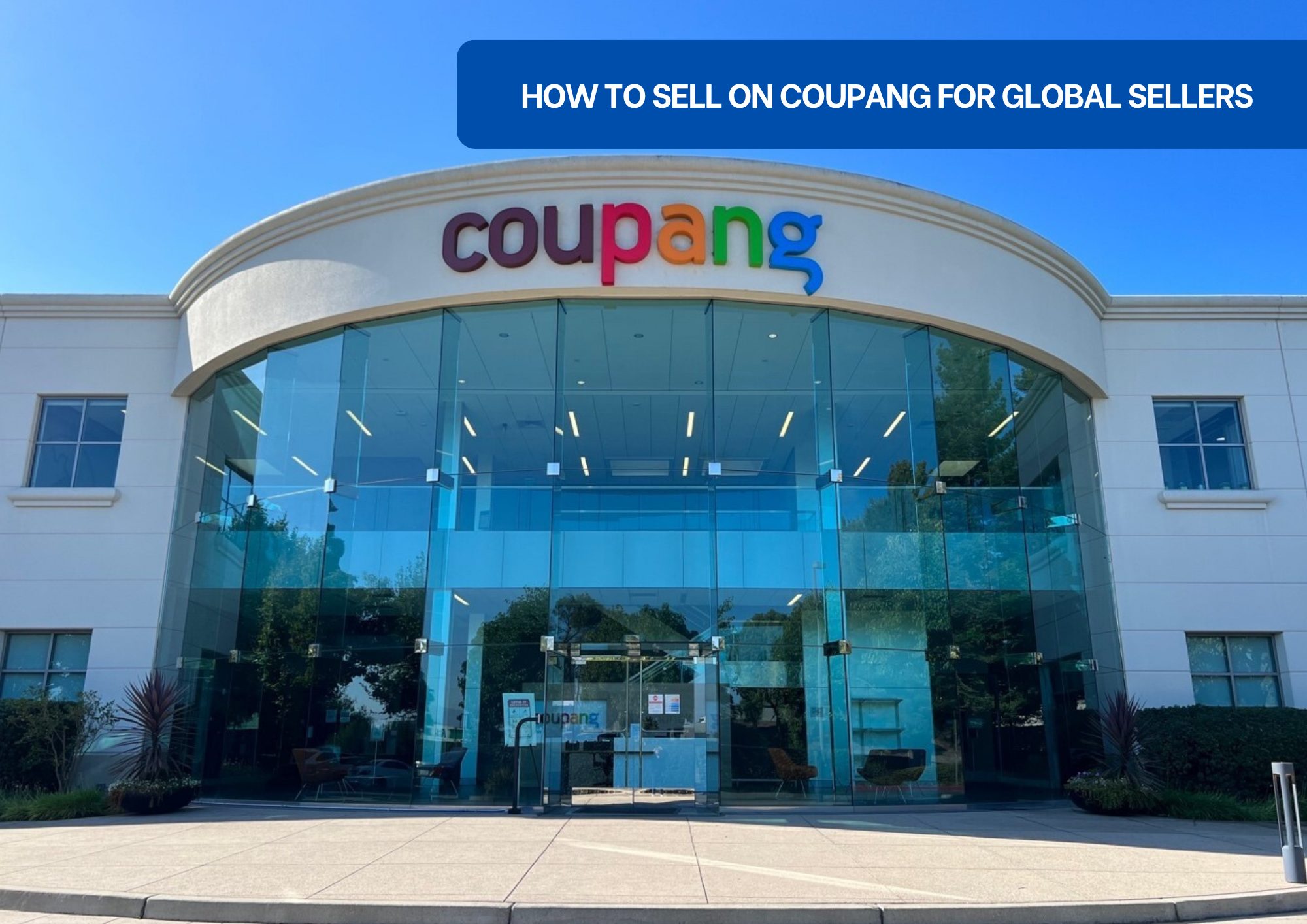
South Korea offers significant opportunities for international consumer brands looking to expand through e-commerce. For businesses planning to sell on Coupang, entering the Korean market requires more than creating a seller account. Companies must also understand local demand, product regulations, pricing, logistics, and customer expectations before committing resources.
For companies planning to sell on Coupang, the platform provides access to Korean consumers through cross-border e-commerce without necessarily establishing a local legal entity. Nevertheless, a successful launch depends on selecting suitable products, preparing the required documents, and building a reliable fulfillment model. International businesses can also benefit from local market knowledge when evaluating their entry strategy.
As an International Business Accelerator, Source of Asia (SOA) supports companies exploring expansion opportunities across Asia, including South Korea. This guide explains how global sellers can register on Coupang, list products, manage selling costs, and prepare for long-term growth in the Korean market.
Quick Answer:
How Can Global Sellers Start Selling on Coupang?
Global sellers can sell on Coupang by registering for an international seller account, completing business verification, and listing eligible products through Coupang WING, the platform’s seller management system.
The process generally involves seven steps:
- Check seller eligibility: Confirm that the business and its products meet Coupang’s requirements.
- Prepare registration documents: Gather business registration, identity, ownership, and banking records.
- Create a seller account: Apply through Coupang’s global seller registration process.
- Complete verification: Submit the information required to verify the business and receive payments.
- List products: Prepare product descriptions, prices, images, and shipping information.
- Arrange fulfillment: Select an appropriate delivery and returns process.
- Launch and optimize: Monitor orders, customer feedback, advertising, and profitability.
According to Coupang’s official global seller guide, seller registration is free, and approved global sellers can begin listing products after completing the required verification process. However, account approval does not automatically authorize every product for sale. Businesses must also check product-specific regulations and marketplace restrictions before launching.</span
Coupang is one of South Korea’s major online shopping platforms, offering international businesses a way to reach Korean consumers through its global marketplace. For brands considering cross-border expansion, this can provide an alternative to building a standalone e-commerce website or establishing a full local operation immediately.
However, marketplace access alone does not guarantee commercial success. Businesses should evaluate Coupang’s customer base, product categories, competitive environment, and fulfillment conditions to determine whether the platform supports their growth objectives.
Access to South Korea’s Online Consumer Market
According to the official Coupang Marketplace website, the platform provides access to an active customer base exceeding 21 million. This scale creates opportunities for international brands to introduce their products to Korean shoppers without first developing an independent e-commerce infrastructure in the country.
Nevertheless, the opportunity varies considerably by product category. Established competitors, local brands, customer reviews, and pricing all influence product visibility and purchase decisions. Therefore, companies should assess demand and competition within their specific categories rather than relying solely on Coupang’s overall customer reach.
A Cross-Border Entry Option Without a Korean Company
One important advantage of Coupang’s global marketplace is that eligible overseas businesses can apply without necessarily establishing a Korean legal entity. Instead, global sellers can use business documents issued in their home country and complete the required verification process. This creates a potential entry route for brands that want to test Korean consumer demand before committing to a larger local investment.
However, seller registration requirements should not be confused with product import and regulatory requirements. Certain categories may require Korean safety certification, specific labeling, or arrangements involving a local importer or representative. As a result, businesses should confirm that their proposed selling model is suitable for their products before proceeding with registration.
An Opportunity to Test Product-Market Fit
Coupang can also help international brands gather initial insights into Korean consumer preferences. By monitoring sales performance, customer reviews, returns, and responses to promotional campaigns, sellers can identify which products and price points generate interest. In addition, these insights may help businesses refine their product selection and positioning before expanding into other channels.
However, marketplace data should be considered alongside wider market research. Customer behavior on a single platform may not fully represent demand across South Korea. For companies evaluating longer-term expansion, SOA’s guide to doing business in South Korea provides additional context on market conditions, local business practices, and commercial considerations.
How to Start Selling on Coupang Marketplace: Step-by-Step Guide
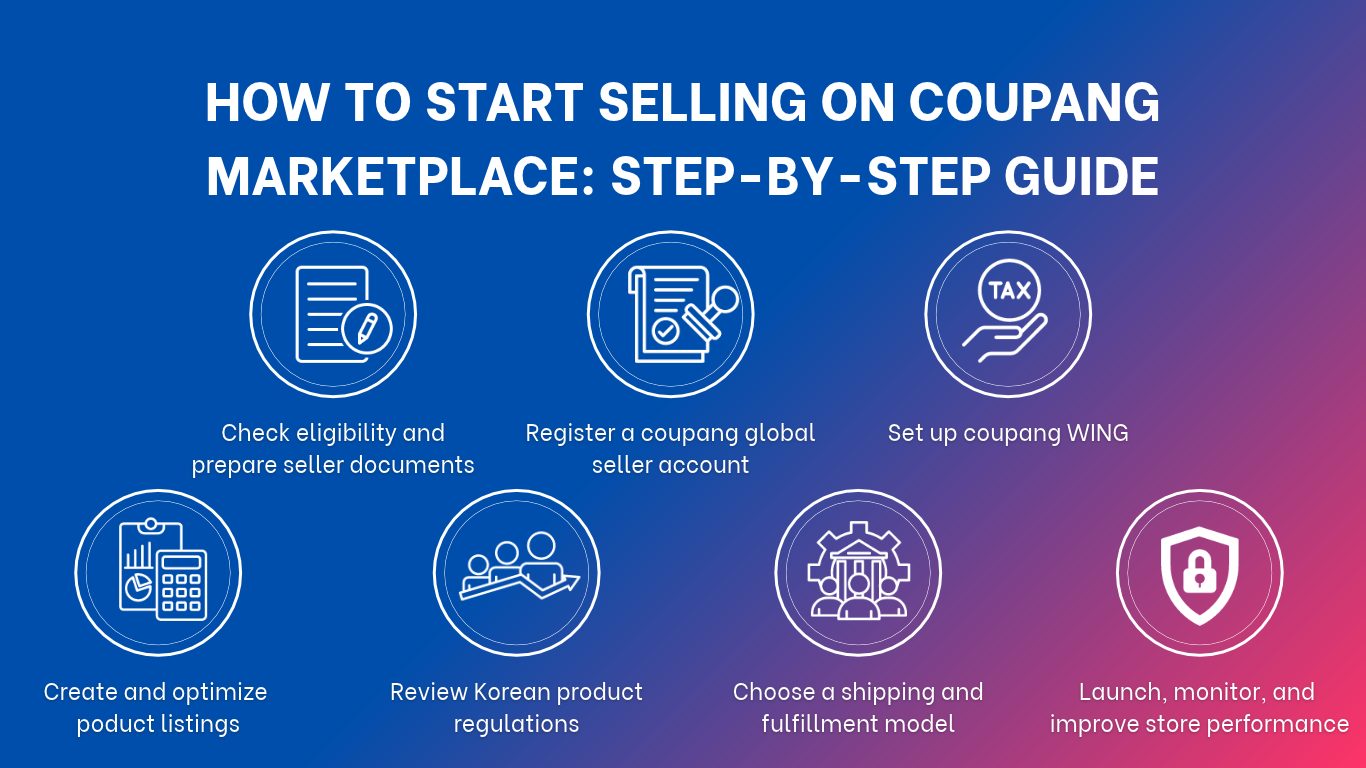
Seven essential steps for global sellers to launch and manage their business on Coupang in South Korea.
Global sellers should approach Coupang registration as part of a wider commercial preparation process. Before launching, businesses need to verify their eligibility, prepare documents, create accurate listings, and establish a reliable delivery model. The following steps explain the main requirements and practical considerations involved.
Check Eligibility and Prepare Seller Documents
Before applying to sell on Coupang, businesses should confirm that they meet the platform’s registration requirements and have the necessary supporting documents. According to Coupang’s seller registration guide, global sellers generally need business registration documents, identification, proof of ownership, and bank account information.
| Required document | Purpose |
| Business license or registration | Verifies the legally registered business |
| Passport or government-issued identification | Confirms the relevant individual’s identity |
| Proof of business ownership | Establishes business ownership or control |
| Bank statement or banking documentation | Supports payment and account verification |
Document requirements may vary depending on the country or region where the business is registered. Therefore, applicants should review the instructions relevant to their jurisdiction and ensure that company names, ownership information, and banking details are consistent across their documents. Preparing accurate records in advance can help reduce delays caused by incomplete applications or additional verification requests.
Register a Coupang Global Seller Account
Once the documents are ready, businesses can begin the registration process through Coupang’s global seller portal. Applicants must provide company details, contact information, and the documents required for identity and business verification. In addition, sellers must complete the relevant Know Your Customer (KYC) procedures before their accounts can be fully approved for commercial activity and payment processing.
According to Coupang’s official FAQ, registration typically takes up to five business days when all required documents are submitted correctly. However, this is an indicative processing period rather than a guaranteed approval deadline. Applications requiring additional verification may take longer, so businesses should avoid scheduling commercial launches before account approval is confirmed.
Global sellers can begin the process through the official Coupang registration guide.
Set Up Coupang WING
After registration and verification, sellers can use Coupang WING to manage their marketplace activities. This system provides access to core functions such as product listings, prices, stock levels, orders, and payment records. As a result, businesses can coordinate multiple activities through a single seller management platform.
Before launching, companies should become familiar with the system’s operational requirements and assign clear responsibilities to the appropriate employees. For example, one team may manage product content and prices, while another handles orders, delivery information, and customer-related issues. Establishing these processes early can help reduce listing errors and improve operational consistency once order volumes increase.
Create and Optimize Product Listings
Accurate product listings are essential for helping Korean consumers understand what a brand offers. Coupang’s product listing guide explains how sellers can select categories, enter product information, upload images, and configure prices, stock quantities, and shipping details through WING.
In addition to meeting the platform’s technical requirements, businesses should consider how their product information will be understood by Korean shoppers. Clear titles, relevant product specifications, accurate images, and well-organized descriptions can improve the customer experience. Where appropriate, Korean-language content and localized product information should also be prepared.
A product listing should cover the following elements:
- Product title and category: Identify the product clearly and select the appropriate category.
- Images and descriptions: Present accurate product features, materials, dimensions, and usage information.
- Product variants: Provide correct information about available sizes, colors, or versions.
- Pricing and inventory: Maintain current selling prices and stock quantities.
- Shipping information: Specify the correct dispatch location and expected delivery arrangements.
However, localization should never compromise accuracy. Product specifications, safety claims, country-of-origin information, and other regulated details must remain consistent with the actual product and applicable requirements.
Review Korean Product Regulations
Product compliance is one of the most important considerations for international sellers. Although a business may qualify for a Coupang seller account, individual products can still be subject to restrictions, safety standards, or additional approvals under Korean law. Therefore, companies should assess product compliance before making inventory commitments or publishing listings.
For example, certain electrical appliances, children’s products, and other regulated consumer goods may require Korea Certification (KC) or related safety documentation. Coupang’s KC guidelines for global sellers explain the importance of meeting relevant certification requirements and the potential consequences of non-compliance. Some certification procedures may also require a Korean business entity or local partner.
| Product consideration | What sellers should verify |
| Marketplace eligibility | Whether the category is permitted or restricted |
| Safety certification | Whether KC certification or another approval applies |
| Labeling | Required product and consumer information |
| Import conditions | Customs, documentation, and import requirements |
| Local representation | Whether an importer or local entity is necessary |
| Product claims | Whether descriptions and supporting documents meet applicable rules |
Businesses should consult Coupang’s Rules and Policies and the relevant Korean regulatory authorities for their product category. Importantly, approval for one product does not automatically mean that other products in the same portfolio can be sold under identical conditions.
Choose a Shipping and Fulfillment Model
When businesses sell on Coupang from overseas, shipping performance becomes a major part of the customer experience. Sellers must determine where products will be stored, how orders will be shipped, and how returns or customer complaints will be handled. These decisions also affect delivery times, operating costs, and overall profitability.
Under the standard cross-border selling approach, global sellers can arrange delivery from overseas to Korean customers. Coupang’s shipping and returns guidance outlines key responsibilities, including accurate tracking information and appropriate delivery estimates. Therefore, businesses should ensure that their logistics partners can support reliable order processing and communication.
Other fulfillment arrangements may be available through specific Coupang programs. However, these services have separate eligibility and operational conditions, so companies should verify the options available to their accounts rather than assuming that all fulfillment services are included with standard marketplace registration.
| Fulfillment approach | Main consideration | Potential limitation |
| Direct cross-border shipping | Ship orders from outside South Korea | International delivery times and returns |
| Eligible Coupang fulfillment programs | Use program-specific logistics services | Separate eligibility and operating conditions |
| Local logistics or distribution partner | Manage inventory, delivery, or returns locally | Additional partner management and costs |
Before selecting a fulfillment model, sellers should compare shipping fees, delivery expectations, customs requirements, stock management, and return-handling procedures. For lower-margin products, these costs can have a significant impact on the financial viability of selling internationally.
Launch, Monitor, and Improve Store Performance
After account approval, product listing, and logistics preparation, sellers can begin commercial operations. However, the launch itself should be viewed as the beginning of the market-testing process rather than the final objective. Businesses need to monitor customer behavior, sales performance, delivery issues, and profitability to understand whether their offer is competitive.
Coupang provides guidance on advertising, promotions, and store management through its Seller University. Nevertheless, brands should establish their own performance indicators, including conversion rates, customer acquisition costs, product returns, and contribution margins. By reviewing these figures regularly, businesses can identify which products justify further investment and which require changes in pricing, positioning, or fulfillment.
How Much Does It Cost to Sell on Coupang?
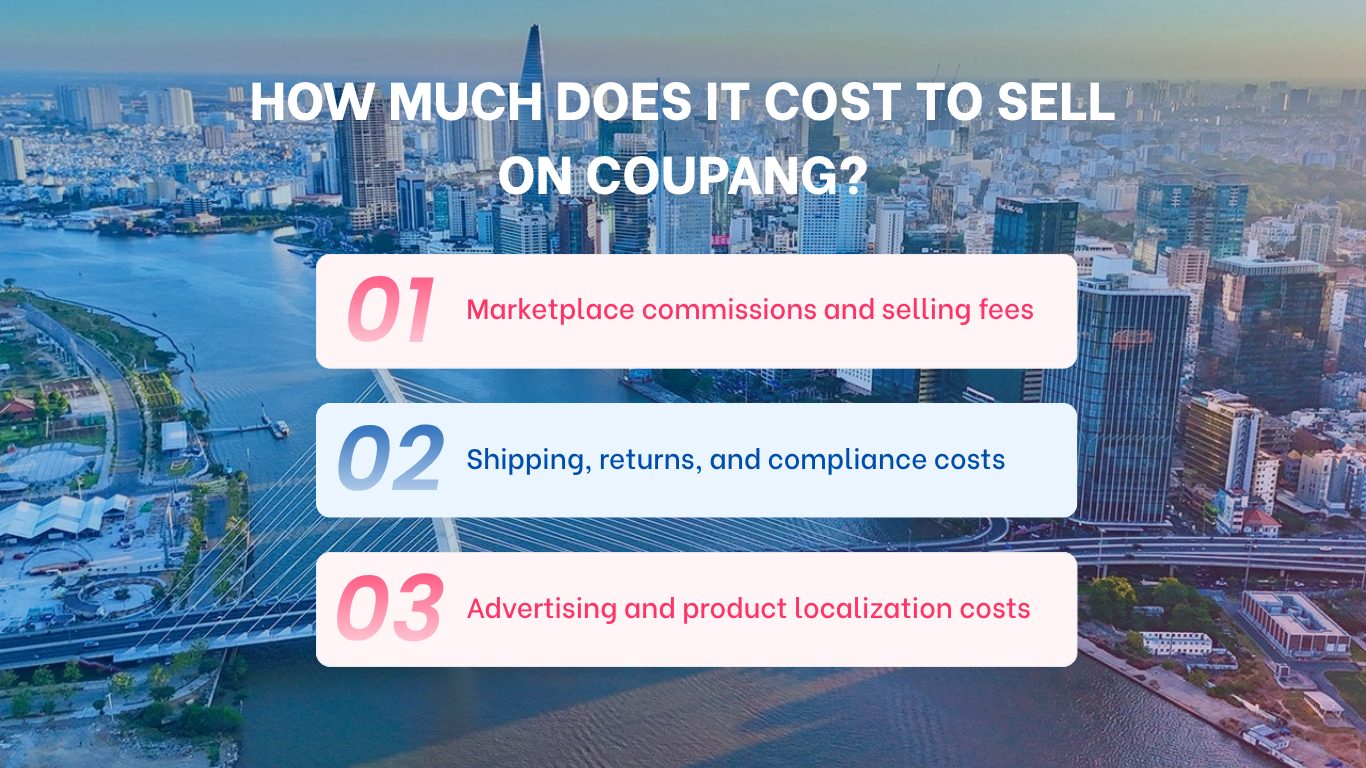
Three main cost categories global sellers should consider when selling on Coupang in South Korea.
Although global seller registration is free, businesses still incur costs when operating on Coupang. These expenses include marketplace commissions, shipping, returns, advertising, product compliance, and other operational activities. Therefore, the total cost should be evaluated at the product level rather than based only on the platform’s registration conditions.
Marketplace Commissions and Selling Fees
Coupang charges commissions according to product category and, in some cases, more specific subcategory classifications. Its official fee guide provides a reference for understanding how these charges are structured.
| Example category | Published standard commission |
| Beauty | 9.6% |
| Fashion | 10.5% |
| Food | 10.6% |
| Furniture/Home Interior | 10.8% |
| Digital Appliances | 7.8% |
These figures are examples from Coupang’s previously published fee reference, not verified current 2026 rates. Sellers should confirm the applicable commission and any additional charges in their own seller account before setting prices.
In addition to category commissions, sellers may face other charges depending on shipping arrangements, promotions, and applicable program conditions. Consequently, brands should calculate the total cost of each transaction before determining their selling prices.
Shipping, Returns, and Compliance Costs
International shipping can significantly affect the profitability of cross-border e-commerce. Businesses may need to pay for packaging, freight, customs-related services, returns, and the administrative work involved in managing overseas orders. Moreover, certain products require additional certification, labeling, or documentation before they can be sold in South Korea.
For example, a product with a strong gross margin may generate limited profit after international delivery and return costs are included. Therefore, companies should evaluate the full cost per order before expanding their inventory or entering additional product categories.
Advertising and Product Localization Costs
Marketing expenses can also become an important part of the selling budget. Depending on the category, brands may invest in product advertising, translated content, photography, creative assets, and promotional campaigns. These activities can support product visibility, particularly when entering a competitive market with limited brand recognition.
However, advertising should not replace the work of validating product demand and profitability. Before increasing promotional spending, companies should confirm that their prices, product descriptions, fulfillment model, and customer offer are suitable for the Korean market.
A useful calculation is:
Contribution per order = Selling price − Product cost − Marketplace fees − Shipping and fulfillment costs − Expected returns and promotional expenses
This calculation provides an initial view of product-level economics. Businesses should also consider taxes and other applicable financial obligations separately to avoid treating all transaction amounts as the company’s own expenses.
How to Sell into South Korea with Coupang Successfully
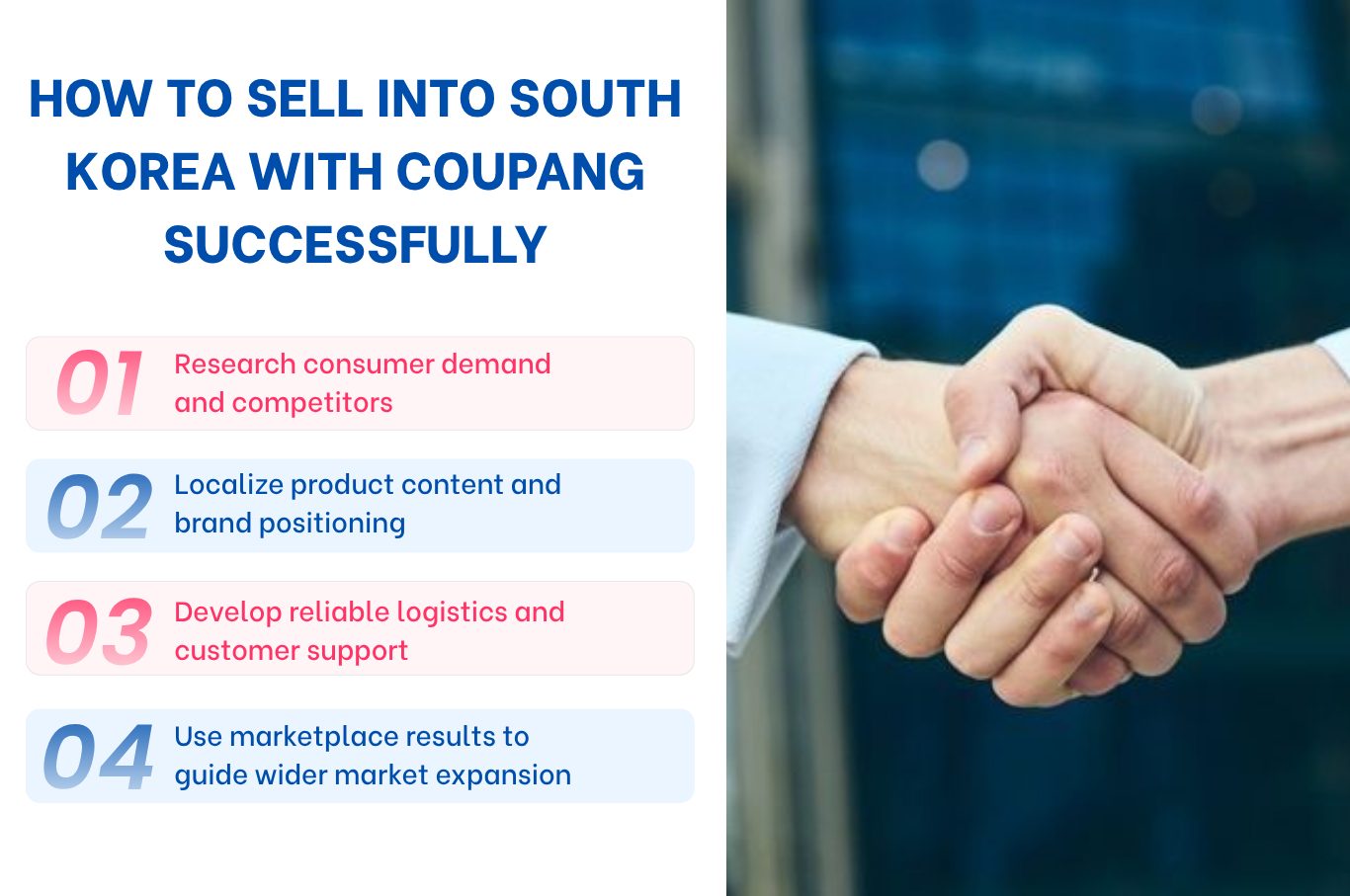
Four key strategies for global sellers to build a successful presence on Coupang and expand into the South Korean market.
Coupang can provide international brands with a route into South Korea’s consumer market, but long-term growth requires a broader commercial strategy. Businesses need to understand local preferences, adapt their product positioning, and establish reliable logistics before scaling their investment. The following considerations can help companies strengthen their approach.
Research Consumer Demand and Competitors
Before committing significant inventory, businesses should assess demand within their target category. Competitor pricing, product features, customer reviews, and category-specific preferences can provide useful insights into the market. For example, Korean consumers may prefer different product sizes, packaging formats, or features from those offered in a brand’s home market.
In addition, established competitors may benefit from stronger local recognition, faster delivery, or more extensive customer reviews. Therefore, brands need to identify a clear competitive advantage rather than assuming that international origin alone will attract Korean buyers. Market research should help determine which products have a realistic opportunity to compete.
Localize Product Content and Brand Positioning
Successful localization involves more than translating product descriptions into Korean. Businesses should consider how consumers interpret product benefits, pricing, packaging, and brand claims within the local market. For example, a product positioned primarily around affordability in one country may need a different value proposition when competing against established Korean alternatives.
Moreover, product information must remain accurate and consistent with regulatory requirements. Brands should test localized messaging and review customer feedback before investing heavily in broader promotional campaigns.
Develop Reliable Logistics and Customer Support
Delivery performance and customer service are closely connected to customer satisfaction. International sellers need reliable procedures for order tracking, delayed shipments, damaged items, returns, and customer inquiries. Coupang’s shipping guidance emphasizes accurate delivery information and timely order handling.
For global sellers, returns may be particularly challenging because goods can originate outside South Korea. Therefore, businesses should clarify how returned products will be received, inspected, replaced, or refunded before launching. A reliable process can help reduce operational disruption as sales volumes grow.
Use Marketplace Results to Guide Wider Market Expansion
Marketplace performance can provide valuable insights into demand, pricing, and consumer expectations. However, these results should be evaluated alongside broader market conditions and the company’s long-term business objectives. For example, strong sales may justify investment in local distribution, while weak margins may indicate that the current logistics approach needs adjustment.
In addition, businesses should consider whether other sales channels or local partners could complement their Coupang operations. For companies developing a wider market-entry strategy, SOA’s Market Expansion Playbook explores market validation, commercial planning, and expansion considerations across Asia.
Common Mistakes Global Sellers Should Avoid on Coupang
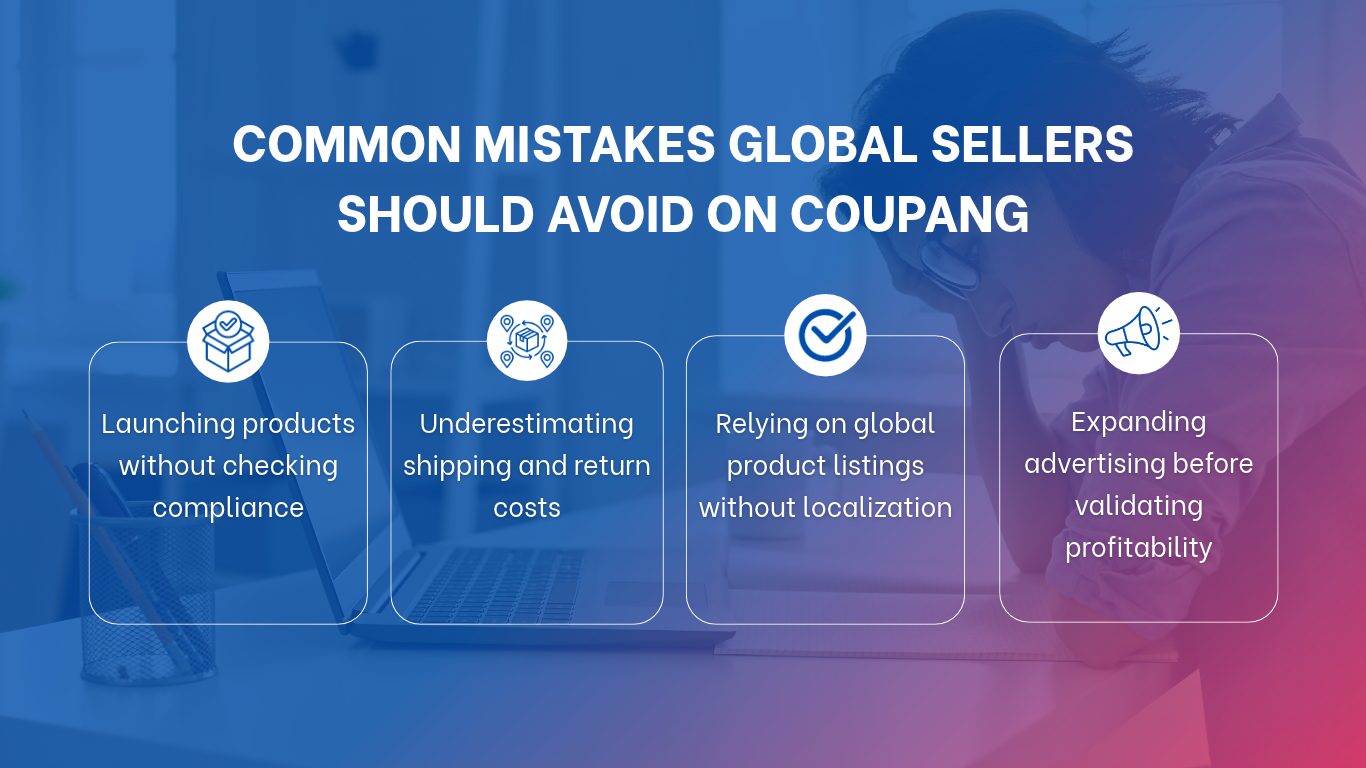
Four common mistakes international brands should avoid when selling on Coupang in South Korea.
Even after successfully registering a seller account, international businesses can face challenges that affect growth and profitability. Many of these problems arise from insufficient market preparation, unrealistic cost assumptions, or an incomplete understanding of Korean customer expectations.
Launching Products Without Checking Compliance
One common mistake is assuming that seller account approval means every product is ready for sale. In reality, certain categories require additional documentation, safety certification, or local arrangements. As a result, products may face restrictions even after the business has completed marketplace registration.
To reduce this risk, brands should review product eligibility and regulatory requirements before preparing large quantities of inventory or investing in promotional activities.
Underestimating Shipping and Return Costs
Global sellers may focus heavily on product prices and marketplace commissions while overlooking the full cost of cross-border delivery. International shipping, product weight, return rates, and handling procedures can all affect profitability. For example, low-priced or bulky products may become difficult to sell competitively when delivery expenses are included.
Therefore, businesses should compare logistics options and calculate their expected contribution margin before scaling sales. This is particularly important for products with limited room to absorb additional costs.
Relying on Global Product Listings Without Localization
Product information developed for other markets may not communicate effectively with Korean consumers. Unclear descriptions, unfamiliar terminology, or missing technical details can make it harder for customers to evaluate an unfamiliar brand. In addition, listing information that does not match the actual product can create complaints or returns.
Companies should therefore review their product content from the perspective of local customers and adapt it where appropriate, while preserving accurate specifications and legally required information.
Expanding Advertising Before Validating Profitability
Advertising can increase exposure, but higher traffic does not necessarily lead to profitable growth. If pricing, shipping costs, or product positioning are not competitive, promotional spending may increase losses rather than improve performance.
Instead, brands should begin with a manageable product selection, measure results, and adjust their approach before increasing investment. This allows businesses to scale based on actual demand and financial performance rather than assumptions.
How Source of Asia Supports Brands Entering South Korea
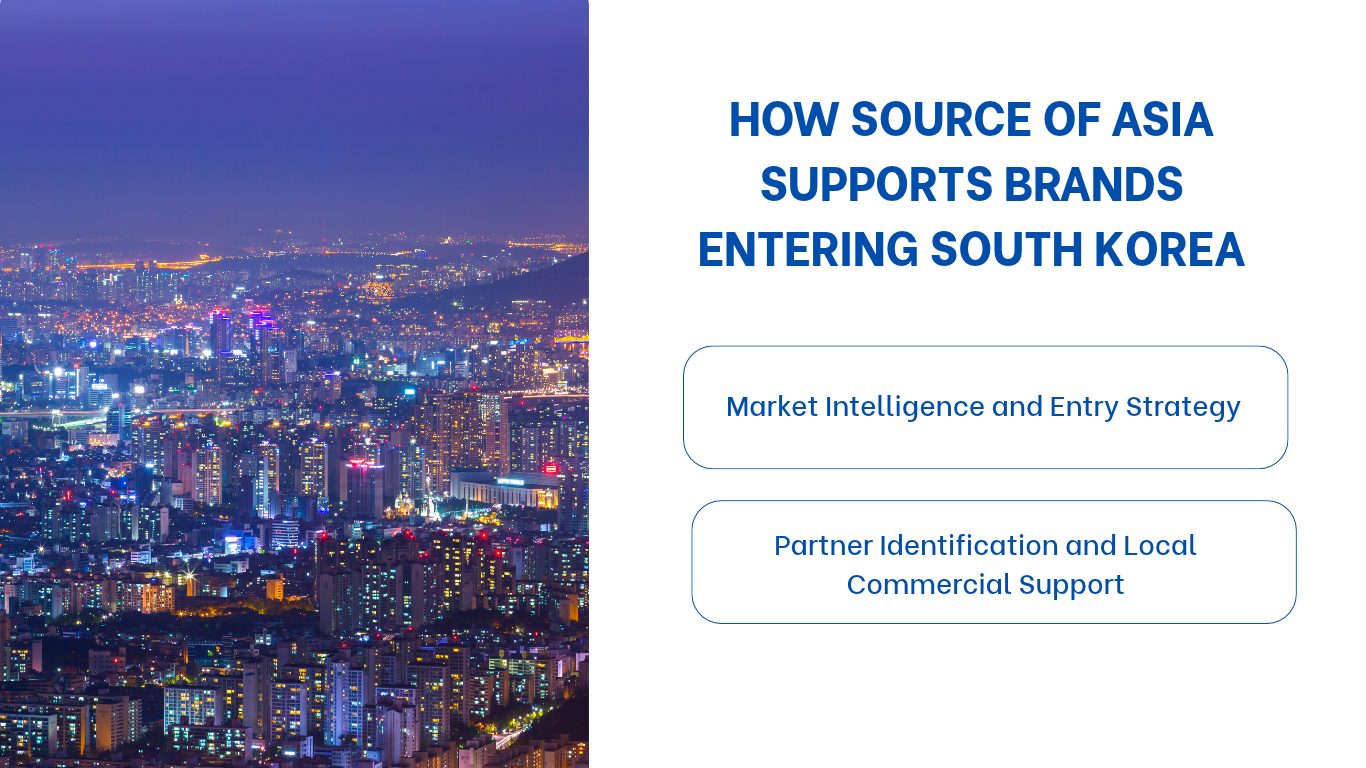
Source of Asia helps international brands explore South Korea through market research, entry strategy, and local partner development.
For international companies, marketplace entry is one part of a broader decision about how to develop business in South Korea. Understanding customer demand, evaluating market conditions, and identifying suitable commercial channels can help brands determine where Coupang fits into their long-term plans.
As an International Business Accelerator, SOA supports companies exploring expansion opportunities across Asia, including South Korea. Its market-entry capabilities focus on helping businesses evaluate opportunities and build approaches suited to local conditions.
Market Intelligence and Entry Strategy
Before entering South Korea, brands need to understand local demand, competitive positioning, pricing, and potential barriers to market entry. Without this preparation, companies risk selecting products or sales channels that do not match local commercial conditions.
Through its Market Expansion Services, SOA supports international businesses with market research, competitor analysis, and route-to-market planning. These activities can help brands assess whether Coupang should function as a testing channel, a primary online sales channel, or part of a wider distribution strategy.
Partner Identification and Local Commercial Support
Some brands may also need local partners to support distribution, regulatory coordination, logistics, or broader commercial development. This is particularly relevant when product categories have specific import or certification requirements that cannot be addressed through standard cross-border selling arrangements alone.
Through its regional business network, Source of Asia (SOA) supports international companies exploring local market opportunities and commercial partnerships. However, businesses should confirm the scope of support and responsibilities of any prospective partner before making operational commitments.
For companies planning to sell on Coupang, the wider strategic question is how marketplace sales can contribute to a sustainable presence in South Korea.