Introduction
As businesses expand into new markets, acquire companies, or diversify their activities, managing ownership and financial responsibilities becomes more complex. A holding company can help organize these activities under a parent entity that owns and controls multiple businesses.
This structure allows companies to manage investments, oversee subsidiaries, and separate certain operational risks. However, it also introduces additional accounting, tax, and governance responsibilities that require careful planning.
In this guide, Source of Asia (SOA) explains what a holding company is, how it works, its main structures, benefits and risks, and the practical steps businesses should consider when establishing one.
Quick Answer
What is a holding company and how does it work?
A holding company is a parent company that owns or controls one or more other businesses, known as subsidiaries. Its main purpose is generally to manage ownership, investments, and strategic decisions, while operating subsidiaries handle commercial activities.
Holding companies can own shares, intellectual property, real estate, and other assets, depending on their structure. They may also oversee financing, capital allocation, and corporate governance across the group.
Businesses use holding companies to organize multiple subsidiaries, support acquisitions, manage investments, and expand internationally. However, the structure requires proper legal separation, financial reporting, and compliance with applicable tax regulations.
What Is a Holding Company and How Does It Work?
Holding Company Meaning and Ownership Structure
A holding company is a business entity established primarily to hold ownership interests in other companies. Unlike a company focused on producing goods or providing services directly, a holding company may concentrate on managing investments and overseeing its subsidiaries.
A holding company typically exercises control through voting rights, shareholder agreements, or other arrangements that allow it to influence important business decisions. Although majority share ownership is common, control does not always require holding more than 50% of a company’s shares.
For example, Holding Company A may own 100% of Manufacturing Company B and 70% of Distribution Company C. Both subsidiaries operate as separate legal entities, while Company A maintains control over their strategic direction through its ownership rights.
Under IFRS 10 Consolidated Financial Statements, control is the basis for determining whether a parent must consolidate another entity’s financial results, subject to applicable exceptions.
How Holding Companies Manage Subsidiaries and Assets
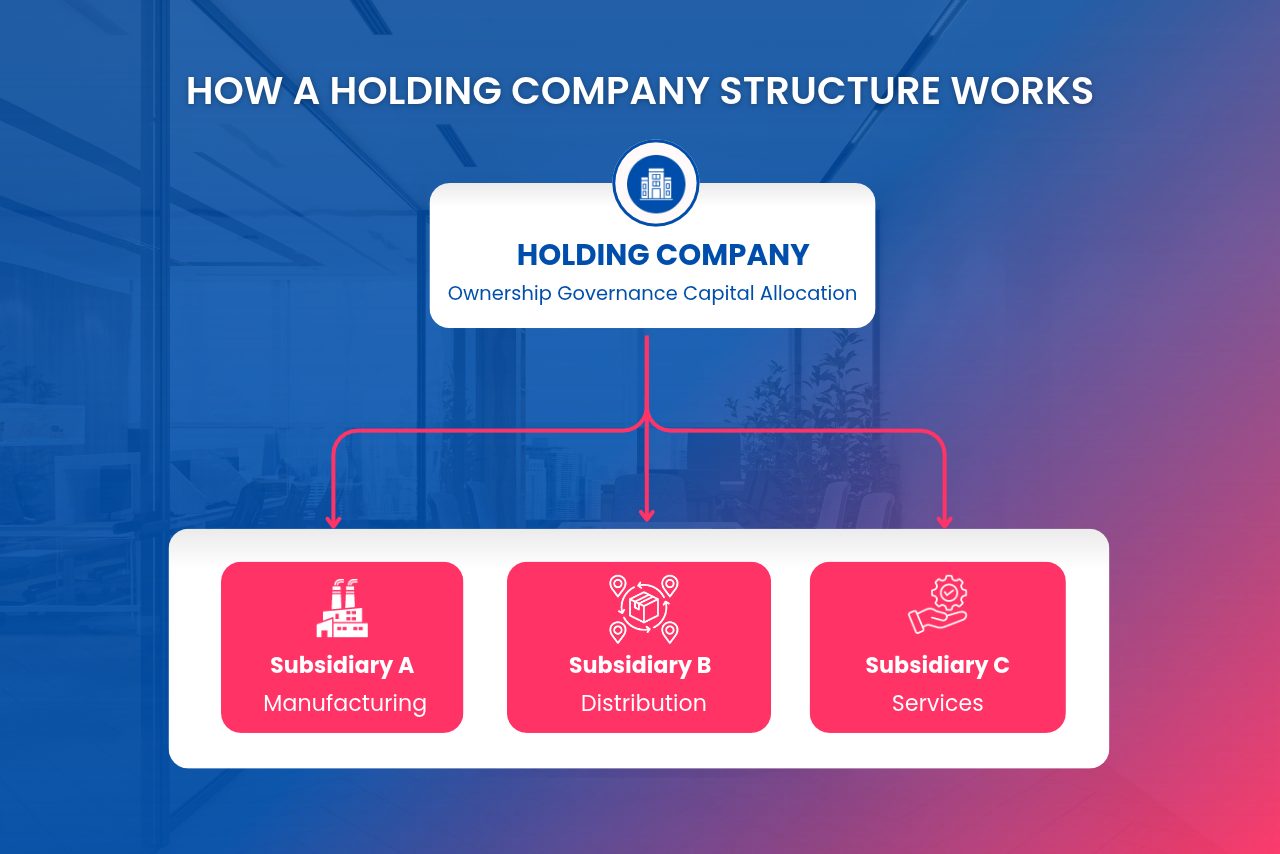
A holding company oversees ownership, investments, and governance across subsidiaries, while each operating company manages its own business activities.
Holding companies generally focus on ownership, financial oversight, and major investment decisions. Meanwhile, operating subsidiaries may manage employees, customers, suppliers, contracts, and daily business activities.
For example, a holding company may approve major investments, appoint directors, and set financial reporting requirements across its subsidiaries. Each operating company can then manage its activities within the authority established by the group’s governance arrangements.
Holding companies may also own important assets, including trademarks, intellectual property, investment portfolios, or real estate. Depending on the structure, subsidiaries can use these assets through properly documented licensing, leasing, or other agreements.
However, transactions between group companies must comply with relevant corporate, accounting, and tax requirements. Clear ownership records and separate financial accounts help maintain transparency across the structure.
What Are the Main Types of Holding Company Structures?
Holding companies can be classified according to their business activities, ownership relationships, and geographic operations. These categories describe how a corporate group is organized and may overlap within the same structure.
Pure Holding Companies vs Mixed Holding Companies
A pure holding company primarily owns and controls other businesses without directly conducting substantial commercial operations. Its activities generally focus on investment management, corporate governance, and ownership of subsidiaries.
For example, a pure holding company may own manufacturing, distribution, and service companies while allowing each subsidiary to manage its respective commercial activities.
A mixed holding company, meanwhile, combines ownership of subsidiaries with direct business operations. It may manufacture products, provide services, or manage commercial contracts while controlling other companies.
The appropriate model depends on whether the parent intends to remain focused on investments or participate directly in commercial activities. Both arrangements require clearly defined management and financial responsibilities.
Immediate, Intermediate, and International Holding Structures
An immediate holding company directly owns or controls a subsidiary. For example, Company A directly holds the shares of Company B, establishing a parent-subsidiary relationship.
An intermediate holding company operates between an ultimate parent company and subsidiaries further down the ownership chain. This can help organize businesses across different divisions or geographic markets.
An international holding structure involves companies established in multiple countries. Such arrangements may support regional expansion, acquisitions, and coordination of foreign subsidiaries.
However, international structures introduce additional legal, tax, and reporting requirements. SOA’s guide to registering a company in South Korea illustrates how local incorporation and foreign investment requirements can differ between markets.
Holding Company vs Subsidiary vs Operating Company
Holding companies, subsidiaries, and operating companies perform different roles within a corporate group. Understanding these roles helps businesses distinguish ownership responsibilities from commercial activities.
| Criteria | Holding company | Subsidiary | Operating company |
| Main role | Owns or controls other businesses | Operates under a controlling parent | Conducts commercial activities |
| Ownership | Parent-level entity | Controlled by another company | Depends on corporate structure |
| Main activities | Investments, ownership, governance | Depends on its purpose | Sales, production, or services |
| Management | Group-level oversight | Local or group-appointed management | Daily business operations |
| Typical use | Managing corporate groups | Expansion and investment | Delivering products or services |
These roles can overlap. For example, an operating company may also be a subsidiary, while an intermediate holding company can be controlled by another parent company.
Therefore, the distinction depends on the company’s role within the ownership structure, not simply its registered legal form.
What Are the Benefits and Risks of a Holding Company?
A holding company structure can provide several advantages for businesses managing multiple entities. However, these benefits depend on how the group is established, financed, and managed.
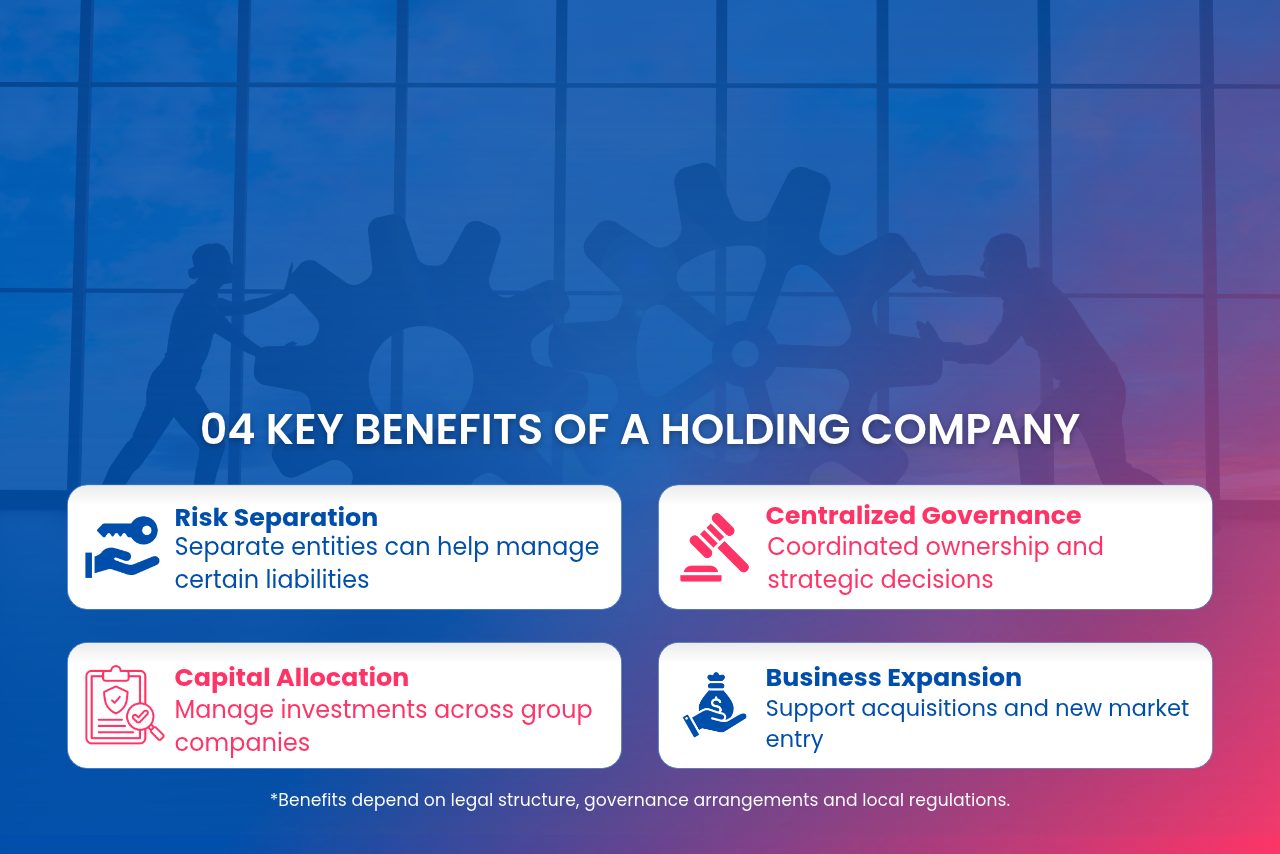
Holding companies can help businesses organize ownership, coordinate investments, manage certain risks, and expand through subsidiaries, subject to legal and financial requirements.
Benefits of a Holding Company Structure
- Risk separation and asset management
Separate legal entities can help distinguish certain business liabilities from assets held elsewhere in the corporate group. For example, a holding company may own valuable intellectual property while a subsidiary manages commercial operations that involve contractual or operational risks.
However, this separation is not absolute. Parent guarantees, misconduct, and other legal exceptions may expose the wider group to additional liabilities.
- Centralized ownership and corporate governance
A holding company can coordinate strategic decisions, ownership arrangements, and financial oversight across subsidiaries. This may be useful when a business operates several companies with different management teams or activities.
For example, the parent company can establish common reporting standards while allowing subsidiaries to make operational decisions within agreed limits.
- Capital allocation and investment management
Holding companies may receive dividends from subsidiaries, provide financing, or allocate investment capital across the group, subject to applicable laws and financial conditions.
This can support expansion when one subsidiary requires additional resources or when the group plans to invest in another business.
- Business expansion and diversification
A holding structure can help organize acquisitions, new business activities, and foreign subsidiaries. Companies can develop separate operating entities while maintaining an identifiable ownership structure.
For international investors, SOA’s guide to expanding a business in Vietnam explains how local establishment, investment planning, and operational preparation influence expansion decisions.
Disadvantages and Potential Risks
Despite these benefits, holding companies can create additional legal and administrative costs. Each incorporated entity may require registration, accounting records, tax filings, corporate governance, and ongoing compliance.
Financial reporting can also become more complex because the parent may need to consolidate results from several subsidiaries. Meanwhile, intercompany transactions, including loans, service fees, and royalties, may create transfer pricing and tax obligations.
International structures introduce further challenges. Tax residency, withholding taxes, foreign ownership rules, and reporting requirements may differ across jurisdictions, increasing the need for specialist support.
Finally, a holding structure does not automatically reduce taxes or protect every asset. Businesses must evaluate whether the expected financial and operational benefits justify the costs of maintaining multiple legal entities.
Holding Company Examples and Business Use Cases
Real-World Examples: Berkshire Hathaway and Alphabet
Berkshire Hathaway
Berkshire Hathaway is a well-known example of a holding company managing businesses across several industries. Its subsidiaries operate in insurance, freight transportation, energy, manufacturing, services, and retail.
According to Berkshire Hathaway’s 2025 Annual Report filed with the SEC, its operating subsidiaries are managed through a highly decentralized approach, while the parent oversees major capital allocation and investment decisions.
This illustrates how a holding company can maintain ownership of diverse businesses while allowing operating subsidiaries to manage their activities.
Alphabet Inc.
Alphabet Inc. provides another example of a corporate group organized around a parent company. Google LLC is one of Alphabet’s subsidiaries, as confirmed in its 2025 SEC subsidiary disclosure.
Alphabet oversees businesses operating in areas such as digital services, cloud technology, and other investments. Its structure demonstrates how a parent company can manage different activities within a broader corporate group.
When Do Businesses Use Holding Companies?
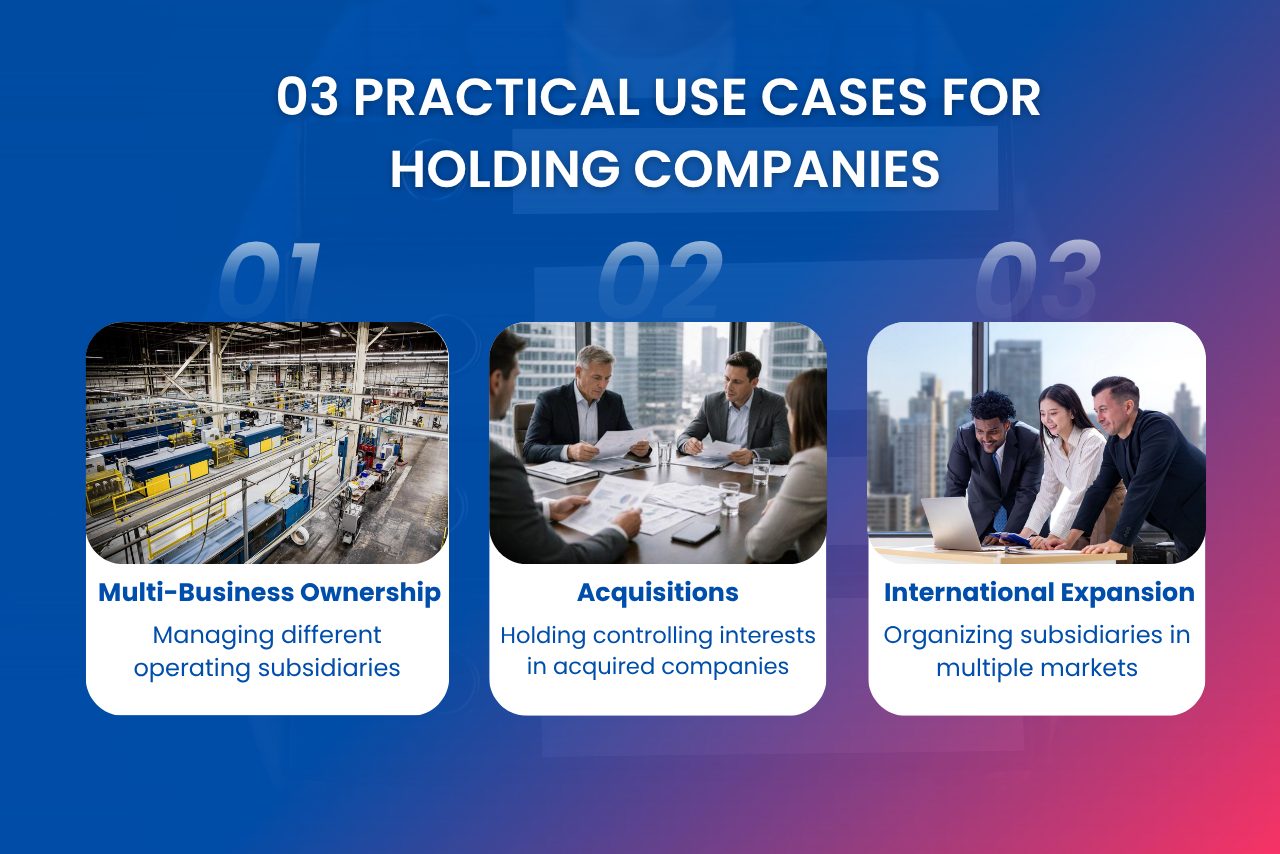
Businesses may use holding companies to manage diverse operations, organize acquisitions, and oversee subsidiaries across different markets
A holding company may be suitable when a business owns several subsidiaries and needs a clear structure for ownership, governance, and financial management. For example, a manufacturing group may operate separate companies for production, distribution, and regional sales.
Another use case involves acquisitions. A parent company may acquire controlling interests in businesses across different sectors while keeping their existing operations legally separate.
Holding structures can also support international expansion. A company entering several Asian markets may establish local subsidiaries under a common parent, allowing each entity to operate according to its country’s regulations.
However, businesses should assess whether the additional entities provide sufficient commercial or financial value before adopting this model.
How to Set Up a Holding Company
Establishing a holding company requires more than registering a new business name. Companies must define their ownership objectives, choose an appropriate legal structure, and establish clear relationships between the parent and its subsidiaries.
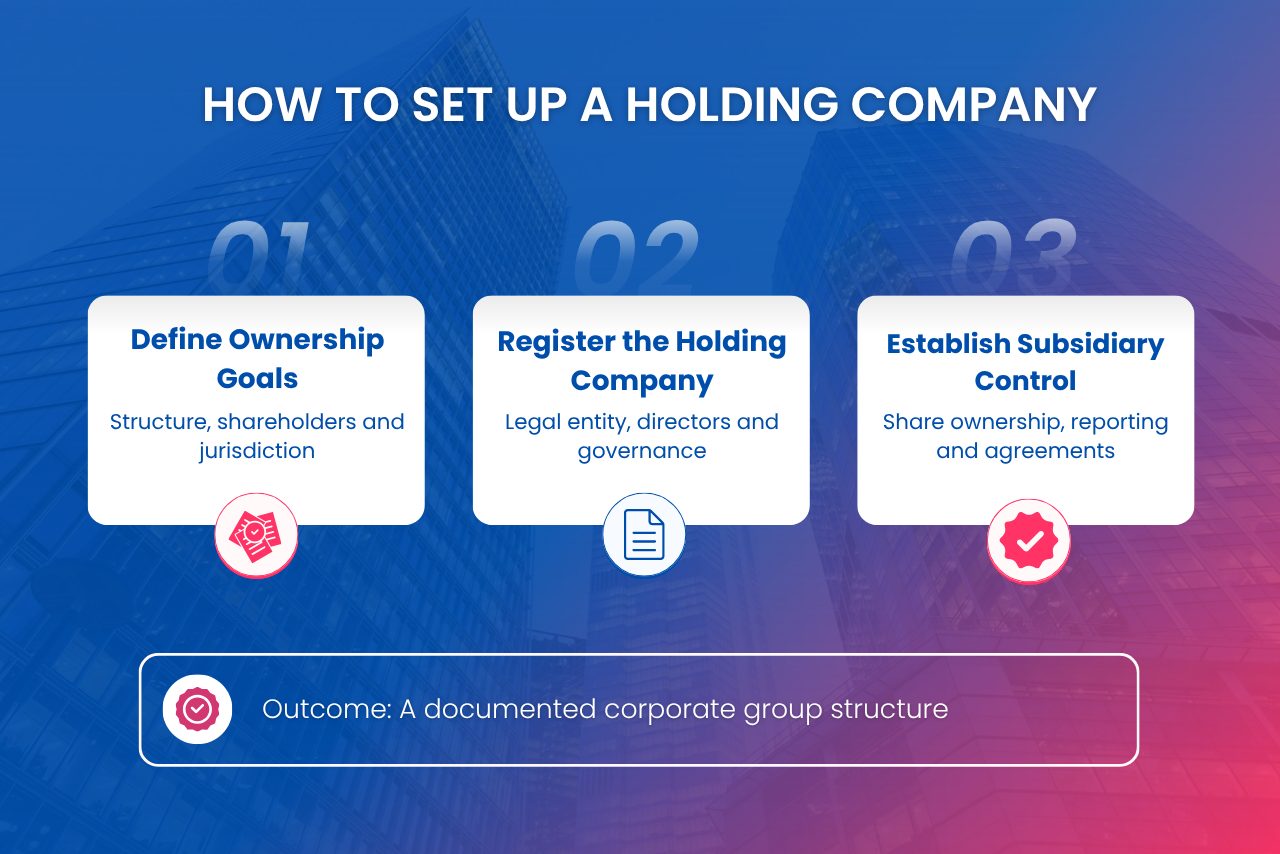
Three-step infographic explaining how to set up a holding company, from ownership planning and registration to subsidiary governance.
Step 1: Define Ownership Goals and Choose a Jurisdiction
The first step is to determine why the holding company is needed. Businesses should identify which companies or assets will be held, who the shareholders will be, and how ownership and decision-making authority should be distributed.
Next, they should evaluate the proposed jurisdiction. Important considerations include corporate laws, investment restrictions, tax residency, governance requirements, and the location of existing subsidiaries.
For example, an international company establishing a regional presence may need to compare incorporation requirements across several markets. SOA’s guide to registering a company in Malaysia provides practical context on local entity options and registration procedures.
Expected outcome: A proposed ownership structure and jurisdiction aligned with business objectives.
Step 2: Select a Legal Entity and Register the Holding Company
A holding company is generally established using a legal entity form available in the chosen jurisdiction. Depending on local law, this may be a corporation, limited liability company, or another permitted corporate structure.
The registration process typically involves preparing incorporation documents, identifying shareholders and directors, establishing governance arrangements, and completing applicable business registrations.
Companies should also determine capital requirements, banking arrangements, and whether the holding entity will directly conduct commercial activities.
For businesses considering Vietnam, SOA’s guide to starting a business in Vietnam explains common legal structures and the requirements involved in company establishment.
Expected outcome: A registered parent entity with documented ownership and governance arrangements.
Step 3: Establish Subsidiary Ownership and Governance
After registering the holding entity, businesses can establish new subsidiaries or transfer ownership of existing companies into the group structure.
This may involve share purchases, capital contributions, shareholder resolutions, or other legal arrangements. Existing shareholders, lenders, or regulatory authorities may also need to approve certain transactions.
Once the ownership structure is established, companies should define how subsidiaries report to the parent, which decisions require approval, and how financial information will be managed.
Separate accounting records, intercompany agreements, and clear management responsibilities are essential for ongoing operations.
Expected outcome: A documented corporate group with defined ownership, reporting, and management responsibilities.
What Legal, Tax, and Reporting Requirements Should Holding Companies Consider?
Holding companies must comply with the corporate and financial requirements of their jurisdictions. For international groups, these responsibilities may apply separately to each subsidiary and at the consolidated group level.
Corporate Tax, Dividends, and Intercompany Transactions
Holding companies may receive dividends, interest, royalties, or other investment-related income. The tax treatment of these payments depends on domestic laws, applicable tax treaties, and the nature of each transaction.
For example, dividends distributed from a foreign subsidiary may be subject to withholding tax or other requirements. Meanwhile, loans, licensing arrangements, and management services between related companies may require transfer pricing documentation.
Therefore, companies should evaluate cross-border payment arrangements and tax obligations before establishing financial flows between group entities.
Financial Reporting, Governance, and Compliance
Holding companies must maintain appropriate corporate records and financial reporting processes. Depending on applicable accounting standards, the parent may also be required to prepare consolidated financial statements covering controlled subsidiaries.
Under IFRS 10, consolidation is generally based on control, although specific exceptions apply to certain investment entities.
Furthermore, companies should establish governance policies covering directors’ responsibilities, financial approvals, shareholder rights, and related-party transactions.
As the number of subsidiaries grows, consistent reporting and documentation become important for maintaining oversight and meeting legal requirements.
How Source of Asia Supports International Business Expansion
Source of Asia supports international companies evaluating market opportunities, establishing local entities, and preparing business operations across Asian markets.
Business Structure Assessment and Market Entry Planning
SOA helps businesses evaluate market entry options, local establishment requirements, and practical considerations for developing an international presence.
Depending on project needs, this may include market research, business model assessment, local partner identification, and coordination with relevant legal or professional advisers. SOA’s Vietnam market entry guide explains how companies can compare local operating models based on their objectives.
Company Establishment and Local Operational Support
SOA also supports company establishment and operational preparation through services such as recruitment, HR administration, payroll, office search, and coordination with local professional partners.
For example, SOA supported French dermocosmetics company SVR Laboratories with establishing a local entity in Vietnam. The project included office search, salary benchmarking, management recruitment, payroll support, and coordination of establishment procedures.
These services help foreign businesses prepare local operations while maintaining coordination with their international headquarters.
Final Considerations
A holding company can help businesses manage multiple subsidiaries, organize ownership, and oversee investments across industries or countries. However, its effectiveness depends on appropriate governance, financial arrangements, and compliance with relevant laws.
Before establishing a holding structure, companies should assess the commercial purpose, expected costs, ownership requirements, and long-term expansion plans.
Planning to establish or expand business operations in Asia? Contact Source of Asia to discuss market entry, company establishment, and local operational support.
Frequently Asked Questions
What Is a Holding Company?
A holding company is a parent entity that owns or controls other businesses, usually called subsidiaries. Its main activities often involve managing ownership, investments, and strategic decisions. Operating subsidiaries generally handle commercial activities, although some holding companies also conduct business directly.
How Does a Holding Company Make Money?
A holding company may receive dividends from subsidiaries, earn interest on loans, collect licensing or rental income, or realize gains from investments. These income sources depend on its assets and ownership arrangements, while payments between related companies remain subject to applicable tax and legal requirements.
What Are the Main Benefits of a Holding Company?
Common benefits include centralized ownership, coordinated governance, investment management, and potential separation of certain business risks. Holding structures can also support acquisitions and international expansion. However, these advantages depend on proper implementation and do not eliminate all liabilities or compliance costs.
Can a Small Business Set Up a Holding Company?
Yes. A small business can establish a holding company where permitted by local law. However, the additional registration, accounting, and administrative costs should be justified by its ownership, asset management, or expansion objectives. A simpler structure may be more appropriate for businesses with limited operations.
How Much Does It Cost to Set Up a Holding Company?
There is no universal setup cost. Expenses depend on the jurisdiction, legal entity type, number of subsidiaries, professional services, and registration requirements. Businesses should also budget for accounting, tax filings, governance, and ongoing compliance before deciding whether a holding structure is financially appropriate.