Introduction
When companies operate across borders, the same income may become taxable in more than one country. For example, a business might earn revenue overseas while remaining subject to tax in its home country. Without appropriate relief, these overlapping tax obligations can increase costs and complicate financial planning.
Double Taxation Agreements (DTAs) help address this issue by establishing how participating countries tax cross-border income and when relief may be available. However, their benefits depend on the specific treaty, the type of income, and the company’s eligibility.
In this guide, Source of Asia (SOA) explains how double taxation agreements work, which business transactions they cover, and what international companies should consider when claiming tax treaty benefits.
Quick Answer
What is a double taxation agreement, and how does it protect businesses?
A double taxation agreement (DTA), also called a double tax treaty, is an agreement between two countries that establishes rules for taxing income connected to both jurisdictions. Its purpose is to reduce double taxation while supporting cooperation between tax authorities.
DTAs can allocate taxing rights, provide tax credits or exemptions, and limit withholding tax on certain cross-border payments. They also establish rules concerning business profits, permanent establishments, and tax-related disputes.
However, treaty benefits are not automatic. Businesses must verify the applicable agreement, establish their tax residency, assess the relevant income, and comply with local documentation and filing requirements.
What Is Double Taxation and What Is a Double Taxation Agreement?
What Is Double Taxation and Why Does It Occur?
Double taxation occurs when income is subject to tax more than once. In international business, this can happen because countries apply different rules to determine where income should be taxed.
For example, Company A is a tax resident of Country A but earns income in Country B. Country B may seek to tax that income because it arises within its territory, while Country A may also include the income in Company A’s taxable earnings.
This situation is commonly called juridical double taxation, involving the same taxpayer and income. A related concept, economic double taxation, can arise when the same economic profit is taxed in the hands of different taxpayers, including certain transfer pricing adjustments.
Double Taxation Agreement Meaning and Purpose
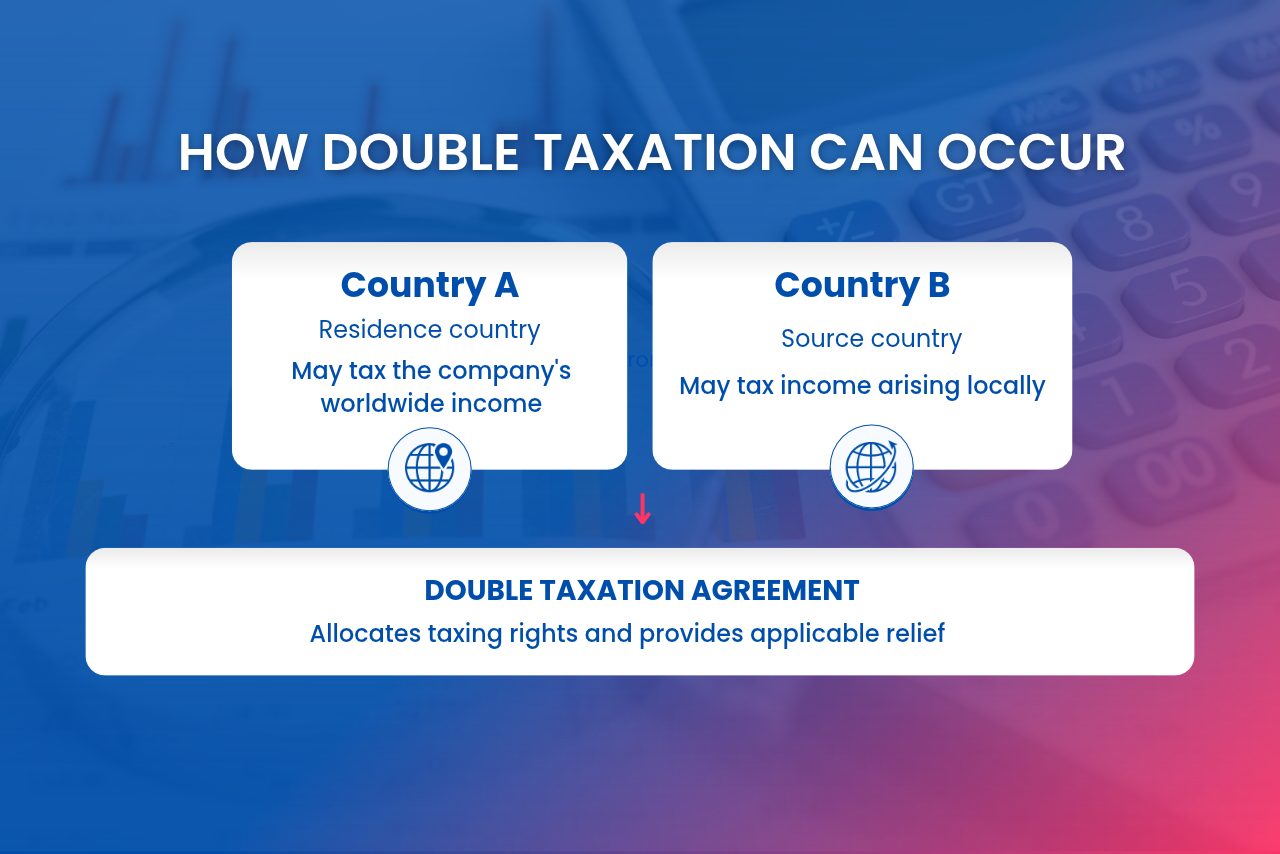
Double taxation agreements help countries allocate taxing rights and provide relief when the same cross-border income may otherwise be taxed in both jurisdictions.
A double taxation agreement is an international treaty that defines how two countries exercise their taxing rights over specified types of income. These treaties aim to reduce overlapping taxation, clarify tax responsibilities, and support international investment.
Most bilateral tax treaties follow principles reflected in the OECD Model Tax Convention on Income and on Capital 2025. The United Nations also provides a model convention that gives particular attention to taxation in countries where income arises.
Although these models influence treaty negotiations, individual agreements can contain different provisions. Therefore, businesses must review the treaty that applies to their specific transaction.
How Do Double Taxation Agreements Work?
DTAs operate through several mechanisms that determine where income is taxable and how overlapping tax obligations may be reduced.
Tax Residency, Source Country, and Allocation of Taxing Rights
Two important concepts are the residence country and the source country. The residence country is generally where a taxpayer is considered resident for tax purposes, while the source country is where the relevant income arises under applicable tax rules.
A DTA determines whether one country has the primary right to tax certain income or whether both countries may impose tax under specified conditions.
For example, some business profits may be taxable only in the company’s residence country unless it has a permanent establishment in the other country. In contrast, certain dividends, interest, and royalties may be taxable in both countries, subject to treaty limitations.
Foreign Tax Credits and Tax Exemption Methods
Tax treaties can provide relief through foreign tax credits or exemptions, depending on their provisions and domestic implementation.
Under a foreign tax credit system, the residence country may allow taxes paid abroad to reduce domestic tax payable on the same income. However, the credit is generally subject to limitations and eligibility requirements.
Under a tax exemption system, certain foreign income may be excluded from taxation in the residence country, subject to the applicable rules.
Both methods help address overlapping taxation, although they operate differently. Therefore, companies should determine which method applies before calculating their tax liabilities.
Reduced Withholding Tax on Cross-Border Payments
Withholding tax is commonly applied when a company makes certain payments to a foreign recipient. These may include dividends, interest, or royalties, depending on local law.
A double tax agreement may limit the tax that the source country can withhold from an eligible payment. For example, a treaty may provide a lower withholding tax rate than the rate established under domestic legislation.
However, the reduced rate depends on the specific treaty, income classification, and eligibility conditions. The recipient may also need to establish beneficial ownership and provide supporting documentation before relief can be applied.
Which Cross-Border Business Transactions Do DTAs Cover?
Double taxation agreements address several types of cross-border income. However, each income category may be governed by different treaty provisions.
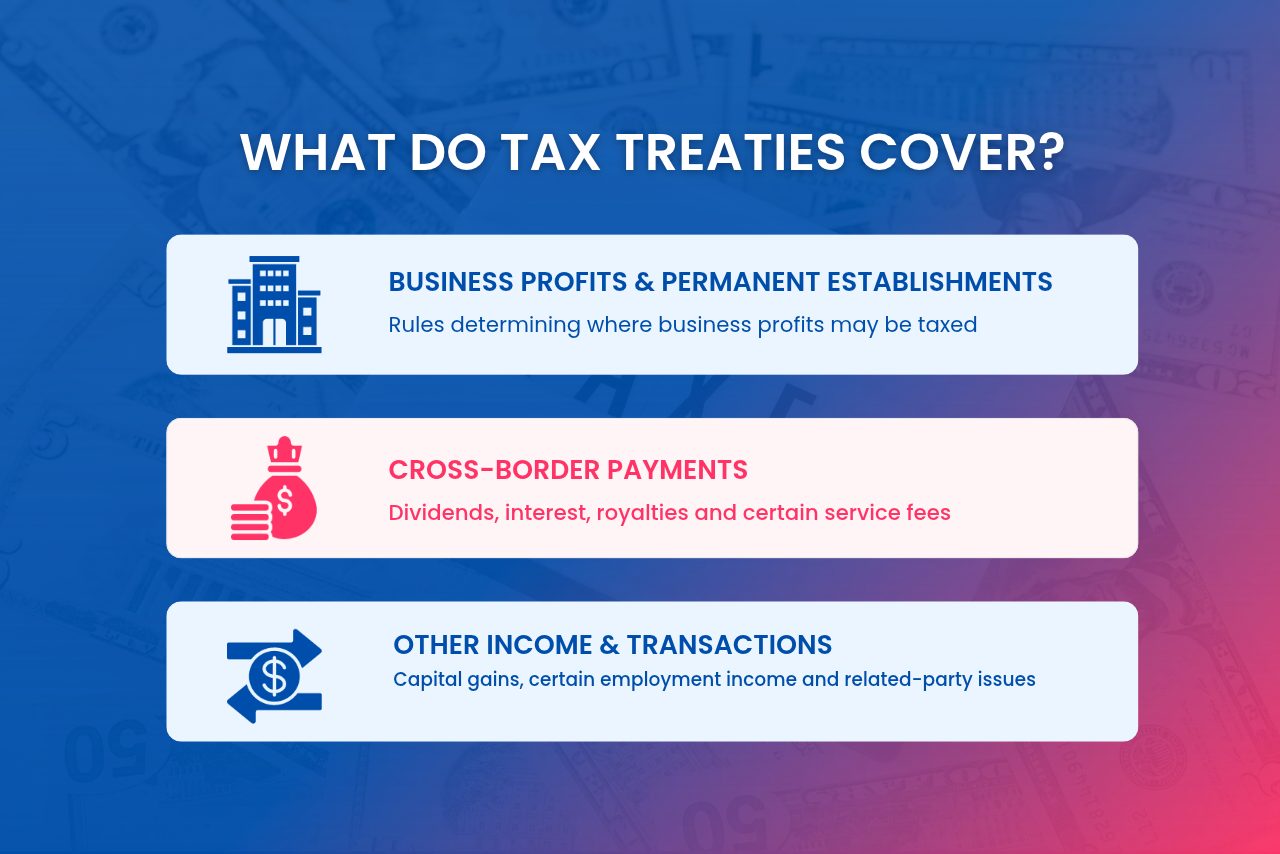
Double taxation agreements can address business profits, cross-border payments, and other income categories, with specific taxing rights and relief conditions determined by each treaty.
Business Profits and Permanent Establishment
A permanent establishment (PE) generally refers to a taxable business presence in another country, as defined by the relevant treaty. It can include certain fixed business locations or activities that meet the treaty’s conditions.
Under many agreements, business profits are generally taxable in the company’s residence country unless the business operates through a PE in the other country. Where a PE exists, the source country may tax profits attributable to it.
For example, a foreign engineering company conducting a long-term project overseas may need to assess whether its activities create a PE. This assessment depends on the applicable treaty, duration of activities, contractual arrangements, and operational facts.
Dividends, Interest, Royalties, and Service Fees
Cross-border payments between companies are another important area covered by tax treaties.
Dividends paid to foreign shareholders may qualify for reduced withholding tax, while interest on international loans may receive different treatment. Similarly, royalties for intellectual property can be subject to treaty-specific tax limits.
Service fees require particular attention because their treatment varies between agreements. Certain payments may fall under business profits provisions, while some treaties contain separate rules for technical services.
Businesses should review the nature of each payment and the applicable treaty article before applying withholding tax relief.
Capital Gains, Related-Party Transactions, and Employee Income
DTAs may also address gains from selling shares, businesses, or particular assets. However, taxing rights can differ depending on the asset involved, including whether its value is connected to immovable property.
In addition, related-party transactions may create transfer pricing issues where two tax authorities make different adjustments to the same economic profit. Certain treaty provisions and dispute procedures can help address these situations.
Employment income can also fall within treaty coverage, particularly when employees work temporarily in another country. The applicable rules depend on residence, employment arrangements, and other treaty conditions.
What Are the Benefits and Limitations of Double Taxation Agreements?
Benefits of Double Tax Agreements for International Businesses
One major benefit of a DTA is the potential reduction of double taxation. By clarifying taxing rights and providing relief mechanisms, treaties can help companies avoid paying overlapping taxes on eligible income.
DTAs may also reduce withholding tax on cross-border payments, improving the financial predictability of international transactions. Moreover, clearer tax rules can support investment planning and help businesses understand their obligations before entering another market.
Another benefit is access to dispute resolution procedures. The Mutual Agreement Procedure (MAP) allows competent tax authorities to discuss certain cases where taxation may be inconsistent with a treaty. However, the procedure does not guarantee that every dispute will be resolved.
Companies should also distinguish treaty relief from domestic incentives. SOA’s guide to tax incentives in Vietnam explains how preferential tax rates and investment incentives operate under local legislation.
Limitations, Treaty Conditions and Anti-Abuse Rules
Double tax agreements do not eliminate every form of taxation. Their scope is generally limited to specified taxes on income and, where applicable, capital. VAT, customs duties, and social security contributions are not automatically covered.
Furthermore, businesses must satisfy residency and other eligibility conditions. Provisions concerning beneficial ownership, permanent establishments, and treaty residence can affect whether relief is available.
Anti-abuse measures also restrict inappropriate treaty claims. These may include the Principal Purpose Test (PPT) or Limitation on Benefits (LOB) provisions, depending on the agreement.
Consequently, establishing an entity in a treaty country does not automatically entitle a business to preferential tax treatment.
How Double Taxation Agreements Work: Practical Business Examples
Example 1: A Foreign Company Claiming a Tax Credit
Consider Company A, a tax resident of Country A, earning US$100,000 in taxable income from Country B. Assume Country B imposes US$10,000 in tax, while Country A calculates US$20,000 in tax on the same income.
If the applicable rules allow a full US$10,000 foreign tax credit, Company A may reduce its Country A tax liability to US$10,000. The combined tax would then be US$20,000 instead of US$30,000.
This example is illustrative. Actual credit calculations depend on domestic legislation, treaty provisions, the type of income, and applicable limitations.
Example 2: Reduced Withholding Tax on Royalty Payments
Suppose Company B pays US$100,000 in royalties to an eligible foreign company. Assume the source country’s domestic withholding tax rate is 15%, while an applicable treaty limits the rate to 5%.
Under these assumptions, withholding tax could decrease from US15,000 to US5,000, provided the recipient qualifies for treaty relief and completes the required procedures.
These are hypothetical rates, not figures taken from a specific treaty. The final tax treatment, including any residence-country taxation, must be assessed separately.
How Can Businesses Claim Benefits Under a Double Tax Agreement?
Claiming treaty relief requires more than identifying a favorable tax rate. Businesses must verify the agreement, assess eligibility, and follow the applicable procedures.
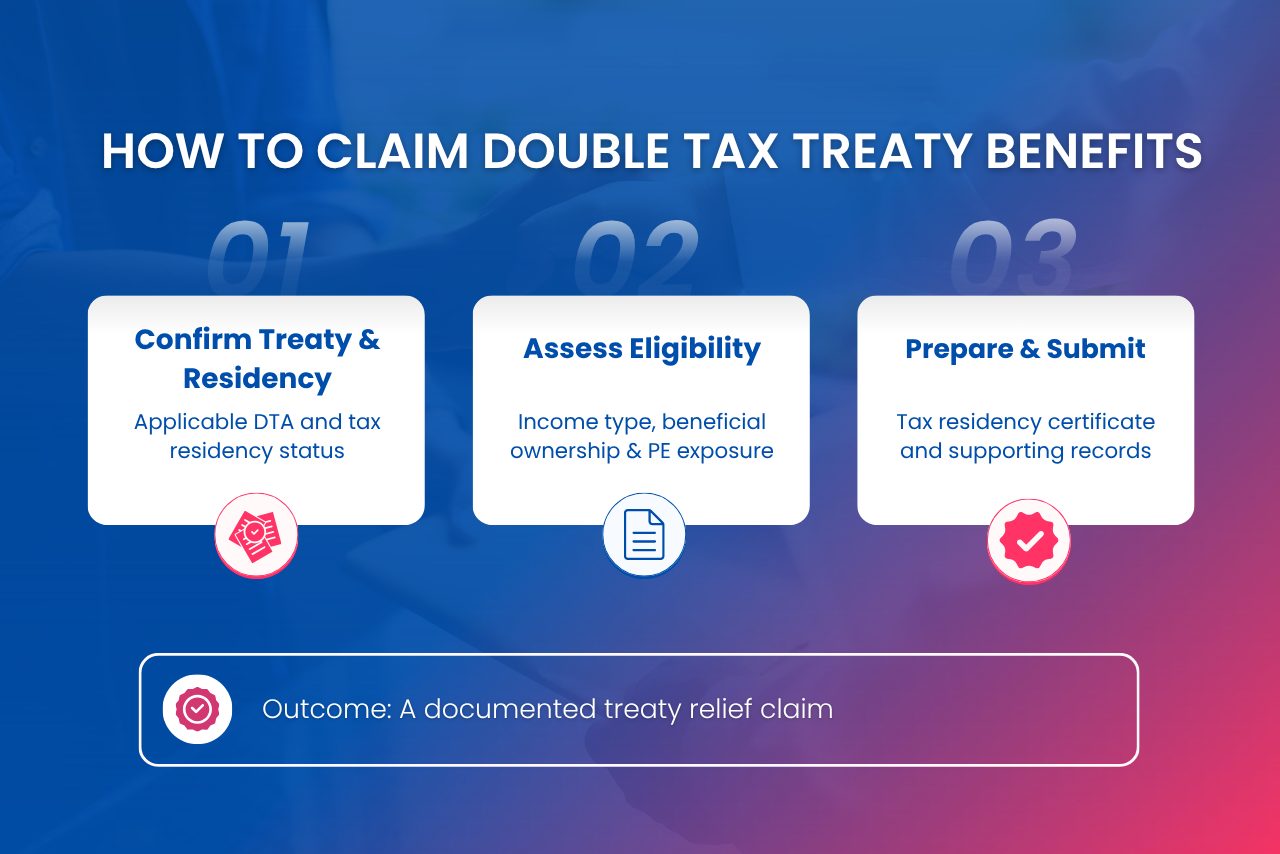
Businesses seeking double tax treaty relief should verify the applicable agreement, confirm eligibility, and prepare the required documentation before submitting a claim.
Step 1: Confirm the Applicable Treaty and Tax Residency
First, identify whether a double taxation agreement exists between the relevant countries and whether it is in force for the income and period concerned.
Next, confirm the company’s tax residency. Tax authorities may require a Certificate of Tax Residence (COR) issued by the relevant jurisdiction as evidence that the company qualifies as a treaty resident.
Businesses should also check whether special treaty provisions affect entities with connections to multiple jurisdictions.
Expected outcome: Confirmation of the applicable treaty and the company’s tax residency status.
Step 2: Assess Income Classification and Treaty Eligibility
After identifying the treaty, companies should classify the income and determine which provision applies.
For example, dividend payments, royalties, and business profits may be subject to different rules. Businesses should also assess beneficial ownership where relevant, permanent establishment exposure, and applicable anti-abuse provisions.
This review is particularly important for intercompany transactions because ownership relationships and contractual arrangements can affect tax treatment.
Expected outcome: A documented assessment of treaty eligibility and applicable tax provisions.
Step 3: Prepare Documentation and Follow Local Claim Procedures
The documentation required depends on the countries involved and the nature of the transaction. Common supporting materials include tax residency certificates, contracts, invoices, payment records, and evidence of taxes paid abroad.
Businesses may also need information demonstrating beneficial ownership or the commercial purpose of a transaction.
Depending on local procedures, relief may be applied at the time of withholding or claimed through a subsequent refund or tax filing. Companies should verify submission deadlines and maintain accurate supporting records.
For operations in Vietnam, SOA’s business compliance checklist provides guidance on tax registration, accounting records, and ongoing filing responsibilities.
Expected outcome: A properly documented treaty claim supported by the required filings and records.
What Should Foreign Companies Know About DTAs in Vietnam and ASEAN?
Vietnam’s Double Tax Treaty Framework in 2026
Vietnam maintains double taxation agreements with numerous international partners. However, the existence and effective date of each agreement must be confirmed before a company applies for relief.
In 2026, Vietnam updated its tax treaty framework through Circular 95/2026/TT-BTC and Circular 89/2026/TT-BTC, both effective from July 1, 2026.
As explained in PwC’s July 2026 review of Vietnam’s DTA framework, the updated regulations replace earlier guidance on treaty implementation and administrative procedures. Circular 95 also addresses Mutual Agreement Procedures and Advance Pricing Agreements.
Foreign companies should therefore verify the current requirements when claiming treaty benefits, particularly for cross-border payments, capital transfers, and related-party transactions.
Companies preparing a local presence can also review SOA’s guide to starting a business in Vietnam to understand the broader establishment and compliance framework.
Why Treaty Reviews Matter for ASEAN Market Entry
International businesses operating across ASEAN may face different tax rules in each jurisdiction. For example, a regional group receiving royalties, service fees, or dividends from several subsidiaries may need to assess multiple bilateral tax treaties.
The treatment of each payment depends on the countries involved, the legal entities, and the nature of the income. Therefore, businesses should review tax implications alongside their broader market entry and corporate structure decisions.
SOA’s guides to Vietnam market entry and company registration in Malaysia provide additional context on local establishment and operating requirements.
How Source of Asia Supports Cross-Border Business and Tax Compliance
Market Entry, Business Structure, and Cross-Border Planning
Source of Asia supports international businesses evaluating market opportunities, choosing local operating arrangements, and preparing expansion across Asian markets.
Depending on project requirements, this can include market research, business structure assessment, company establishment coordination, and identifying relevant local professional support.
For example, SOA supported SVR Laboratories with establishing a local entity in Vietnam, including operational preparation and administrative coordination.
Accounting, Corporate Compliance, and Local Operational Support
Beyond establishment, SOA supports businesses with accounting coordination, payroll administration, corporate services, and ongoing local operations.
These activities can help companies maintain accurate records, manage reporting responsibilities, and coordinate with appropriate tax and legal specialists when cross-border issues arise.
The scope of assistance depends on the market and project requirements, while specific treaty interpretations and claims should be reviewed with qualified tax advisers.
Final Considerations
Double taxation agreements help international businesses manage overlapping tax obligations through agreed rules on taxing rights, relief methods, and dispute resolution.
However, treaty benefits depend on the applicable agreement, income classification, eligibility conditions, and local procedures. Companies should review these factors before making cross-border payments or establishing international structures.
Planning business expansion in Asia? Contact Source of Asia to discuss market entry, corporate establishment, and local compliance support.
Frequently Asked Questions
What Is a Double Taxation Agreement?
A double taxation agreement is a treaty between two countries that establishes rules for taxing cross-border income. It may provide tax credits, exemptions, or reduced withholding tax rates, depending on the income involved and the taxpayer’s eligibility.
How Does a Double Tax Treaty Prevent Double Taxation?
A treaty can allocate taxing rights between countries and provide relief when both jurisdictions may tax the same income. Common mechanisms include foreign tax credits, exemptions, and limits on source-country taxation. The applicable method depends on the treaty.
What Types of Business Income Are Covered by DTAs?
DTAs commonly address business profits, dividends, interest, royalties, and certain capital gains. Some agreements also contain provisions covering technical services or employment income. Each category must be assessed under the relevant treaty and domestic tax rules.
Can a Company Automatically Claim Benefits Under a DTA?
No. Companies generally need to establish treaty eligibility, including relevant tax residency and income-related conditions. They may also need to provide tax residency certificates, transaction documents, and additional information required by the relevant tax authority.
What Happens If Two Countries Disagree on How Income Should Be Taxed?
Where a treaty provides for it, a taxpayer may request assistance through the Mutual Agreement Procedure. The competent authorities can discuss the case and seek a resolution consistent with the treaty. However, access, deadlines, and outcomes depend on the applicable rules.