Introduction
When entering a new market, foreign companies often need a local presence to understand customers, build relationships, and assess business opportunities before making a larger investment. Establishing a representative office can be a practical option for companies at this stage.
A representative office allows a foreign business to conduct permitted activities such as market research and local liaison. However, it generally cannot generate commercial revenue or operate as an independent company. Its activities remain subject to local regulations and licensing conditions.
In this guide, Source of Asia (SOA) explains the purpose of a representative office, what it can and cannot do, how to establish one, and when businesses should consider alternative market entry structures.
Quick Answer
What is a representative office, and what can it do?
A representative office (RO), also called a rep office, is a local presence established by a foreign company to conduct permitted non-commercial activities in another market. It typically supports market research, communication with local partners, and business opportunity development.
Unlike a subsidiary, a representative office generally has no separate legal identity and operates under the responsibility of its foreign parent company. It usually cannot sell products, issue commercial sales invoices, or earn revenue independently.
Businesses often use representative offices during early market exploration. However, the available activities, registration requirements, and ongoing obligations depend on the laws of the host country.
What Is a Representative Office?
Representative Office Definition and Legal Status
A representative office is an office established by a company to represent its interests in another location, often in a foreign country. Its main role is to maintain a local presence and support activities permitted under the host country’s regulations.
In most international business contexts, a representative office does not operate as a separate legal entity. Instead, it forms part of the foreign parent company’s organization, which generally remains responsible for the office’s activities and obligations.
For example, Vietnam’s Decree 07/2016/ND-CP regulates representative offices established by foreign traders. Their permitted functions primarily involve liaison, market research, and promotion of business opportunities, subject to applicable restrictions and specialized regulations.
Therefore, companies should distinguish between establishing a representative office and incorporating a local business entity.
How Does a Representative Office Work?
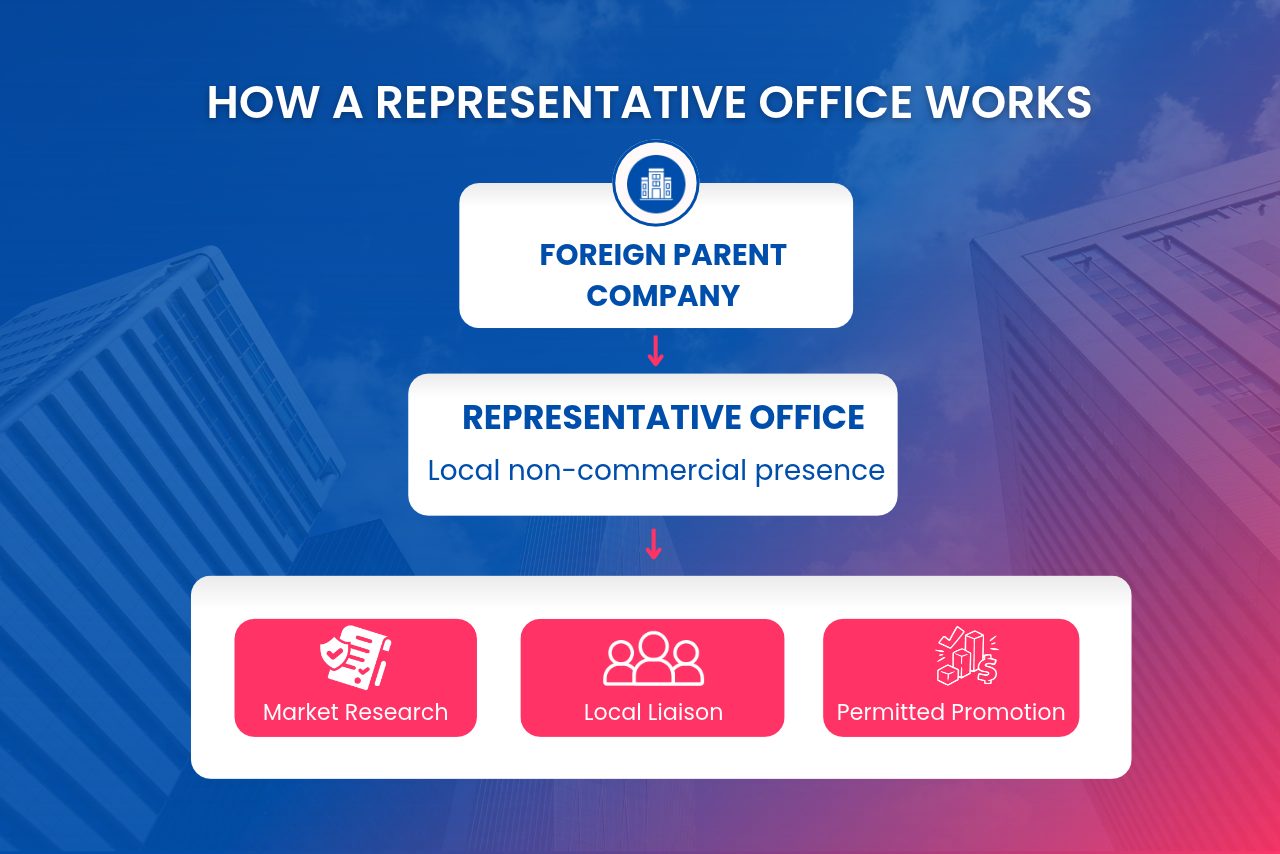
How a representative office supports a foreign parent company through market research, local liaison, and permitted business promotion.
A representative office acts as a local point of contact between the foreign parent company and the target market. It may employ staff, maintain office premises, and communicate with customers or business partners within the scope permitted by law.
For example, a German industrial equipment manufacturer considering expansion into Vietnam might establish a representative office to study customer needs, attend business meetings, and identify potential partners. The information gathered would help headquarters evaluate market demand and decide whether to establish commercial operations.
However, the office cannot independently perform activities reserved for licensed commercial entities. Sales transactions and contractual arrangements must remain within the applicable legal framework and the authority granted by the parent company.
What Is the Purpose of a Representative Office?
A representative office helps companies develop local market knowledge and business relationships without immediately establishing a fully operating subsidiary.
Market Research and Business Opportunity Assessment
One important purpose of a representative office is to collect information about local market conditions. This may involve studying customer needs, identifying competitors, monitoring industry developments, and assessing potential business opportunities.
For example, a foreign machinery supplier may use a representative office to research manufacturing clusters and identify factories that could require its equipment. These findings can support decisions about product suitability, pricing, and future market entry.
However, market research should be structured around clear business questions. SOA’s Vietnam market entry guide explains how companies can evaluate demand, identify target customers, and compare potential entry models before committing significant resources.
Local Liaison and Partner Relationship Development
Representative offices also support communication between headquarters and local stakeholders. Their employees may arrange meetings, exchange information, and maintain relationships with potential customers, suppliers, or business partners.
A local presence can be useful when companies need regular communication across different languages, business practices, and time zones. It also allows headquarters to receive market feedback from employees working directly in the target country.
Nevertheless, liaison activities must remain within the office’s authorized scope. The office should not independently perform commercial transactions simply because it maintains relationships with customers or suppliers.
Brand Representation and Permitted Business Promotion
A representative office may help introduce its parent company’s brand, products, or services to a new market. Depending on local regulations, this can involve sharing company information, participating in permitted promotional activities, or supporting business events.
For example, an international technology company may use its representative office to introduce its technical capabilities and develop relationships with industry associations.
However, promotional activities and direct sales are legally different. Companies should confirm which marketing activities are allowed and whether particular events, advertisements, or commercial promotions require additional approvals.
What Can and Cannot a Representative Office Do?
The permitted activities of a representative office depend on local law. Vietnam provides a useful example because its commercial legislation establishes a clear distinction between representation and direct profit-making activities.
Permitted Activities of a Representative Office
Under Vietnam’s general framework for representative offices of foreign traders, permitted activities typically include market research, local liaison, and promotion of business opportunities within the authorized scope.
A representative office may also carry out administrative activities necessary for its operations, including renting office premises, purchasing equipment, and employing Vietnamese or foreign workers in accordance with applicable laws.
In addition, it may maintain an authorized bank account for office-related activities and use its registered seal where permitted. However, these arrangements serve the office’s administrative needs and do not authorize independent commercial trading.
Businesses should verify whether their industry is subject to specialized regulations, as additional rules may apply.
Restricted Commercial Activities and Contract Signing
The principal limitation of a representative office is its inability to conduct independent revenue-generating activities. In Vietnam, this restriction is established under the Commercial Law, particularly Articles 17 and 18.
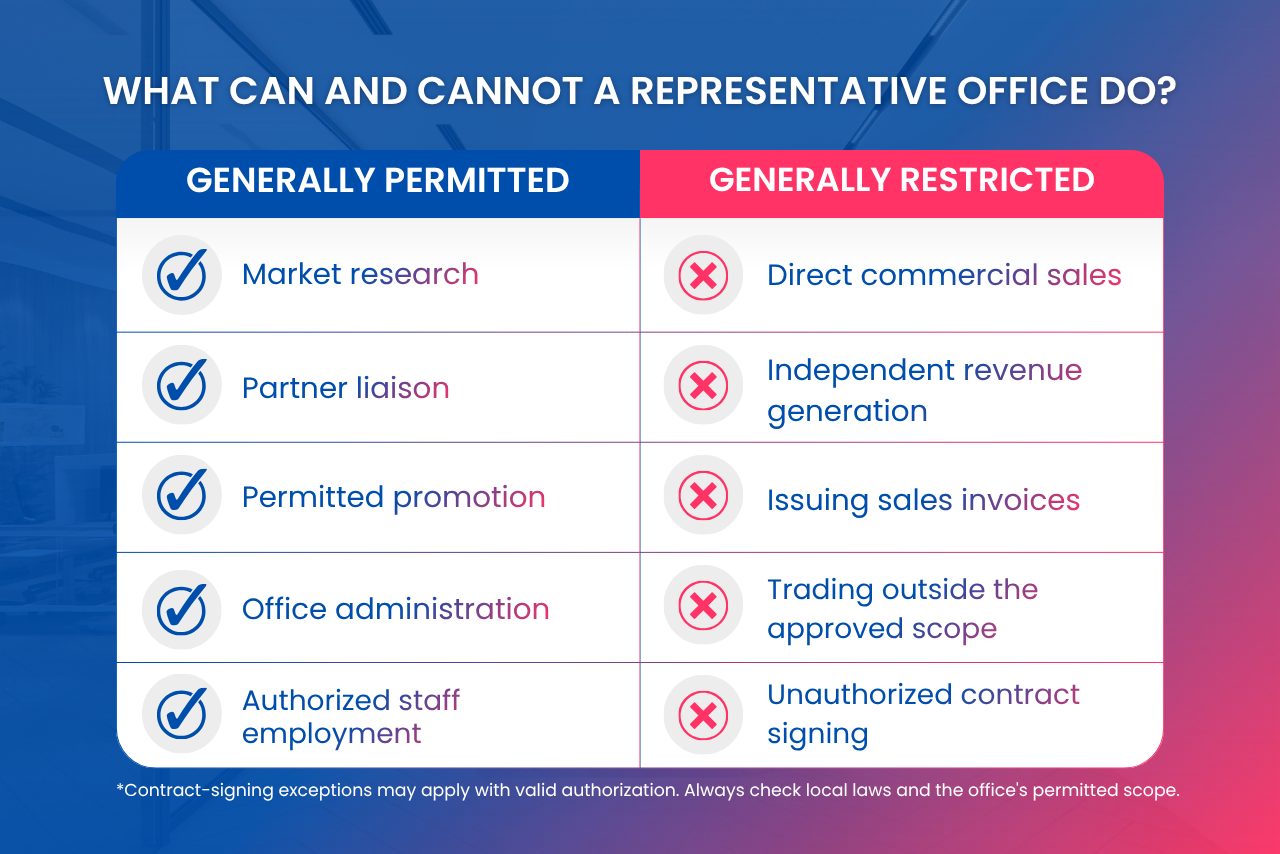
Representative offices generally support research and liaison activities but face restrictions on direct sales, revenue generation, and commercial transactions.
A representative office in Vietnam generally cannot enter into or amend commercial contracts on behalf of its foreign parent without valid authorization. However, the law recognizes exceptions, including situations where the chief representative receives proper written authorization from the parent company. Decree 07/2016 requires such authorization to be documented for each relevant contract signing or amendment.
This exception does not grant the representative office an independent right to conduct business. Companies must still verify the nature of the transaction and whether the underlying activity is permitted.
Representative Office vs Branch Office vs Subsidiary
Representative offices, branches, and subsidiaries provide different ways for foreign companies to establish a presence in another country. The main differences concern legal identity, commercial activities, and responsibility for business obligations.
| Criteria | Representative Office | Branch Office | Subsidiary |
| Legal status | Generally not separate | Generally part of the parent | Separate legal entity |
| Main purpose | Research and liaison | Permitted direct business operations | Local commercial operations |
| Revenue generation | Generally prohibited | May be permitted | May be permitted |
| Parent liability | Generally responsible | Parent generally responsible | Generally separated, subject to exceptions |
| Typical use | Market exploration | Direct overseas presence | Long-term local business |
A representative office may suit companies seeking information and relationships before investing. In contrast, branches and subsidiaries can support commercial operations, provided the relevant activities are authorized.
However, establishing a subsidiary usually involves additional corporate governance, accounting, and registration requirements. SOA’s guide to expanding a business in Vietnam explains how foreign businesses can compare these options based on their commercial needs.
What Are the Benefits and Limitations of a Representative Office?
A representative office can offer a useful starting point for international expansion. However, its restricted commercial role means that it will not suit every business model.
Advantages of Establishing a Representative Office
One advantage is the ability to maintain a formal local presence while evaluating market opportunities. Employees can gather information, communicate with potential partners, and help headquarters understand local business conditions.
Furthermore, a representative office may involve less corporate administration than establishing a separate subsidiary. This can be relevant when a company is still assessing demand and has not committed to substantial local operations.
A representative office can also support more consistent communication with local stakeholders. For businesses entering unfamiliar markets, having dedicated employees on the ground may improve the quality and continuity of market research.
Limitations and Operating Risks
The main limitation is the restriction on direct commercial activities. A representative office generally cannot independently generate revenue, issue sales invoices, or operate as a fully licensed trading business.
Despite its limited commercial scope, the office may still incur costs for premises, employees, administration, and compliance. The foreign parent generally remains responsible for these activities.
In addition, representative offices must comply with local employment, tax, reporting, and licensing requirements. Therefore, companies should not assume that a non-revenue-generating office is automatically exempt from all tax or administrative obligations.
As business activities expand, these limitations may make another operating model more appropriate.
How to Set Up a Representative Office
The process of setting up a representative office varies between countries. However, it generally involves checking eligibility, preparing the required documents, applying for authorization, and completing local administrative procedures.
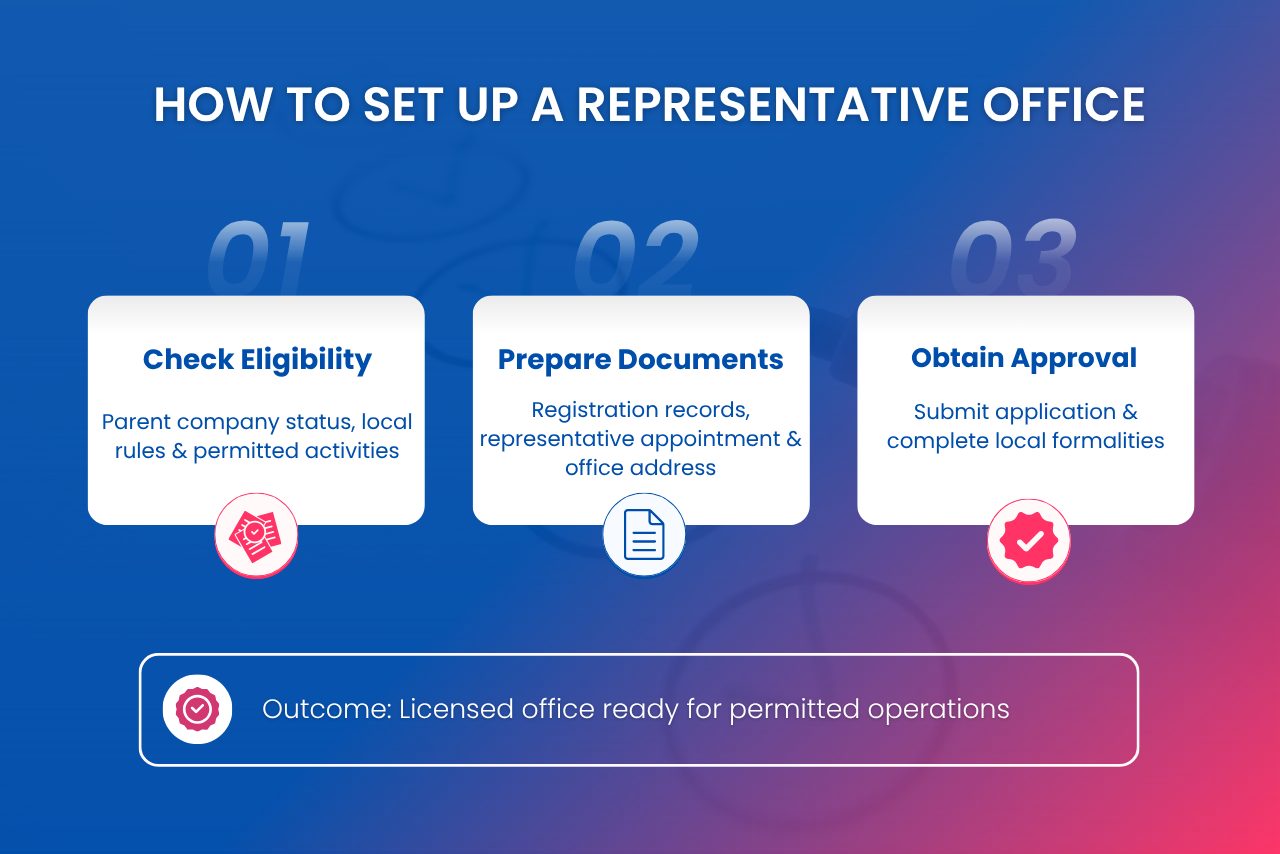
Three-step guide to setting up a representative office, covering eligibility checks, required documents, registration, and post-approval procedures.
Step 1: Check Eligibility and Local Legal Requirements
Before establishing a representative office, companies should verify whether the proposed activities are permitted in the target market. They should also assess the eligibility of the foreign parent company and identify the relevant licensing authority.
In Vietnam, Decree 07/2016/NĐ-CP generally requires the foreign trader to have operated for at least one year. The application must also satisfy conditions relating to the trader’s legal status, remaining business registration validity where relevant, and permitted operating scope.
Certain sectors are governed by specialized regulations. Therefore, companies should confirm whether the general representative office framework applies to their intended activities.
Expected outcome: Confirmation of the parent company’s eligibility and the activities that the representative office may legally perform.
Step 2: Prepare Required Documents and Local Arrangements
Once eligibility is confirmed, the company should prepare the registration documents required by the host country.
For Vietnam, a typical application includes the foreign trader’s business registration documents, financial evidence, an appointment letter for the representative office head, identification documents, and information about the proposed office premises.
Foreign-issued documents may require certification, translation, or legalization, depending on applicable rules and exemptions. These requirements can affect the preparation schedule, particularly when documents must be obtained from several authorities.
Companies should also identify a suitable office location and appoint the person responsible for local operations. The office premises must meet relevant registration and operating requirements.
Expected outcome: A complete application file, designated representative, and suitable local office arrangements.
Step 3: Submit the Application and Complete Post-Approval Formalities
After preparing the documents, the company submits its application to the competent licensing authority. The authority reviews the file and may request additional information before making a decision.
Under Vietnam’s general procedure, the statutory decision period is seven working days after receiving a complete and valid application, with additional procedures possible in cases requiring consultation or specialized approval. Document preparation and post-licensing formalities can extend the overall timeline.
Representative office licences in Vietnam generally have a maximum validity of five years, subject to the remaining validity of the foreign trader’s registration documents where applicable.
Once approval is obtained, companies should complete relevant tax registration, employment, office administration, and other required procedures.
For businesses considering a more extensive commercial presence, SOA’s guide to starting a business in Vietnam explains the additional requirements associated with establishing a local company.
Expected outcome: A licensed representative office with the administrative arrangements needed to operate within its approved scope.
What Are the Ongoing Compliance Requirements for a Representative Office?
Obtaining a licence is only the beginning of a representative office’s compliance responsibilities. Companies must continue meeting the requirements applicable to their office, employees, and authorized activities.
In Vietnam, representative offices must submit annual activity reports to the licensing authority before January 30, covering the preceding year. They must also monitor licence validity and complete amendment or renewal procedures when required.
Employment obligations are another consideration. A representative office hiring local or foreign employees must comply with applicable labor, payroll, personal income tax, and social insurance requirements. It may also need to maintain relevant personnel and administrative records.
For companies considering different approaches to local hiring, SOA’s guide to Employer of Record services in Vietnam explains an alternative employment arrangement, subject to applicable legal requirements.
Companies should also ensure that everyday activities remain within the representative office’s authorized scope. Changes in business objectives, staffing arrangements, or commercial responsibilities may require a review of the selected market entry structure.
When Should a Business Use a Representative Office or Consider Another Structure
The suitability of a representative office depends on the company’s development stage and the activities it intends to perform locally.
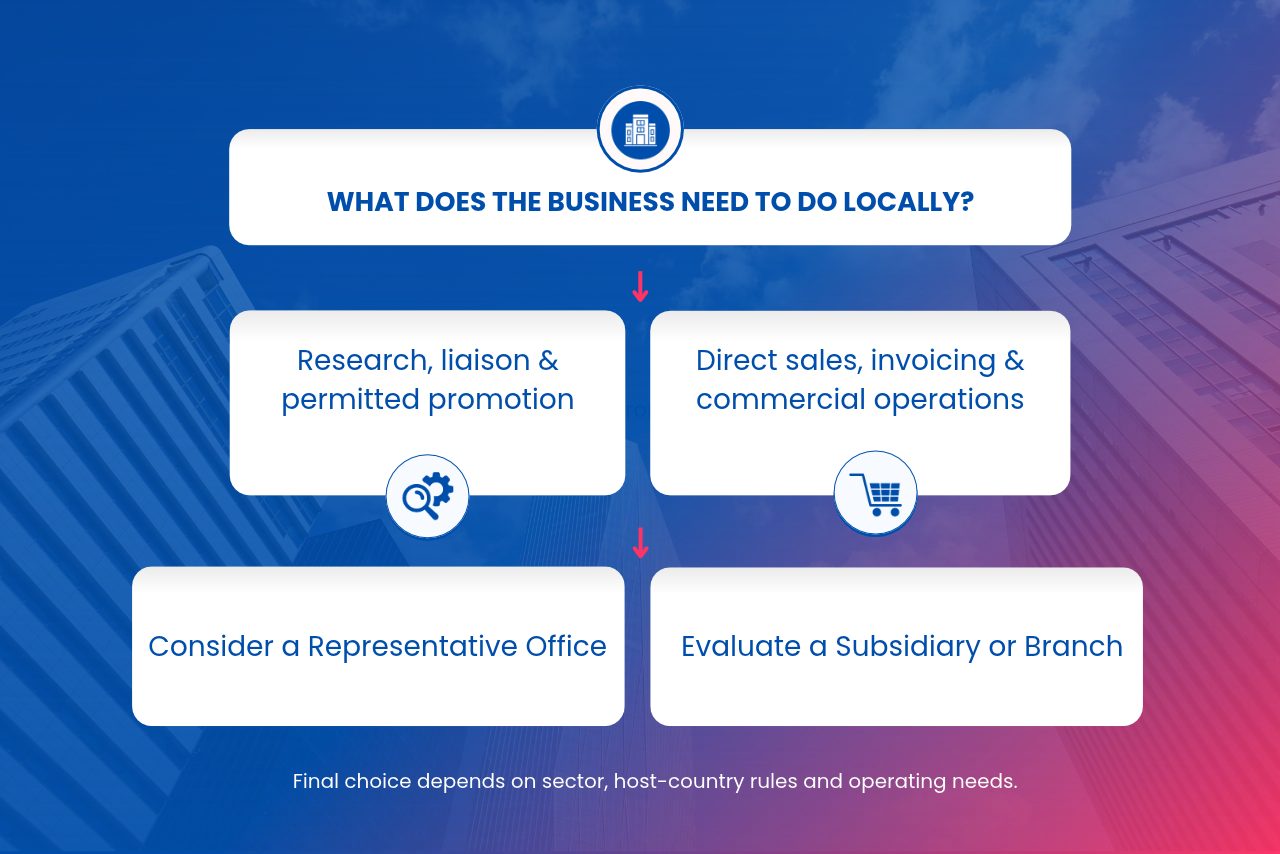
Decision framework showing when foreign companies should consider a representative office or evaluate a subsidiary or branch for commercial operations.
Business Scenarios Where a Representative Office May Be Suitable
A representative office can be useful during early market exploration. For example, a European equipment manufacturer may establish a local office to research industrial demand, identify potential customers, and maintain contact with industry organizations.
Another suitable situation involves ongoing liaison with business partners. A foreign company may need employees who understand local market conditions and can coordinate communication between headquarters and relevant stakeholders.
These activities can provide valuable market knowledge without requiring the company to establish full commercial operations immediately. However, the office must remain within its permitted non-commercial role.
When to Move Toward a Subsidiary, Branch, or Alternative Market Entry Model
A representative office may become unsuitable when a company plans to generate local revenue, issue invoices, or undertake direct commercial transactions.
At that stage, the business should evaluate whether a subsidiary, branch office, or another legally permitted arrangement better supports its activities. The decision should consider investment requirements, licensing, staffing, taxation, and long-term operating plans.
Some companies also choose to develop their local presence gradually through business incubation or external operational support. For example, SOA’s Hallmark business incubation case study describes how the company initially operated with a hosted local team before moving toward its own entity.
Business incubation and representative office registration are different arrangements. Companies should therefore confirm the legal responsibilities and permitted activities associated with each option.
How Source of Asia Supports Representative Office Planning and Market Entry
Source of Asia supports foreign companies assessing market opportunities and preparing business operations across Asian markets. Our approach combines local market knowledge with practical support for planning and developing an appropriate business presence.
Market Assessment and Local Presence Planning
SOA helps international businesses evaluate local demand, identify potential partners, and assess market entry options based on their commercial objectives.
Depending on project requirements, this can include market intelligence, business model assessment, and planning for local operations. These activities help companies determine whether a representative office, local entity, or phased market entry approach is suitable.
Business Setup Coordination, Staffing, and Local Operations
SOA also supports companies through recruitment, HR administration, payroll, office search, and business establishment coordination, working with relevant professional partners where required.
For example, SOA supported French dermocosmetics company SVR Laboratories with establishing a local entity in Vietnam. The project involved salary benchmarking, office search, management recruitment, payroll support, and coordination of company establishment procedures.
These services can help international companies prepare for local operations while managing the administrative requirements of market entry.
Final Considerations
A representative office can help foreign companies research markets, develop business relationships, and establish a formal local presence before making larger investments. However, its limited commercial authority and ongoing compliance obligations must be considered carefully.
The appropriate structure depends on the company’s intended activities, operating requirements, and expansion plans. Businesses should verify local legal conditions before establishing an office or changing their market entry approach.
Exploring business opportunities in Asia? Contact Source of Asia to discuss market assessment, local presence planning, and operational support.
Frequently Asked Questions
What Is a Representative Office?
A representative office is a local office established by a foreign company to conduct permitted activities such as market research, liaison, and business promotion. It generally does not have a separate legal identity and operates under the responsibility of its parent company.
What Can a Representative Office Do?
A representative office can typically research markets, communicate with local stakeholders, and carry out permitted business promotion. Depending on local law, it may also employ staff and rent premises. However, the specific activities must comply with its licence and applicable regulations.
Can a Representative Office Generate Revenue or Sign Contracts?
A representative office generally cannot generate revenue independently. In Vietnam, commercial contract signing is also restricted, although the chief representative may sign certain contracts with valid written authorization from the foreign parent. Such authorization does not remove restrictions on the office’s commercial activities.
How Do You Set Up a Representative Office in Vietnam?
Foreign companies must confirm eligibility, prepare registration and financial documents, appoint a representative, arrange suitable premises, and apply to the competent licensing authority. After approval, they must complete relevant administrative formalities and comply with ongoing employment and reporting obligations.
What Is the Difference Between a Rep Office and a Subsidiary?
A representative office generally has no separate legal identity and is limited to permitted non-commercial activities. A subsidiary is a separate legal entity controlled by a parent company and can conduct authorized commercial operations. The appropriate option depends on local regulations and business objectives.