Introduction
Choosing the right business structure is one of the first decisions when starting or expanding a company. It determines how a business is owned, managed, taxed, and held responsible for its financial obligations. It can also affect future investment and expansion plans.
Different business structures offer varying levels of control, liability protection, and administrative flexibility. A model suitable for an independent professional may not meet the needs of a growing company with multiple shareholders. In this guide, Source of Asia (SOA) explains common business structures, how they operate, their practical applications, and what companies should consider when choosing a legal structure.
Quick Answer
What are the main types of business structures?
Business structures are legal arrangements that determine how companies operate, distribute ownership, manage responsibilities, and meet tax obligations. The most common types include sole proprietorships, partnerships, limited liability companies (LLCs), and corporations. Other models, such as cooperatives and nonprofit organizations, serve specific ownership or operational purposes.
Each structure has different implications for personal liability, management control, funding, and compliance. For example, a sole proprietorship offers direct ownership but generally exposes the owner to business debts. Meanwhile, an LLC or corporation typically provides a separate legal identity and limited liability protection. The appropriate structure depends on business objectives, ownership arrangements, financial needs, and local laws.
What Is a Business Structure?
Business Structure Definition and Purpose
A business structure is the legal framework under which a company or business activity is established and operated. It defines the relationship between owners and the business, including ownership rights, management responsibilities, liability, and tax treatment. According to the U.S. Small Business Administration, choosing a business structure affects taxation, fundraising, reporting requirements, and personal liability.
For example, a sole proprietor generally owns the business directly and remains personally responsible for its obligations. In contrast, a corporation is a separate legal entity that can own assets, enter contracts, and continue operating despite changes in shareholders. Therefore, choosing a structure requires consideration of both current operations and future business plans.
Business Structure vs. Organizational Structure
Business structure and organizational structure describe different aspects of a company. A business structure determines its legal form, ownership, and financial responsibilities, while an organizational structure explains how employees, departments, and managers work together.
For example, an LLC may organize its employees into sales, finance, and operations departments. It could also adopt a functional or divisional management system without changing its legal form. Understanding this distinction helps companies separate corporate registration decisions from internal management planning.
What Are the Different Types of Business Structures?
Different types of business structures offer varying degrees of legal protection, ownership flexibility, and administrative responsibility. Their availability and characteristics depend on national legislation, so businesses should understand how each model works before selecting one.
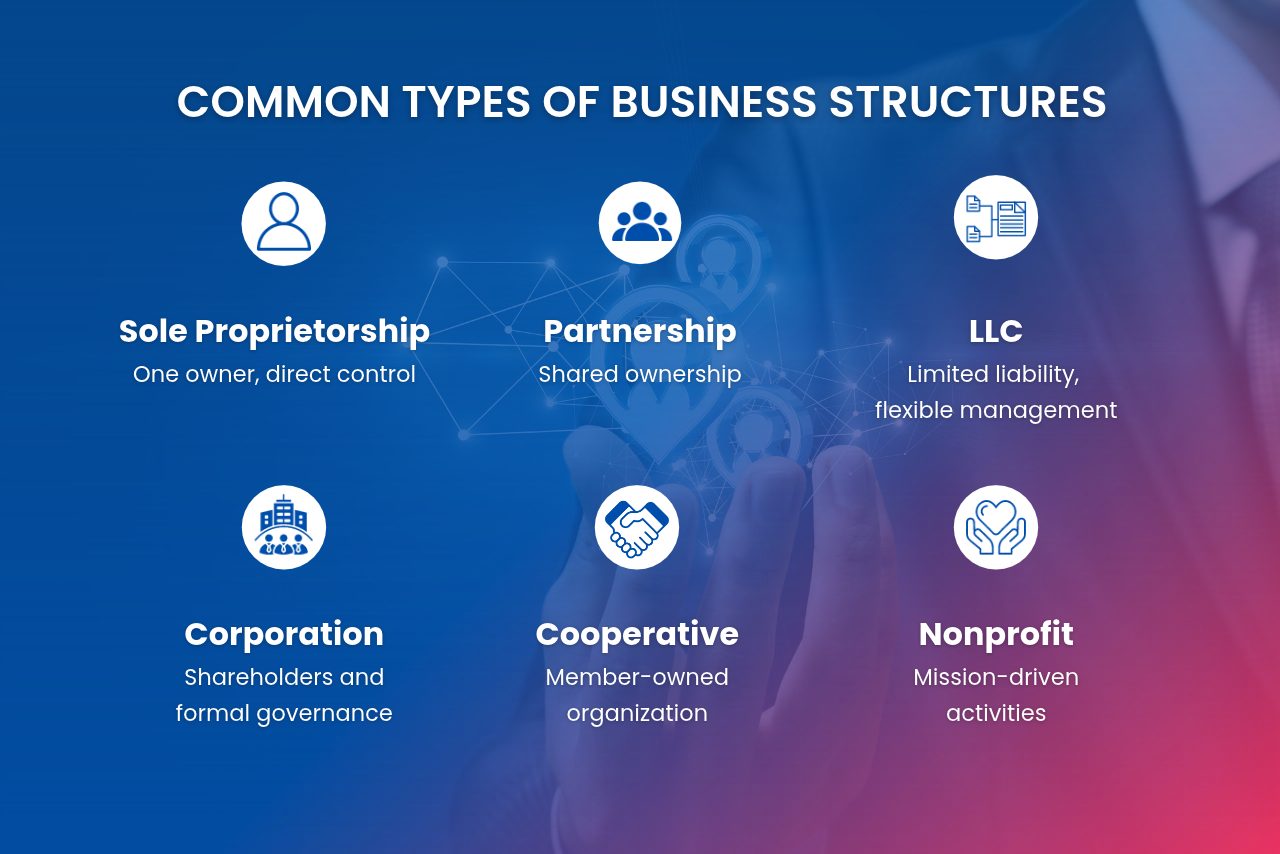
Common business structures differ in ownership, liability, management, and purpose.
Sole Proprietorship
A sole proprietorship is a business owned and operated by one individual. It is generally one of the simplest structures to establish because the owner maintains direct control over operations and business decisions. However, a sole proprietorship usually does not create a separate legal entity. As a result, the owner may be personally responsible for business debts and other obligations.
This structure can suit freelancers, independent consultants, and small businesses with relatively limited financial exposure. Nevertheless, raising investment can be difficult because sole proprietorships cannot issue company shares. Owners planning significant expansion should therefore consider whether this structure can support their future needs.
Partnerships
A partnership involves two or more parties sharing ownership, responsibilities, and business returns. Partnerships are commonly used by professional service firms, small businesses, and founders combining resources. However, the relationship between partners depends on the partnership type, the applicable law, and any agreements governing their operations.
Common partnership structures include:
- General Partnership (GP): Partners generally share management responsibilities and personal liability for business obligations.
- Limited Partnership (LP): General partners manage the business, while limited partners typically have restricted liability and management involvement.
- Limited Liability Partnership (LLP): Partners receive certain liability protections, subject to local law.
Regardless of the structure, a partnership agreement should define capital contributions, profit distribution, decision-making authority, and procedures for resolving disagreements. Clear arrangements can help reduce disputes as the business grows or ownership changes.
Limited Liability Company (LLC)
A limited liability company (LLC) is generally a separate legal entity that protects owners from personal responsibility for ordinary business debts, subject to legal exceptions. LLCs can be owned by one or several members and, depending on the jurisdiction, may offer flexible management arrangements and fewer corporate formalities than some corporations.
However, tax treatment varies. In the United States, an LLC may be treated as a disregarded entity, partnership, or corporation for federal income tax purposes, depending on its ownership and tax elections. The Internal Revenue Service explains these classifications.
LLCs can suit SMEs, professional service companies, and foreign investors establishing local operations. Nevertheless, businesses should verify the applicable rules because similar company names in different countries do not guarantee identical legal or tax treatment.
Corporations
A corporation is a legal entity separate from its shareholders. It can own assets, enter contracts, employ staff, and raise capital according to applicable corporate laws. Ownership is usually represented through shares, while directors oversee governance and management. This separation can support business continuity when shareholders change.
Corporations are often suitable for companies planning significant expansion, investment rounds, or more complex ownership arrangements. However, they generally require more formal governance, financial reporting, and compliance. In the United States, C corporations and S corporations have different federal tax treatment. An S corporation is primarily a tax classification subject to eligibility requirements, rather than a universal legal entity type.
Cooperatives
A cooperative is an organization owned and controlled by members who share a common economic or social interest. Members may include customers, producers, workers, or suppliers. Unlike conventional shareholder-controlled companies, cooperative governance often emphasizes member participation, with benefits distributed to members or reinvested according to the cooperative’s rules.
For example, agricultural producers may establish a cooperative to purchase supplies, coordinate distribution, or improve access to markets. However, membership rules, liability, and legal registration requirements differ across countries. Businesses considering this model should therefore assess how membership rights and governance obligations operate under local law.
Nonprofit Organizations
Nonprofit organizations are established to pursue specific purposes, such as education, charitable work, research, or community development. Unlike conventional profit-distributing businesses, nonprofits generally use available surpluses to support their stated objectives. Their governance and reporting obligations depend on the legal form and jurisdiction.
For example, an organization supporting vocational education may operate as a nonprofit entity under applicable local law. However, nonprofit status does not automatically provide tax exemption. Eligibility for tax benefits may require separate approval and ongoing compliance.
How Do Business Structures Work in Practice?
Business structures influence how decisions are made, how financial responsibilities are shared, and how businesses respond to ownership changes. These differences affect everyday operations and can become more significant as companies expand.
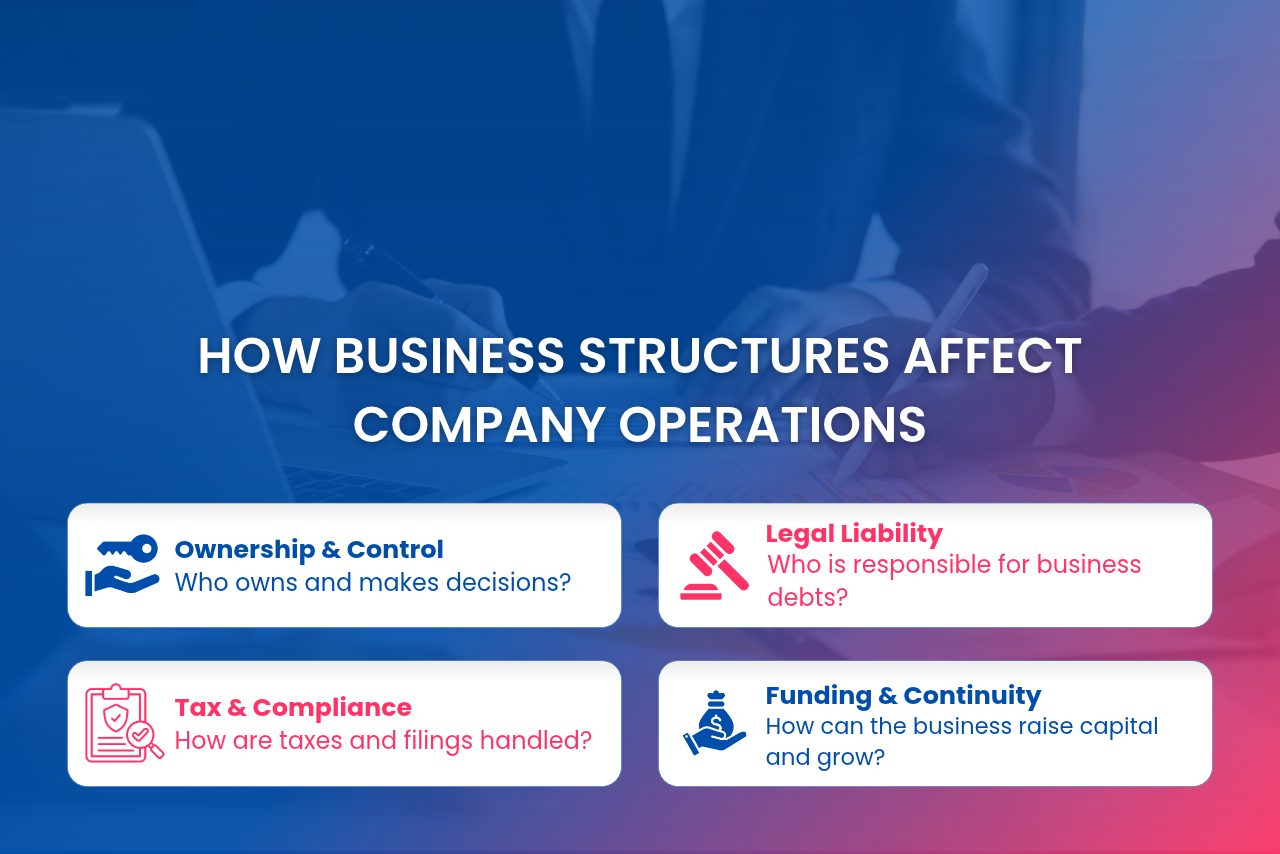
A company’s legal structure influences decision-making, financial responsibility, tax obligations, and its ability to attract investment and support future growth.
Ownership, Management, and Legal Liability
Ownership determines who controls a business and who benefits from its financial performance. In a sole proprietorship, the owner usually manages operations directly, while partnerships distribute responsibilities according to agreements and applicable law. Meanwhile, corporations separate ownership from governance through shareholders, directors, and management teams. LLCs may allow different management arrangements depending on local regulations.
Legal liability is another important difference. Separate legal entities generally provide limited liability protection, while sole proprietors and general partners may face personal exposure to business debts. However, limited liability is not absolute, particularly where personal guarantees, misconduct, or other legal exceptions apply.
Tax Treatment and Compliance Responsibilities
The chosen structure affects how business income is reported and taxed. For example, certain sole proprietorships and partnerships report income through their owners, while corporations may be taxed at the entity level. Some jurisdictions also provide special tax classifications or elections, which can change how a business’s income is treated.
In addition, legal entities may need to maintain accounting records, submit annual reports, register for applicable taxes, and meet corporate governance requirements. Therefore, companies should evaluate the full administrative burden rather than compare structures only by registration fees.
Fundraising, Ownership Changes, and Business Continuity
Business structures also affect access to external funding and the ability to accommodate new owners. Corporations can generally issue shares under applicable laws, making them suitable for certain investment arrangements. In contrast, sole proprietorships cannot offer investors corporate shares, which may limit their funding options.
Ownership changes are another consideration. A corporation can often continue operating when shareholders transfer their interests, while changes within partnerships may require revised agreements or restructuring. Consequently, businesses expecting investors, acquisitions, or long-term expansion should consider these requirements before choosing their initial legal form.
How Do Different Business Structures Compare?
The following table summarizes the main characteristics of common business structures. It provides a general comparison of ownership, personal liability, administrative requirements, and typical business applications.
| Business structure | Ownership | Personal liability | Administrative requirements | Typical use case |
| Sole proprietorship | One individual | Generally unlimited | Relatively simple | Freelancers, small businesses |
| General partnership | Two or more partners | Generally unlimited | Low to moderate | Multi-owner businesses |
| LLC | One or more members | Generally limited | Moderate | SMEs, growing companies |
| Corporation | Shareholders | Generally limited | More extensive | Investment and expansion |
| Cooperative | Members | Depends on legal form | Varies | Member-owned operations |
| Nonprofit organization | Depends on legal form | Varies | Often specialized | Charitable, educational activities |
This comparison provides a general overview. Ownership rules, liability protection, taxation, and registration requirements vary by jurisdiction.
The main distinction lies in how each structure balances control, financial responsibility, and flexibility. Therefore, businesses should compare available structures against their operating needs instead of selecting one based only on simplicity or perceived tax advantages.
Which Business Structure Is Suitable for Different Business Use Cases?
Choosing among different business structures becomes easier when the decision is connected to actual business needs. The following scenarios illustrate how ownership arrangements, liability, and growth plans can influence the choice.
Independent Professionals and Small Businesses
A freelance designer or independent consultant may initially consider a sole proprietorship because it offers direct control and relatively simple administration. However, the owner should evaluate personal liability and contractual risks, particularly when taking on larger projects or working with corporate clients.
As the business hires employees or expands its services, forming a limited liability entity may become appropriate. The decision depends on the scale of activity, exposure to financial claims, and long-term plans.
Multi-Founder Businesses and Professional Service Firms
When several founders establish a business together, ownership arrangements become more complex. Partnerships, LLPs, or limited liability companies may offer suitable options, depending on the jurisdiction and the responsibilities each founder intends to assume.
For example, a consulting firm established by three professionals should clarify ownership percentages, management authority, profit distribution, and procedures for admitting new partners. A formal agreement can help reduce disputes as the company develops, especially when partners contribute different levels of capital or operational involvement.
Growing Companies Seeking Investors and Long-Term Expansion
Businesses planning investment rounds, acquisitions, or international expansion may need structures that accommodate new shareholders and more formal governance. Corporations and certain limited liability entities can offer these features, depending on applicable laws and the company’s funding requirements.
Before restructuring, companies should assess how ownership changes could affect taxation, reporting, shareholder rights, and operational control. SOA’s guide to expanding a business in Vietnam explains additional considerations for companies developing a longer-term international presence.
How Do Business Structures Differ Across Countries?
Although many business structures share similar principles, their legal characteristics and registration requirements differ between countries. International companies should therefore assess the rules of each target market before selecting a legal form or establishing a local presence.
Comparing Legal Business Structures Across Markets
The United States commonly uses LLCs and corporations, while the United Kingdom offers sole trader arrangements, partnerships, and limited companies. In Vietnam, common incorporated structures include limited liability companies and joint stock companies. Foreign investors must also review applicable ownership restrictions and investment registration requirements. SOA’s guide to starting a business in Vietnam provides further context.
Meanwhile, Malaysia commonly uses private limited companies (Sdn Bhd) and LLPs, while South Korea offers structures such as stock companies and limited companies. The relevant procedures are explained in SOA’s guides to company registration in Malaysia and company registration in South Korea. These forms may share characteristics without being legally equivalent.
Subsidiary, Branch Office, and Representative Office
International companies must also choose how to establish a presence in another market. A subsidiary is a separate legal entity controlled by a parent company, while a branch office generally operates as an extension of the foreign parent. Meanwhile, a representative office typically performs permitted non-commercial activities, such as market research and liaison work.
Each option has different implications for liability, commercial activities, registration, and compliance. For example, a company planning to generate local revenue may need a different structure from one that only wants to research the market and develop business relationships. SOA’s Vietnam market entry guide explains how companies can evaluate entry models alongside their commercial objectives.
Growing Companies Seeking Investors and Long-Term Expansion
For international businesses, the structure chosen in one country can affect expansion into others. For example, a company may operate through a parent entity with subsidiaries in several markets, supporting centralized ownership while allowing local entities to manage commercial activities.
However, cross-border arrangements introduce additional reporting, tax, governance, and regulatory responsibilities. Companies should assess how these obligations interact before establishing multiple entities, particularly when planning intercompany transactions or regional management arrangements.
How to Choose the Right Business Structure
Selecting a suitable structure requires a clear understanding of business needs and the legal options available. Companies should evaluate ownership, financial responsibilities, and future plans together before deciding how to establish the business.
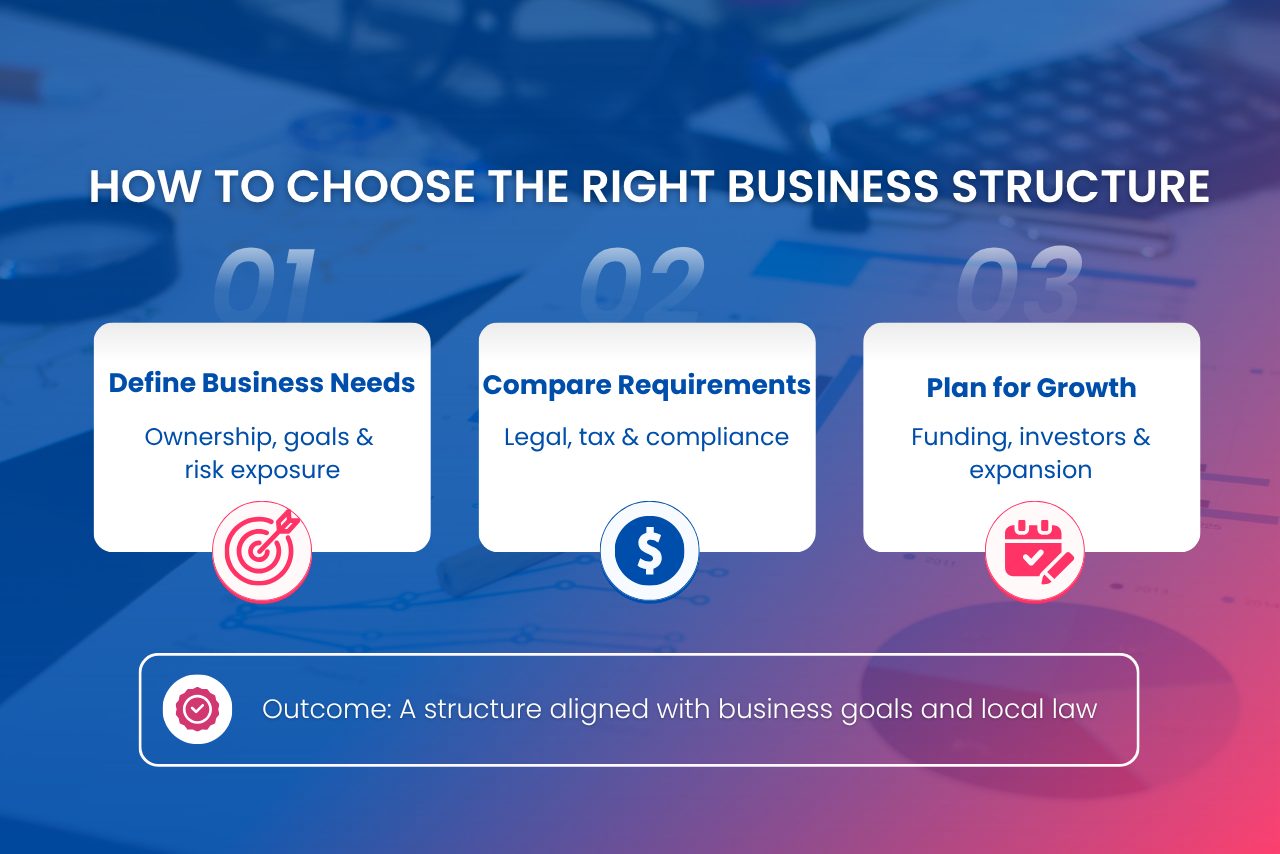
Three-step framework for choosing a business structure based on ownership needs, legal and tax requirements, and long-term growth plans.
Step 1: Define Ownership, Business Goals, and Risk Exposure
First, identify who will own and manage the business. Consider the number of founders, expected activities, decision-making responsibilities, and financial risks. For example, an independent consultant may prioritize simplicity, while a manufacturing business may require stronger separation between personal and business liabilities.
Expected outcome: A clear ownership model and an understanding of the required liability protection
Step 2: Compare Legal, Tax, and Financial Requirements
Next, assess the registration requirements, tax treatment, compliance costs, and management obligations associated with each available structure. For international operations, foreign ownership restrictions, licensing, employment, and reporting requirements should also be considered, as these obligations can affect financial viability during early market entry.
Expected outcome: A shortlist of legally available structures with comparable operating requirements.
Step 3: Assess Funding Needs and Long-Term Growth Plans
Finally, consider how the business may develop over the next several years. Plans to seek investors, add shareholders, establish subsidiaries, or enter new markets may affect which structure is suitable. Companies should also review whether future restructuring could create additional tax costs, approval requirements, or changes in ownership rights.
Expected outcome: A business structure aligned with current operations and realistic growth plans.
What Common Mistakes Should Businesses Avoid When Choosing a Structure?
One common mistake is selecting a structure based only on registration costs. Although a simpler model may reduce initial expenses, it can create problems if the business later needs investors or stronger liability protection. Another mistake is assuming that limited liability eliminates every personal financial risk, as owners may still face obligations through guarantees or other legal exceptions.
Businesses may also overlook tax treatment, annual reporting, or restrictions on foreign ownership. In addition, choosing a structure without discussing management rights and profit distribution can lead to disputes between founders. Therefore, legal, financial, and operational requirements should be reviewed together before registration.
How Source of Asia Supports Business Setup and International Expansion
Source of Asia supports international companies preparing to establish and develop business operations across Asian markets. This includes assessing market entry options, coordinating local establishment activities, and preparing for ongoing operations.
Business Structure Assessment and Company Establishment
SOA helps businesses evaluate market entry options, local establishment requirements, and practical considerations for selecting a suitable corporate presence. Depending on the project, this can include market assessment, coordination with legal partners, company registration support, and preparation for local operations.
For example, SOA supported French dermocosmetics company SVR Laboratories with establishing a local entity in Vietnam, including recruitment, administrative coordination, and early-stage payroll support.
Market Entry, Local Operations, and Ongoing Corporate Support
Beyond company establishment, SOA provides operational support covering areas such as recruitment, HR administration, payroll, and business development. These services help international companies prepare for local operations while maintaining coordination between headquarters and local teams.
The scope of support depends on the market, project requirements, and relevant legal or professional partners. Companies can therefore evaluate the level of assistance they need based on their selected structure and stage of expansion.
Final Considerations
Different business structures offer different approaches to ownership, liability, taxation, and growth. Sole proprietorships and partnerships may suit simpler operations, while LLCs and corporations can support more formal ownership and investment arrangements.
However, the right choice depends on local regulations and business objectives. Companies should assess both immediate requirements and future expansion plans before registering.
Planning to establish or expand a business in Asia? Contact Source of Asia to discuss company setup, market entry, and local operational requirements.
Frequently Asked Questions
What Is a Business Structure?
A business structure is the legal framework defining how a business is owned, managed, taxed, and held responsible for its obligations. Common examples include sole proprietorships, partnerships, LLCs, and corporations. Available structures and their legal treatment vary by country.
What Are the Four Main Types of Business Structures?
The four commonly discussed business structures are sole proprietorships, partnerships, limited liability companies (LLCs), and corporations. Other arrangements, including cooperatives and nonprofit organizations, may also be available depending on local laws and the purpose of the organization.
What Is the Difference Between an LLC and a Corporation?
Both generally provide a separate legal identity and limited liability protection. However, they differ in ownership arrangements, management rules, taxation, and reporting requirements. In the United States, LLCs may have different federal tax classifications, while corporations follow distinct corporate tax rules.
Which Business Structure Offers Limited Liability?
LLCs, corporations, and certain partnership structures, such as LLPs, generally provide limited liability protection. However, the extent of protection depends on local laws. Personal guarantees, misconduct, and other legal exceptions may still expose owners to financial responsibility.
Can a Business Change Its Legal Structure Later?
Yes. Many jurisdictions allow businesses to change their legal structures through conversion, incorporation, or other restructuring procedures. However, the process may involve regulatory approvals, tax consequences, ownership changes, and additional costs. Businesses should review these requirements before making changes.