Introduction
In 2026, location strategy has shifted from cost optimization to geopolitical risk management. Decisions on manufacturing, sourcing, and regional headquarters are increasingly shaped by trade policies, sanctions, and international alignment, directly affecting operational stability and compliance.
Southeast Asia has become a strategic region in this context. ASEAN offers a relatively balanced geopolitical environment for diversification, enabling companies to reduce reliance on a single market and build more balanced, multi-country operations across the region.
In this guide, we – Source of Asia, explain how geopolitics impacts location decisions, why ASEAN matters, and how companies adjust their strategies to maintain resilience and long-term growth.
Key Insights
- Geopolitics now drives location strategy, forcing companies to balance risk, compliance, and operational resilience alongside cost.
- Southeast Asia serves as a diversification hub, offering flexible supply chains, market access, and reduced dependency on China.
- Regional trade frameworks like RCEP and CPTPP directly shape sourcing, production, and regulatory alignment across ASEAN.
- Semiconductors, energy, and digital infrastructure require supply chain security, technology access, and cybersecurity management.
- Risk-aware strategies must address policy shifts, overexposure to single markets, and fragmented ASEAN regulations.
Why Geopolitics Now Matters in Southeast Asia
In 2026, geopolitics is no longer a background noise. Companies must now factor trade, regulations, and supply chain resilience into every location decision, making location strategy in ASEAN as much about risk management as cost efficiency.
A snapshot of location strategy in global business
In the past, location strategy was driven by cost, labor, and logistics. Companies focused on minimizing expenses by offshoring production to lower-cost markets, often building extended supply chains to maximize efficiency. The report from McKinsey shows that this model enabled firms to reduce operating costs by 20–40%, reinforcing a strong focus on cost-led decisions.
However, the approach has shifted in 2026. Companies must decide where to set up manufacturing, where to be HQ, and where to set up a sourcing base based on trade exposure, regulatory conditions, and supply chain resilience. According to the World Economic Forum, over 80% of firms are restructuring supply chains, showing that location strategy is now a core operational decision.
How geopolitics entered business decision-making
Geopolitics has moved from a background factor to a direct input in business decisions. Companies now need to assess how external policies affect daily operations, not just long-term strategies.
In practice, this means accounting for:
- Trade tariffs that change cost structures
- Export controls that limit access to technology and inputs
- Sanctions that restrict market access and partnerships
- Policy-driven supply chains shaped by national priorities
Thus, geopolitical risks for business directly influence where companies operate, how supply chains are structured, and how partnerships are formed.
From efficiency-driven to risk-adjusted location strategy
In the past, companies followed a simple model where the lowest cost defined the decision. This approach prioritized efficiency but often overlooked exposure to policy changes and supply chain disruption.
Today, companies apply a different framework for location strategies. Indeed, location choices must balance resilience, compliance, and alignment with global policies. This means evaluating regulatory stability, trade exposure, and operational continuity alongside cost. Thus, location strategy in ASEAN is now used to manage both risk and opportunity, helping businesses maintain stability while positioning for long-term growth.
|
To apply this shift effectively in Southeast Asia, it is important to understand how the region’s economic resilience is often interpreted in practice. Explore our: What US Executives Misread About ASEAN’s Economic Resilience (2026) |
Key Geopolitical Forces Reshaping Southeast Asia
Geopolitical risks shift are redefining how companies structure operations in Southeast Asia, with trade policy, technology control, and global alignment directly influencing location strategy in ASEAN and investment decisions.
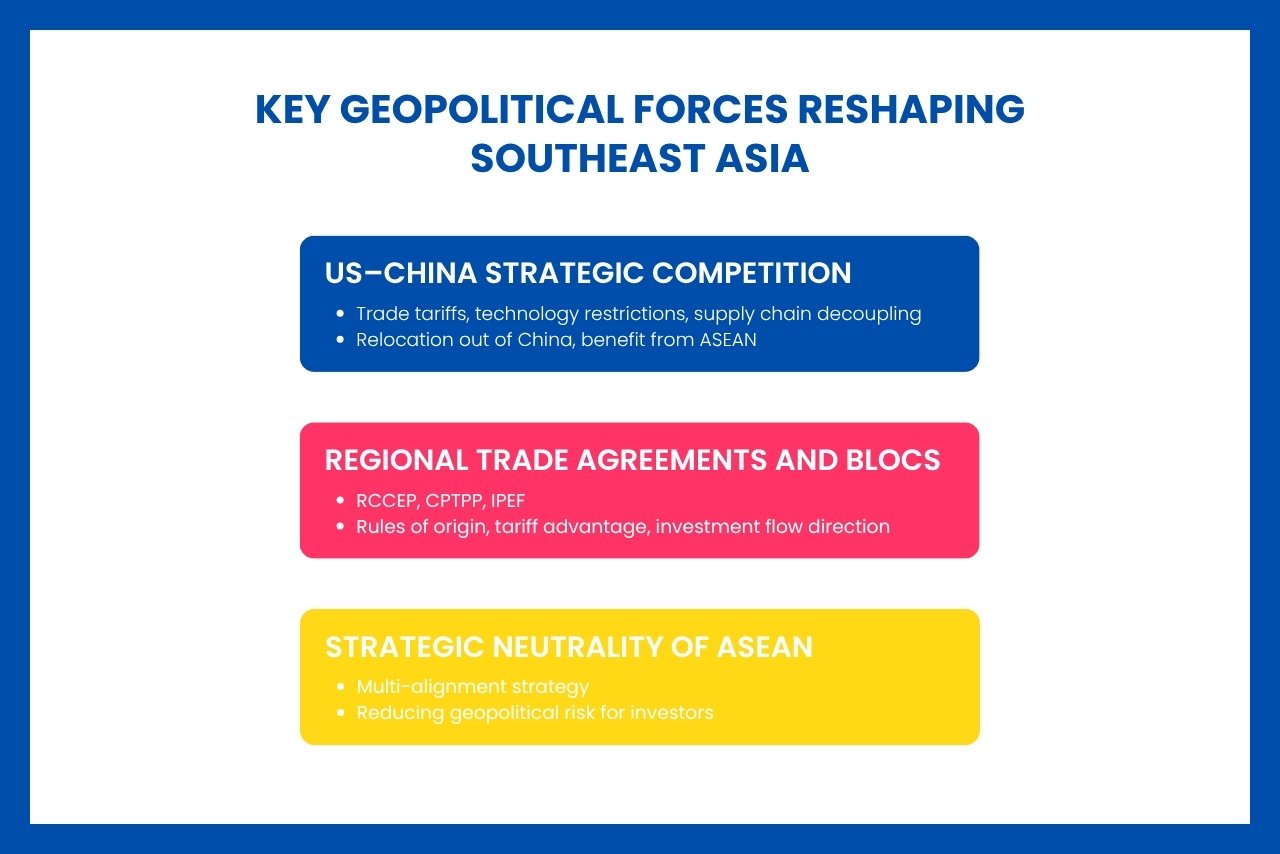
Geopolitical shifts in Southeast Asia are influencing trade, technology, and supply chain strategies for global businesses.
US–China strategic competition
Strategic competition between the US and China now directly affects production and sourcing decisions. The focus has moved toward trade measures and technology control, shaping how companies access markets and manage supply chains.
Key factors include:
- Trade tariffs: Import taxes applied to goods crossing borders, increasing costs for exporters and reducing price competitiveness
- Technology restrictions: Controls on the transfer of advanced technologies, limiting access to critical components and equipment
- Supply chain decoupling: The gradual separation of production networks to reduce dependency on a single country
These pressures are driving companies to relocate part of their operations out of China and into alternative markets. Southeast Asia benefits from this shift, offering a practical base for diversification, improved market access, and more flexible supply chain structures.
Regional trade agreements and blocs
Regional trade frameworks play a direct role in shaping location strategy in ASEAN. Companies must align operations with agreements that influence market access, cost structure, and compliance requirements. Key frameworks cover:
- RCEP (Regional Comprehensive Economic Partnership): Simplifies trade across Asia by reducing tariffs and aligning rules, supporting regional supply chain integration
- CPTPP (Comprehensive and Progressive Agreement for Trans-Pacific Partnership): Provides tariff advantages and access to high-standard markets, while setting clear rules on labor and compliance
- IPEF (Indo-Pacific Economic Framework for Prosperity): Focuses on standards, supply chain cooperation, and governance, rather than traditional tariff reduction
These frameworks directly affect operations. Rules of origin guide sourcing and production, tariff structures impact costs, and regulatory alignment shapes investment decisions across ASEAN.
Strategic neutrality of ASEAN
ASEAN follows a multi-alignment approach, maintaining balanced relationships with major economies instead of aligning with a single bloc. For example, the region participates in RCEP while countries like Vietnam and Malaysia are also part of CPTPP, giving companies access to different trade systems within one region.
For businesses, this creates a more stable operating base and reduces geopolitical risk. It also allows flexible location planning, as companies can distribute operations across ASEAN to align with trade rules, regulatory conditions, and market access.
|
As geopolitical factors increasingly shape location decisions, many companies reassess their ASEAN footprint to reduce risk and improve flexibility. 👉 Contact our team to evaluate your location strategy in ASEAN |
Why Southeast Asia Becomes a Strategic Location Choice
Southeast Asia offers a practical base for diversification, combining market access, policy support, and flexible operating models across multiple countries.
ASEAN as a diversification hub
ASEAN is increasingly used as a diversification hub as companies reduce reliance on a single market. According to UNCTAD, FDI inflows rose by 8% to $226 billion, as compared with the 11% global decline, confirming its role in global supply chain shifts. This is reflected in how companies are restructuring operations across the region:
- China+1 strategy: Companies maintain China operations while expanding into ASEAN to reduce tariff and concentration risk
- Multi-country sourcing: Firms source across markets based on specialization (e.g. electronics in Vietnam/Malaysia, assembly in Cambodia)
- Distributed production: Regional agreements like RCEP support cross-border production networks and smoother goods movement
Market access and regional integration
Southeast Asia offers both market scale and regional connectivity for business expansion. The region has over 680 million people, while intra-ASEAN investment reached $31 billion, accounting for about 14% of total FDI. This shows growing economic integration, supported by stronger capital flows within the region.
Meanwhile, investment is concentrated in key markets such as Indonesia, Singapore, Vietnam, and Malaysia, which together attract over 90% of intra-regional flows. This concentration, combined with rising middle-class demand, allows companies to serve both export and domestic markets, building more balanced and scalable regional strategies.
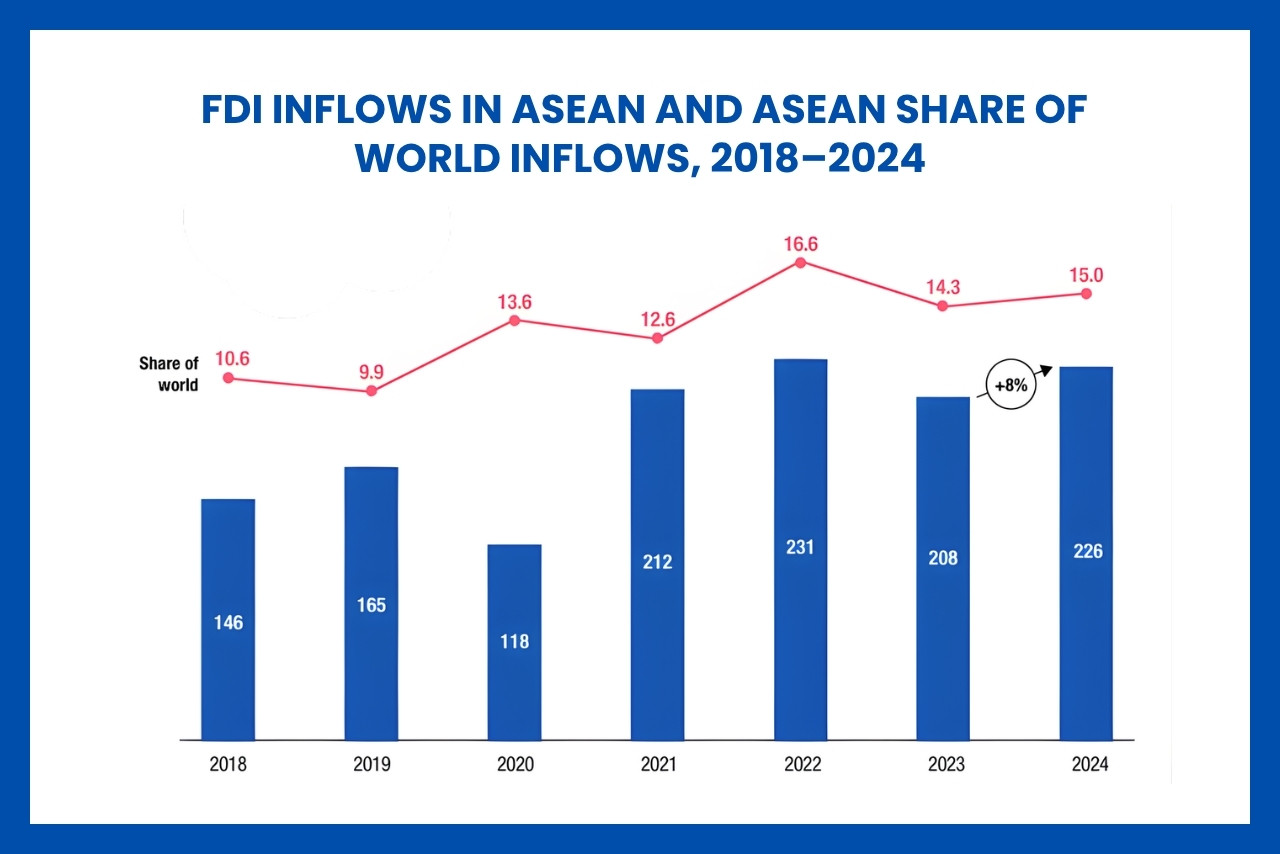
ASEAN attracted $226 billion in FDI in 2024, increasing its share of global inflows despite worldwide declines.
Policy-driven investment attraction
Governments across ASEAN actively guide investment decisions through clear policy frameworks that support both foreign investors and local industry development. These policies focus on reducing entry barriers while directing capital into priority sectors.
For example:
- Investment incentives: tax holidays and duty exemptions in countries like Vietnam and Indonesia
- Industrial policies: targeted development in sectors such as EV (Thailand), electronics (Malaysia, Vietnam), and digital economy (Singapore)
- Infrastructure investment: expansion of ports, industrial zones, and cross-border logistics networks
These measures create a stable environment for companies to align location choices with long-term operational goals.
| To better understand how tax policies influence location decisions, explore Vietnam tax incentives in 2026 |
How Geopolitics Impacts Business Location Decisions
When companies design their production footprint, geopolitical conditions directly influence cost structures, regulatory exposure, and operational continuity. Choosing the right location strategy in ASEAN helps avoid extra taxes, trade restrictions, and delays, while keeping products close to the customers who need them.
Manufacturing location decisions
When deciding where to set up a factory, political and global factors play a key role. Companies should focus on:
- Avoid tariff exposure: Setting up in countries or regions with lower import/export duties helps companies reduce costs and stay competitive. This matters especially for businesses that trade across borders frequently.
- Avoid sanction risk: Operations can be disrupted if a country faces political sanctions or trade restrictions. Placing factories in politically stable regions minimizes the risk of sudden regulatory blocks.
- Proximity to markets: Being closer to major customers cuts shipping time and costs, improves responsiveness to demand changes, and supports just-in-time production strategies.
| Choosing the right location is just the first step. To see how these factors work in real industrial sites, learn more about Where to Implement Your Future Factory in Vietnam? |
Supply chain design and sourcing strategy
A strong supply chain helps companies manage geopolitical risks and maintain smooth operations. Key considerations include:
- Multi-country sourcing: Spreading procurement across different countries reduces reliance on any single market.
- Redundancy planning: Establishing backup routes and alternative capacity ensures operations continue during disruptions.
- Supplier diversification: Working with multiple suppliers across regions lowers the risk of supply shortages and dependency.
By designing supply chains with these strategies, companies can improve resilience, maintain continuity, and respond quickly to changing global conditions.
Regional HQ and governance structure
Geopolitical stability is a critical factor when choosing where to place a regional headquarters and how to structure operations. Companies often weigh tax advantages, selecting location with favorable corporate and cross-border regimes. They also prioritize policy stability, focusing on jurisdictions with predictable regulations that reduce operational uncertainty.
At the same time, businesses consider geopolitical alignment, ensuring their HQ strategy matches markets and partners with compatible political and trade environments. This approach helps maintain smooth operations, manage regulatory risks, and support sustainable growth across the region.
Sector-level Impact of Geopolitics in ASEAN
Geopolitical tensions are increasingly shaping the semiconductor and electronics sector in ASEAN, and companies must understand the main factors that influence production, supply chains, and regional capabilities.
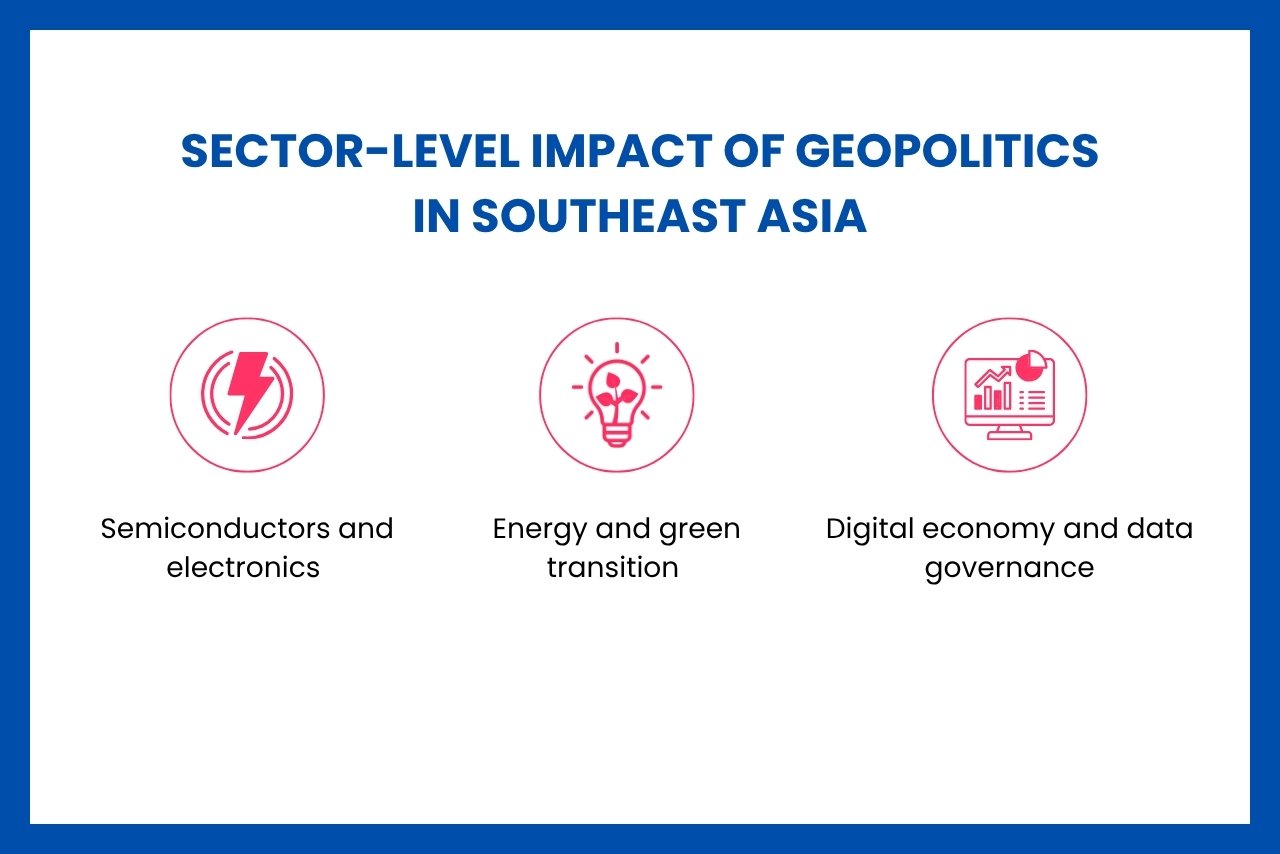
Geopolitical tensions reshape semiconductor, energy, and digital sectors, prompting supply chain diversification across ASEAN markets.
Semiconductors and electronics
Geopolitical tensions are reshaping ASEAN’s semiconductor and electronics sector. For example, export controls from the US–China disputes and regional regulations affect the flow of critical components and raw materials.
At the same time, supply chain security is increasingly important, with production shifting from China to ASEAN to reduce dependency and improve resilience.
ASEAN like Malaysia, Vietnam, Thailand, and the Philippines, are increasingly positioned in back-end semiconductor processes such as assembly and testing. Thus, it allows companies to diversify production without relocating high-end fabrication. This strengthens regional supply chains, supports trade growth, and creates jobs, helping companies operate efficiently amid geopolitical uncertainty.
Energy and green transition
Geopolitics is playing an increasing role in the move toward renewable energy. Rising competition for critical resources, including minerals for solar, wind, and battery technologies, presents both challenges and opportunities. Companies must carefully manage these pressures while ensuring energy security and continuing to invest in clean technologies.
In response, ASEAN is promoting regional integration through cross-border electricity trading and initiatives in hydrogen and battery development. These efforts strengthen a sustainable energy system and allow businesses to support the green transition while maintaining a reliable energy supply and long-term operational stability.
Digital economy and data governance
Geopolitical competition in ASEAN is increasing risks for the digital sector. Rising threats to critical infrastructure make cybersecurity essential, while differing national rules create challenges for data localization and operational compliance. Companies need to manage these risks carefully to keep digital operations secure and efficient.
ASEAN is supporting digital integration through the ASEAN Digital Masterplan, which sets regional standards and encourages collaboration. By following cross-border digital regulation, businesses can safeguard data, comply with evolving rules, and take full advantage of the region’s expanding digital economy for sustainable growth.
Top 3 Risks Companies Must Consider
Before making location strategy in ASEAN, companies need to recognize the key risks that can affect operations, compliance, and market stability. Understanding these factors helps businesses plan smarter and stay resilient.
- Policy uncertainty and regulatory shifts
Sudden changes in laws, tariffs, or trade policies, along with evolving compliance requirements, can disrupt operations, increase costs, and create planning challenges.
- Overexposure to a single market
Relying heavily on one country or region amplifies dependency risk and leaves companies vulnerable to geopolitical shocks, trade restrictions, or sanctions.
- Fragmentation within ASEAN
Differing regulations, enforcement standards, and execution speeds across countries add complexity, requiring tailored approaches for each market to maintain smooth operations and compliance.
Conclusion
Geopolitics has become a core driver of location strategy, shaping decisions on manufacturing, sourcing, and regional headquarters. ASEAN now serves as a diversification hub and strategic buffer, helping companies manage risk while maintaining operational flexibility. Therefore, businesses must actively redesign their regional footprint to align with shifting trade rules, geopolitical exposure, and multi-country operations.
At Source of Asia, we help companies navigate these challenges through location evaluation, risk assessment, and operational advisory. Our team supports footprint planning, supply chain resilience, and strategic alignment with local policies, ensuring long-term stability across Southeast Asia.
👉 Planning your ASEAN strategy? Contact our team for your ASEAN expansion.
For further insights, the following resources may be useful:
Frequently Asked Questions
Southeast Asia offers strategic proximity to major markets, diversified manufacturing hubs, and cost-effective labor. Companies gain resilience by spreading production across multiple countries, reducing dependency on single markets and mitigating risks from trade disruptions and geopolitical tensions.
ASEAN provides regulatory stability, policy-driven incentives, and growing regional integration. While risks exist, careful market evaluation and diversified strategies allow companies to benefit from a stable, flexible environment that supports long-term growth and supply chain security.
Firms should balance cost, compliance, and risk. Prioritize politically stable markets, diversify supply chains, and align headquarters and sourcing trade exposure and regulatory environments to maintain operational continuity and long-term resilience.